Categories
Divine Stone

The Portal Project Begins

(This is Part One of two articles on the early work on the Portal of Paradise. They are written by DivineStone co-author, photojournalist and Cathedral Artist-in-Residence, Robert F. Rodriguez. All of the images in the article are those of the writer.) – RM

Stoneyard apprentices contribute solidly to the first phase

Jessica Aujero Lowrie took a slow walk along 112th Street, the looming Cathedral of St. John the Divine getting larger before her. Memories and emotions arose as she neared the steps leading to the Portal of Paradise – a project she worked on over 35 years ago. This was her first visit since.

The Partal Project begins
Jessica Aujero Lowrie admires the Portal of Paradise on Oct. 25, 2025 during a visit to the Cathedral. She has not seen the work in over 30 years.

“I can’t believe we did this work,” she said, scanning the carved monument on three levels. “What a great thing we did.”

The Portal of Paradise
View of the central portal to the Cathedral on April 20,1987 showing the unfinished 8-foot limestone jambs that would later be carved into the Portal of Paradise

In the fall of 1988, Master Sculptor Simon Verity led a team including Amy Brier, Jessica Aujero (now Lowrie), Gabriele Hiltl-Cohen, Joseph Kincannon, Dennis Reed, D’Ellis “Jeep” Kincannon and later Sebastian Casamajor in carving the bases, or pedestals – the lowest level of the three-tier portal. The 12 major-rank figures would stand on these base carvings.

The primary work of this first short season was to start roughing out the eight-foot-tall limestone blocks of the major-rank figures and get a feel for working in situ. Using wide chisels and heavy hammers, the crew started removing the edges of the rectangular monoliths, chipping away at excess material as a preliminary step to carving.

The Portal of Paradise includes 32 carved limestone biblical figures based on the iconography developed by Cathedral architect Ralph Adams Cram and Bishop William T. Manning in 1925. Dean James Parks Morton wanted to make some updates to the original list of figures in consultation with the Rev. Minka Sprague and Rabbi Rolando Matalon, who remembers being summoned to Dean Morton’s office for a late-evening conversation on which figures should be included. From these meetings, a number of biblical women were added to the iconography.

Rabbi Matalon calls the Portal of Paradise “such an amazing, daring and bold work and it was also very inclusive. They (Dean Morton and Bishop Paul Moore) were aware of the Jewish roots of Christianity and they were committed that the link would never be erased. The Portals also reflect that commitment to celebrate the connection between Jews and Christians.”

Jessica Aujero and Simon Verity
Jessica Aujero Lowrie and Simon Verity study preliminary sketches in the carving shed on Oct. 3, 1988.

The first full season of carving the portal began in April 1989. Jessica recalls working on thin and rickety scaffolding, carefully balancing on the planks to start work on her pedestal. She was the only apprentice to carve two bases. Elijah’s ascension into heaven appeared on the north side. 

Elijah's pedestal
Jessica Aujero Lowrie carves an intricate pedestal showing Elijah’s ascension into heaven in a fiery chariot on the Portal of Paradise, seen in August, 1989.

According to the Bible (2 Kings 2:11), the prophet Elijah ascended to heaven in a fiery whirlwind, with his successor Elisha witnessing the event. Amidst Jessica’s swirling-column base, two carved faces barely emerge from the windstorm, almost gasping for air and seemingly caught up in the vortex. Her narrative blends harmoniously with the carving above of the figures of Elijah and Elisha.

Faces in Jessica's pedestal
Jessica Aujero Lowrie’s pedestal shows two faces caught in the swirl of wind as Elijah’s ascends into heaven in a fiery chariot, seen in September, 1989.

Studying her work Jessica says, “I thought I was carving too deep but I see others that are deeper. In stone, you have to think structurally, also, where the (rain) water will land. When the water freezes, will it destroy or crack anything; can the water drip down cleanly. You have to think about those things.” Overall, Jessica feels the work has held up.

Jessica's pedestal
Jessica Aujero Lowrie’s finished base showing Elijah ascension into heaven on a fiery chariot.

Simon Verity, in Jessica’s opinion, was a hands-off teacher. She remembers only doing a few preliminary sketches. “We would run an idea by Simon and he would say ‘go with it,’” which made Jessica feel nervous. “Simon was nearby and we could always ask each other. We had time to think about it while we were (working) – it was a slow process,” she adds.

Jessica and Gabrielle
Jessica Aujero Lowrie and Gabriele Hiltl-Cohen work on their respective pedestal carvings for the Portal of Paradise, seen in August, 1989.

On the north side of the Portal of Paradise, Amy Brier and Gabriele Hiltl-Cohen’s base carvings flank Jessica’s work.

Amy Brier worked on the base of the major-rank figure of Moses. She recalls, “being Jewish, I thought that was appropriate and I researched into his (Moses’) mythology as a magician (e.g. turning Aaron’s staff into a snake) and the Cabalistic aspects — the mystical side of Judaism.” The Cabala is the mystical writing of the Jews.

Amy Brier
Amy Brier roughs out her pedestal base on April 19, 1989.

“I put the Tree of Life on the base, which is also a kind of feminist statement,” Amy adds. “Traditionally, the Cabala couldn’t even be studied by women, only by men, I think, over a certain age, who were married. I felt like I was putting my mark there.”

One of Amy’s preliminary drawings suggests she wrestled with the iconography for the base. Amy wanted to create a narrative image that expressed the fundamental gesture of Moses’ work and she sought guidance from the Rev. Minka Sprague. “We talked about Judaism and I learned a few things,” says Amy, who remembers Rev. Sprague as “the priest in pink shoes.” 

The Portal Project Begins
Amy Brier sought inspiration from the Biblical Book of Exodus, deciding upon a “moment” on how to depict her pedestal carving, undated photo.

In a December 1988 Cathedral Newsletter article, Rev. Sprague addressed the importance of readings of religious texts. “In case any might feel unequal to Biblical interpretation,” Sprague said, “we’re all unworthy, but we are called on.”

Amy’s finished work shows the Cabala, depicted here using a helix-type figure, one of the Cabala’s several symbols. On the column below someone else started carving chain links that she icorporated into the design, along with the Red Sea, to represent bondage and escape from Egypt.

Amy's pedestal
Amy Brier’s finished pedestal under the major-rank figure of Moses.

Samuel, the first of the great prophets since Moses, is the upper major-rank figure on the north side closest to the Bronze Doors. Gabriele Hiltl-Cohen’s task was to carve a complimentary base below. 

Gabriele's pedestal
Gabriele Hiltl-Cohen carves olive leaves to represent the anointing of Saul. Above the leaves she will later carve, the Capitol building with bombs exploding and hungry people to depict the world going awry under the wrong leaders.

A Cathedral pamphlet provides more details on the Biblical character Samuel, who anointed Saul as king but warned the people that in choosing a king, they were rejecting God. This could be interpreted as no king is above the law of God.

Trained as a stone carver in Germany, Gabriele read pertinent Biblical passages and focused on Saul disobeying God in two ways: by making a rash oath that led to his soldiers sinning, and by failing to destroy the Amalekites and their livestock as commanded. Because of this disobedience, which stemmed from fear of the people and pride, God rejected Saul as king.

the portal project begins
This is a preparatory sketch for Gabriele Hiltl-Cohen’s pedestal carving showing an olive tree and branches to represent the anointing of Saul, July 1989.

“I compared this to the current political situation,” says Gabrielle, referring to Iran-Contra, a political scandal in the United States that centered on arms trafficking to Iran between 1981 and 1986, facilitated by senior officials of the Ronald Reagan administration. The administration hoped to use the proceeds of the arms sale to fund the Contras, an anti-Sandinista rebel group in Nicaragua. The administration’s justification for the arms shipments was that they were part of an attempt to free seven U.S. hostages being held in Lebanon by Hezbollah.

the portal project begins
Gabriele Hiltl-Cohen’s work-in-progress photo showing the emerging U.S. Capitol. Sept. 3, 1989,

Gabriele knew she had to be “very clear in (her) story telling.” Carving traditions from the Middle Ages had to be direct and simple when many people were illiterate.

Her carving shows the U.S. Capitol with bombs and hungry people in a depiction of the world gone awry under the wrong leader. For some, this interpretation can easily be applied to the current administration. 

Cabriele's pedestal
Closeup view of Gabriele Hitl-Cohen’s carving of the U.S. Capitol with bombs and hungry people – a depiction of the world going awry under the wrong leader, seen on Oct. 23, 1989.

Below the Capitol building, a man holds a suitcase full of money that is falling out of the bulging valise. This represents the proceeds from the illegal arms sales. Off to one side, an armed man seems to be guarding blindfolded prisoners. Gabrielle added a number of homeless people pointing to the illegal activity, acting almost as a Greek chorus. She based this grouping on some homeless who frequently took refuge on the steps of the Cathedral. 

Gabriele's pedestal
Finished view of Gabriele Hitl-Cohen’s carving of the U.S. Capitol with bombs and hungry people.

“It reflected our current state of political and social injustices,” Gabriele reminisces, adding that Master Sculptor Simon Verity liked the idea of Gabriele adding the homeless to her piece.

Jessica said Gabriele’s carving of olive leaves on the slender column beneath her tableau was “beautiful – we were partners during the whole carving process.” 

Amy and Simon work on pedestals
Master Sculptor Simon Verity and Amy Brier work on pedestals on the north side of the Portal of Paradise in July, 1989. Simon is carving the birth of Isaac from a seed pod. The chain links carved by Amy represents bondage and the Israelites escape from Egypt.

While the apprentices were carving the pedestal bases, Simon plunged into work on the first major-rank figure, that of Melchizedek, a priest and King of Salem. By late October 1988, the facial features and elongated drapery of the eight-foot carving started to emerge. Simon worked tirelessly on the carving until it was time to remove the scaffolding for the season – one of the drawbacks to working in situ versus having the comfort and relative warmth of the carving shed.

the portal project begins
The face and crown of Old Testament King and Priest Melchizedek is clearly defined as Simon Verity works on the eight-foot limestone jamb on the north side of the Portal of Paradise on Oct. 26. 1988.

The following season, besides continuing work on Melchizedek, Simon also carved two pedestal bases on the north side. Under the major-rank figures of Abraham and Sarah, he carved a depiction of a baby (Isaac, Abraham’s son) emerging from the womb and a spiral representing Abraham climbing the hill to sacrifice him.  His other base carving showed Jacob (the father of the 12 tribes of Israel) wrestling with the Angel of God during his dream, below the major-rank figure of Jacob.
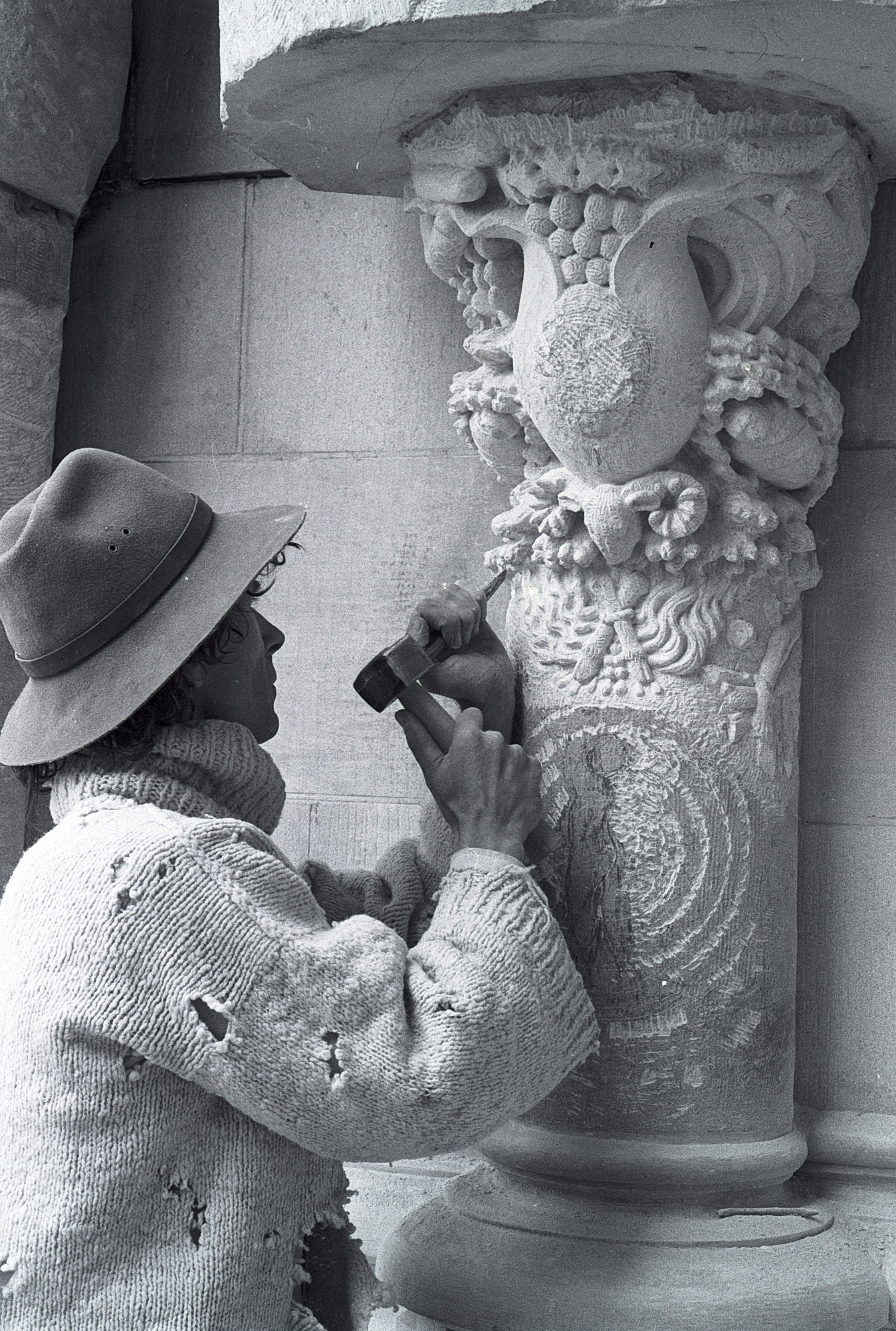
Simon's pedestal
Master Sculptor Simon Verity works on a pedestal on the north side of the Portal of Paradise in July,1989. Simon is carving the birth of Isaac from a seed pod with a spiral representing Abraham climbing the hill to sacrifice Isaac.

At that time, according to Canon Edward Nason West, if a shed were erected around the portal construction zone, the crew could carve all year round – and keep their work from inquisitive eyes, the sidewalk superintendents as well as the gawkers and photo seekers.  However, that did not happen – with Simon and the apprentices becoming part of the never-ending street theater in front of the Cathedral.  

Jessica and Treese Robb
Jessica Aujero Lowrie embraces former co-worker Theresa “Treese” Robb by the Portal of Paradise on Oct. 25, 2025, during a visit to the Cathedral.

Sources: 

  • Cathedral Newsletter Sept 1989
  • Cathedral Newsletter Dec. 1988
  • Portal of Paradise: A Guide to the Sculptures
  • Wikipedia


Categories
Divine Stone

Remembering Timothy Smith

Remembering Tim Smith
At his home in Philmont, NY Tim Smith looks at his photo collection from the Stoneyard on Oct. 13, 2022. Photo: Robert F. Rodriguez

Tim Smith passed away peacefully in his sleep on September 30, 2025, at his home in Philmont, NY. We remember Tim from the early days of the Stoneyard Institute. He was one of the first five apprentices hired to begin the work on the southwest tower. He had some previous experience with stone walls in Vermont and he had been a teacher. When he was interviewed by James Bambridge, the master builder, those qualities got him a position in the first group. Tim was 35 years old, a fellow apprentice, Jose Tapia was only 19. Linda Peer, another member of the first five recalls, Tim “was the person who came from elsewhere to work in the stoneyard. He took the biggest risk.”

During his years at the Cathedral stoneyard, Tim witnessed and was part of all the amazing events that occurred.  He was there in June of 1979, the day the first truckload of large Indiana limestone blocks arrived.

Remembering Timothy Smith
The first 10 ton blocks of Indiana limestone arrive. Tim Smith, Background, Center. June 21, 1979 Photo Courtesy Pamela Morton

As part of that first group, he was taught to fashion joggle joints, the boasting finish, and cutting stone to exacting dimensions by Master Mason Chris Hannaway.

Remembering Timothy Smith
Early days in the stoneyard, learning the boasting technique – Tim Smith far right
The First Five Apprentices
The first five apprentices with their first five stones exposed to their joggle joints- Left to Right – Tim Smith, Master Mason Chris Hannaway, Linda Peer, James Jamerson, Jose Tapia, Manny Alvarado. Photo provided by Jose Tapia

He had his turn at the saws like everyone did. Joseph Kincannon remembers his first day on the saws and an initiation supervised by Tim. “My first day as a Sawyer, Tim urged me to eat some slurry. He said it was a stone cutter’s right-of-passage. He demonstrated by sticking his finger in the slurry and eating it. (But, he didn’t. He switched fingers on the way to his mouth.) I did eat it, though, while he and Eddie (Pizzaro) doubled over laughing. I felt like a chump, but I’m still laughing. Never a dull moment with Tim.”

In May of 1981, Tim won the honor of cutting the 1,000th stone, a milestone for the stoneyard. He cut it from a block of Indiana limestone.

Tim Smith With 1,000th Stone
Timothy Smith is framed by the pier stone with base, the 1,000th stone to be cut in the stoneyard, on March 13, 1981. Photo: Robert F. Rodriguez
Remembering Tim Smith
Timothy Smith and Dean James Parks Morton confer as Tim continues to work on the 1,000th stone cut at the stoneyard on March 13, 1981. Photo: Robert F. Rodriguez

The stone is an intricately carved pier stone with base. It weighs about 1,350 pounds. It is stone number EA50 (East elevation, A Zone, stone #50)

1,000th stone job ticket
Detail of job ticket for Timothy Smith’s 1,000th stone – base as bed mould – seen on March 17, 1981. Photo: Robert F. Rodriguez
Tim Smith with crew at 1,000th stone.
In March 1981, the stoneyard crew celebrate the completion of their 1,000th stone carved by Tim Smith. ve the 1,000th stone From left, Ruben Gibson, Arlene “Poni” Baptiste (behind Ruben), Timothy Smith, José Tapia and Angel Escobar. Standing behind: James Parks Morton, Dean of the Cathedral, Nils Peele, Cynthia “Cynie” Linton (peeking out from behind stone), Robert Stanley, Nelson Otero, Bishop Paul Moore, Manuel Alvarado and Master Builder James Bambridge. Photo by Deborah Doerflin / Cathedral Development Office

Dean Morton took advantage of opportunities to show off the stone yard, like the milestone reached with the cutting of the 1,000th stone. Below, tight rope walker and celebrity Phillipe Petit is looking over the stone with the Dean and Timothy Smith in his favorite red hat.

Remembering Tim Smith
Tim Smith, Philippe Petit, and Dean Morton. Photo courtesy of Tim Smith

Well, it may have been his favorite hat but he had a lot to choose from.

The above photos are by Robert F. Rodriguez

By September 1982, Tim helped set massive limestone blocks on Amsterdam Avenue for Phillipe Petit’s rigging crew to secure guide wires to his overhead cable.

Rigging for the high wire walk
Philippe Petit stands on someone’s shoulder as he secures and tightens the rigging before his high wire walk across Amsterdam Avenue on Sept. 29, 1982. Photo by Timothy Smith

The upcoming ceremony, the setting of the Jerusalem Stone, marked the beginning of construction on the southwest tower.

Remembering Timothy Smith
Stonecutter apprentices have up-front seats on Sept. 29, 1982 to witness Philippe Petit’s high wire walk across Amsterdam Avenue. Tim Smith (leaning on the steps, at right.) Photo: Robert F. Rodriguez

He was up front for the speeches and up top to see Phillip Petit’s high wire walk with the silver trowel.

Philippe Petit Walk
Philippe Petit begins his high wire walk across Amsterdam Avenue to deliver a silver trowel to Bishop Paul Moore, who is waiting at the base of the south tower on Sept. 29, 1982. Petit’s high altitude walk is the highlight of the ceremony to resume construction after 41 years. Photo: Robert F. Rodriguez

After three years of cutting stones, there were 4,000 to start construction. 

Jerusalem Stone Ceremony
From left, apprentice stonecutters Arlene “Poni” Baptiste, Jose Tapia, Master Builder James Bambridge, James Jamerson, D’Ellis “Jeep” Kincannon, Stephen Boyle and Tim Smith pose for a photo in front of the Jerusalem cornerstone on Spept. 29, 1982. Photo: Robert F. Rodriguez

Tim and fellow apprentices, Jose Tapia and James Jamerson, received honors in the Cathedral in May of 1983. They were the first to complete the four-year apprentice program. Tim was a leader in the stoneyard and both a learner and a teacher. 

First Three Apprentices to be Certified
Stonecutters Jose Tapia, Tim Smith and James Jamerson pose by cut stones in May, 1983. The three are the first to complete the four-year apprentice program and were honored in June with a ceremony in the Cathedral. Photo: Robert F. Rodriguez
Tim Smith apprentice graduation
Master Builder James Bambridge presents a set of chisels to Timothy Smith at the apprentice graduation ceremony on May 8, 1983, for stone cutters José Tapia, left, Timothy Smith, and James Jamerson, partially hidden behind Tim. Behind them is Diocesan Administrator Gloria Norman. Photo: Robert F. Rodriguez

Construction on the tower began slowly after the 4,000 stones were cut, due to budget and equipment constraints. Two crews up top would have been ideal and Tim would have been the obvious choice to head up a second fixing crew. According to construction supervisor, Master Mason Steve Boyle, “Tim had a great deal of work experience prior to the Cathedral which included layout and stonework, specifically dry stone walling at which he was very accomplished. Tim demonstrated this ability when the construction site at the south side was being prepared. the existing landscape was such that it was necessary to grade a gentle slope up to the level of the hoist platform retained on one side by a dry stone wall. It was also necessary to construct a shallow pit which would house the buffer and the drum that collected the power cable for the hoist.

“Tim was assigned this project which he carried out with large offcuts from the stoneyard. All credit to Tim, both the retaining wall and the pit were skillfully built and survived intact for the duration of the project. Tim was also chosen because he was industrious, had a really great, positive can-do attitude and was willing to have a go at pretty much anything. He was happy taking responsibility for difficult assignments but also didn’t shy away from even the most menial tasks. I remember seeing him in my first week with his sleeves rolled up cheerfully taking his turn cleaning out the toilets and lunch room in the stoneyard. He was quite content to grease machinery, move stone around in the stacking area and assist wherever help was needed.”

Tim Smith on the Fixing Crew
Dennis Reed, left, and Timothy Smith steady sections of a gablet quatrefoil while construction supervisor Stephen Boyle straightens the alignment with wooden wedges in September, 1986.

By 1986, John Walsh, then Clerk of the Works, had procured more equipment, including monorail modifications and an electric hoist. “Tim really came into his own during this period; he headed up a second crew on the East and North elevations and production increased dramatically,” said Boyle.

I’ll always remember Tim for being a kind, positive, reliable, helpful and generous person whose contributions to the Cathedral and Stone Industry were immense. He will be sorely missed.

– Stephen Boyle
Tim Smith fixing stone on tower
Wide angle view of construction on the south tower on Oct. 16, 1986. From left, James McKnight, Edgar Reyes, Dwayne Crawford (behind chain), Timothy Smith and Yves Pierre. Photo: Robert F. Rodriguez

On to Philmont

After his years at the Cathedral, Tim and his wife, Laurie, moved to Philmont, New York, where they established T.D. Smith Stonemasonry. Tim literally took a piece of the stoneyard with him. Next to his driveway is a limestone block, WA57. In an October, 2022 interview, Tim explained that two of the same stones were inadvertently cut. Tim felt the other stone, which he did not cut, was cleaner and closer to the template lines so that stone should be the one set on the tower. He took his block home as a keepsake.

Remembering Tim Smith
Tim Smith poses with a stone he carved which turned out to be a duplicate – WA57 – on Oct. 13,2022. He took the stone home when he left the Cathedral. The other one was set on the tower. Photo: Robert F. Rodriguez

Interviewed by the Daily Gazette locally in 2011, Tim spoke of his early stone experience that became a love of stone:

“Without his grandparent’s farm, he would have never learned how to build with stone. There were 40 cows on her farm that had to be milked by the farmer, he said, and he tended to get in the way. I got banned from the barn. On occasion, Smith, as a 10-year-old, would sneak into the barn, and on occasion, the farmer would catch him and bring him outside.  ‘He would kickover the stones in this large stone wall and say you can only go back in when you put all of those stones back up.’ That was how he became a mason.

“Tim left the Cathedral with enormous knowledge and experience, but that was not all. He also saw what Bambridge (Master Builder), Bird (Master Mason) and Boyle (Construction Supervisor) did with disadvantaged youths from Harlem, who learned the trade and became successful.”

T.D. Smith Stonemasonry began a program that helped at-risk youths in the area who struggled with school-based education and taught many of them how to survive in life as masons. Tim’s wife Laurie said “The school would drop the kid(s) off in the morning and they’d go back to school in the afternood for classes. They were given credit for working with Tim. It was amazingly successful.”

Tim’s stone restoration work appears all over Columbia County, New York. Several of Tim’s workers recalled how they met Tim and what the opportunity has meant to them. 

One 27-year-old worker said he had known Tim since he was 9 years old, when Tim ran a youth center in Philmont. He said, “I got myself in trouble with a few DWIs and Tim gave me a second chance. He gave me my job back.” That man is now an experienced bricklayer and pointer. Another one of Smith’s workers told how a teacher connected him with Tim. “He put me straight to work for six months every day at 8 a.m. When I was in school, I would attend my two morning classes, and then head to the house to work by noon.” He said the work motivated him to attend college and study architecture.

Some 10 years ago, a handwritten letter from Doreen Clark, James Bambridge’s sister came along. She was asking for a memorial in honor of her late brother, the Master Builder. Tim was one of the first apprentices hired by Bambridge for the Cathedral work. Tim designed a memorial tablet in consultation with Doreen, and in a few months, it was completed.

Tim Smith with the tablets he carved
Cathedral Institute stone cutter Timothy Smith looks at the two memorial tablets he carved, seen at his home in Philmont, NY on Oct. 13, 2022. The marble tablet on left recognizes many of the workers who went through the Stoneyard Institute program and the right tablet honors James R. Bambridge, the stoneyard’s first Master Builder. Photo: Robert F. Rodriguez

It sat there on his porch in Philmont, N.Y. until a chance conversation with Robert F. Rodriguez.  Robert fetched what was now two tablets and brought them to Manhattan, where he and Steve Boyle began to organize a way to get the Bambridge tablet up inside the tower and installed. 

Bambridge tablet uo in the tower
Artist-in-Residence Robert F. Rodriguez and Master Mason Stephen Boyle pose with the memorial tablet for Master Builder James R. Bambridge after it was safely delivered to the tower on June 18, 2024. The marble tablet was carved by former stone cutter Timothy Smith at the request of Doreen Clark, Bambridge’s sister, who requested that a memorial to her brother be placed on St. Paul’s tower. Photo: Robert F. Rodriguez

In 2024, with the help of the facilities department at the Cathedral, the Bambridge tablet was installed inside the bell ringers’ chamber of the tower that Tim helped to build. Timothy Smith’s connection to the Cathedral is deep and long-lasting.

  • Divinestone.org blog
  • Images provided by Robert F. Rodriguez
  • Daily Gazette, Resource Center Opens with Salute to Mason, October 6, 2011.