Simon Verity as a Medieval Image Maker
For more than five years now, “I’ve been carving a necklace of prophets around the Cathedral’s throat, slowly, painfully, intuitively,” said Master Carver Simon Verity during a November 1993 lecture titled Work in Progress. “I’m searching out the wellsprings that gave life to the work of a medieval image maker. The opportunity to carve a whole wall of statues was unique. There is nothing like it going on in Europe.”

During this presentation, Simon outlined his process in carving the major-rank figures of the Portal of Paradise at the Cathedral of St. John the Divine, which he was tirelessly working on at that time. Simon’s complete manuscript was recently uncovered in the Cathedral archives and included a number of drawings; some segments are presented below.
“Dean (James Parks) Morton explained to me the significance of the ‘Easter Doorway.’ Patriarchs and matriarchs were to be carved to act as a procession to lead us into the interior, where we are to be transformed and then we go out through the side doors as martyrs, priests, doctors, whatever we are called to be,” Simon continued.
Simon viewed the task – to carve 16 major figures on 12 eight-foot-tall limestone jambs — as that of a “craftsman to clothe the iconography in form. The stem is the right ordering of the form through geometry. The fruit is a legible piece of work. If the work is true, it will be good, it will be beautiful,” he said during his talk.

“An icon painter writes his icon. The actual word, iconographer means ‘image writer,’” Simon explained. “And his work must be legible to whoever has to read it…The iconographer’s job is to clearly display the icon, which is the art itself…My work as a craftsman is to take the iconography given to me by the priests and clothe them in form.”

This major work gracing the west façade of the Cathedral of St. John the Divine was not Dean Morton’s first choice for a carving project.
In the late 1980s, the Dean created a limited international competition to find a sculptor to create and install the figures for the Preachers’ Portal on the porch of the southwest tower. The task involved carving the eight figures in a workshop, then installing the finished carvings in the empty niches on the porch. The tower — St. Paul’s Tower– was under construction and the focus of the Stoneyard Institute at that time.
In April of 1988, Simon visited the Cathedral and told Dean Morton that he would instead carve the figures at the central portal – which leads to the Great Bronze Doors. This made the project immensely more visible. Unlike the Preachers’ Portal, where the jamb stones could be carved in a studio and placed into the proper slots, the central portal blocks had been set at the portal in the late 1930’s and would have to be carved in situ – in place.
“Putting in the uncarved blocks of stone like this was a mistake made by the architect (Ralph Adams Cram’s 1925 design), who thought that was how they did it in Chartres,” Simon wrote in an essay.
There were a total of 12 limestone blocks, each eight-feet tall, for the major-rank figures. The designated figures from the Old and New Testament were specified in the original plan, which Dean Morton described as “all male and unimaginative.” So, he assembled a group of religious theologians, including the Rev. Minka Sprague, who was a professor at New York Theological Seminary and a Deacon at the Cathedral, and Rabbi José Rolando Matalon, Senior Rabbi and Rosh Kehillah (Head of the Community) at B’nai Jeshurun in New York City, to update the list. Ultimately, there were more names than there were blocks. Simon would have to incorporate two figures on several of the jambs.
Simon also wanted this significant undertaking to blend with other architectural elements of the Cathedral.
He continued his lecture: “With the geometry, I have recently been helped by the master (geometer) Michael Schneider. With him, I was able to resolve connections between the images to be carved and the architecture. The space taken by the statues in elevation is expressed geometrically in two vertical intersecting circles, all together symbolizing the Trinity. The floor plan of the Western doorway reveals intersecting octagons. So we can tie this symbol of the Trinity to the floor plan which relates to humanity and resurrection.”
Michael S. Schneider is an educator and author who wrote A Beginner’s Guide to Constructing the Universe: Mathematical Archetypes of Nature, Art, and Science and Mathematical Ideas for Artists Workbook. Schneider tells us, “he (Simon) organized the individual sculptures harmoniously with each other and with the building and space before it.”
“From points on the circumference of the circles on the wall, I can find departure points for my silhouettes that will need to be read from across the street,” Simon said. “By taking string lines from the octagons, I can mark out my main planes in plan. The link will be a sound harmonic that will give me the main shadows and mid distance.”
“The prophets are already in heaven, so they are draped in heavenly robes. This links them to the architecture with the shadows echoing the mouldings. As I work, the geometry unfolds like a flower, in plan, as a means of elevation,” Simon added to his lecture.
Also imbedded in the geometry is subtle body positioning of the figures and the direction of their gaze. Simon carved the eyes of each sculpted figure to follow the visitor up the stairs in their sequence–each looking at a key point in the geometry, then passing us to the next set of eyes, all watching us enter each step from the street up to the central front doors and through the Great Bronze Doors.
According to Cathedral docent Tom Fedorek, “an intriguing aspect of the Portal of Paradise is how Simon Verity uses gaze to delineate relationships among the figures. The figures appear on the portal in chronological order from the outer figure on the north side (Melchizedek) to the outer figure on the south side (John the Baptist).”

This could explain why Simon’s first major carving was that of Melchizedek — so he could set a line of sight and connection to other figures carved later. Even though they are on diagonally opposite ends of the portal, two kings, Melchizedek, first king of Jerusalem, and David, its greatest king, look at one another.

Conversely, a recently contributed photo indicates that the first figure Simon carved on the south side was that of David.

David’s body is angled so that his gaze falls on his predecessor, Melchizedek, who returns David’s gaze. Furthermore, directly across from David, Samuel’s gaze rests on David. Samuel, the last and greatest of the judges and the first of the great prophets since Moses, recognized David as a future king and anointed him.
We see a different and equally dramatic use of gaze on the figure of John the Baptist – the outermost carving on the south side of the portal.
He is the one figure not looking at any of the other figures in the portal composition. Rather, he looks out at the city and incoming worshippers because, as he said of himself: “I am the voice of one crying in the wilderness. Make straight the way of the Lord.” (John 1:23).

There is one more notable feature about this figure – Simon carved the likeness of John the Baptist based on a homeless man who frequented the Cathedral at that time.
There is a connection, perhaps a shared gaze, between two of the female portal characters added by Dean Morton and his committee. It revolves around two mothers who conceived children in old age. Significantly, Sarah and Elizabeth are positioned directly across from one another in the portal. Sarah, on the north side regards Elizabeth, linked by the miraculous births of their sons, Isaac and John. Sarah, here, represents the Old Testament while Elizabeth appears in the New Testament Gospel of Luke.
While Simon carved the vast majority of the major-rank figures, he received help from a few other carvers.
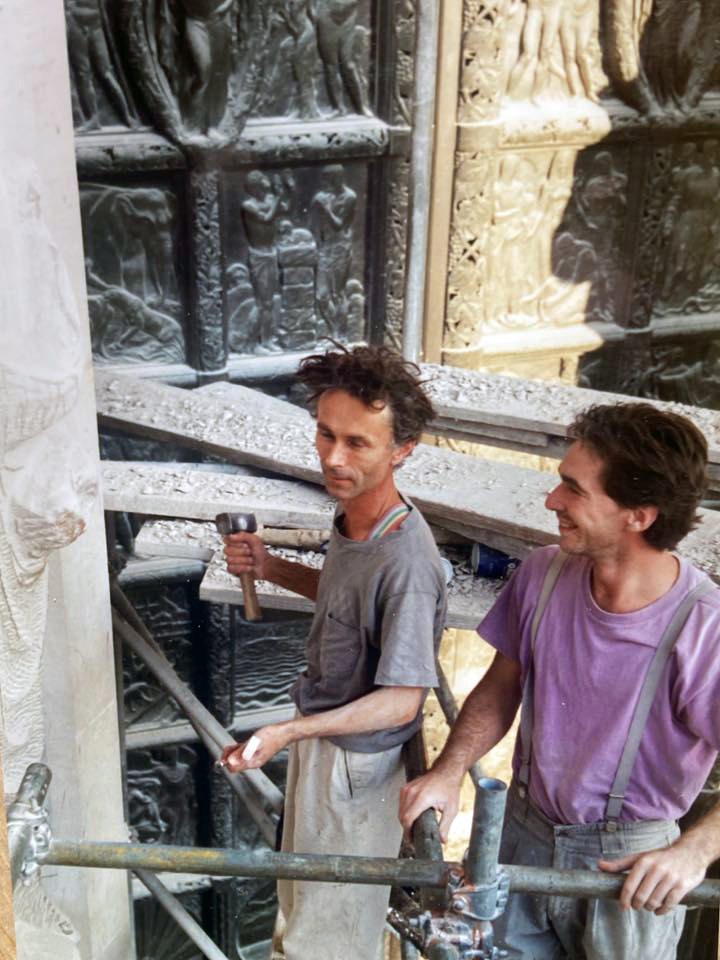
Jean-Claude Marchionni, who was working on outside projects and restorations for Cathedral Stoneworks, joined Simon in 1993. In his lecture, Simon said of Jean-Claude, “I have been so helped by a young French stonecutter, Jean-Claude, who brings his own order and clarity, so that we work as (a) focused team.”

Simon also acknowledged the work of the apprentices as “young American carvers from the (stone) yard (who) poured out their passion and their pioneering spirit, only held in check by the architectural frame and the theology they served.”
Sebastien Casamayor, part of an exchange program with the Cathedral of St. Jean Baptiste in Lyon, France, carved parts of the major-rank figures. Simon once remarked that Sebastien “had thick velvet pants that the dust fell from at the end of the day, with a pocket to hold a bottle of wine – a standard feature in Dijon.”

Sebastien, according to a Cathedral guide to the portal, carved a significant element on the figure of David – the lyre he is holding. In Simon’s carving, David wears a crown and holds a scepter in his left hand, signifying his kingship. His right hand rests on the elongated instrument, which represents joy and divine connection. Many of the ancient hymns known as the Psalms are attributed to David.
Patrick Berthaud, another French-trained carver, who spent seven months at the Cathedral, also assisted Simon on the portal when time allowed.
Of all the carvings of the major-rank figures, the face of Moses is the most unusual. His half-covered face refers to a passage in Exodus after Moses returned from Mount Sinai.

The same Cathedral guide indicates that apprentice Dennis Reed carved the head of Moses – or at least, part of it.
The importance of gaze also comes to play here – Moses looks away from the Cathedral because he never reached the Promised Land.
After Moses led the Israelites through the wilderness, he had an encounter with God on Mount Sinai. When Moses came down from the Mount with the two tablets of the testimony in his hand, he did not know that the skin of his face shone because he had been talking with God. “And, when Aaron and all the people of Israel saw Moses, behold the skin of his face shone and they were afraid to come hear him … And when Moses finished speaking with them, he put a veil on his face.” (Exodus 34:29-30,33).

Two symbols on specific figures literally create Simon’s “necklace” around the entire portal composition. On his first carving on the north side, Melchizedek holds in his hand a chalice like those used for communion wine. Beneath his feet, two hands hold the consecrated bread – a Host.

Across from Melchizedek, on the south side, John the Baptist holds a shell, an ancient symbol of fertility and life. To this day, a shell is often used to administer the water of baptism. John is the final major-rank figure of the Portal of Paradise.
The shell in John’s hand signifies baptism, the chalice in Melchizedek’s, the Eucharist.

So, as you step into the cathedral’s central entryway, you are flanked by symbols of the two great Christian sacraments that are celebrated within the cathedral.
Later in his presentation, Simon said, “As I go down my journey, I think about the traditional craftsman. His work is all connected with gods and heroes so it belongs on temples and churches. His workplace, however humble, is his altar. It is but a different form of priesthood. His work is sacred and he blesses his tools before each day’s work.”

■
Sources:
- Martha Cooper photographs
- Ivan Myjer photographs
- Amy Brier photographs
- Mary Bloom photographs
- Patrick Berthaud photographs
- Archives of the Episcopal Diocese of New York and Cathedral Church of St. John the Divine
- A Guide to the Sculptures – Nicole Di Paoli
- Tom Fedorek’s Guide to the Portal of Paradise
- Simon Verity – Master Sculptor (1945-2024) – Divine Stone
- Cathedral Newsletter, Summer 1994, Vol 8, Number 1
- Country Life – Patriarchs the Live Stone, March 11, 1999
2 replies on “Carving the Major-Rank Figures”
An amazing and inspiring account of the skill and spirituality of the stone carvers. You’re right, I walk past great works like these without pausing to take in their beauty and meaning. Thanks for providing these insights
Medieval builders frequently left rough un-carved blocks in locations that were to later receive further carving. I have photographed multiple instances in monastic and church buildings in Britain and on the continent especially bosses and other structural blocks.