
Tim Smith passed away peacefully in his sleep on September 30, 2025, at his home in Philmont, NY. We remember Tim from the early days of the Stoneyard Institute. He was one of the first five apprentices hired to begin the work on the southwest tower. He had some previous experience with stone walls in Vermont and he had been a teacher. When he was interviewed by James Bambridge, the master builder, those qualities got him a position in the first group. Tim was 35 years old, a fellow apprentice, Jose Tapia was only 19. Linda Peer, another member of the first five recalls, Tim “was the person who came from elsewhere to work in the stoneyard. He took the biggest risk.”
During his years at the Cathedral stoneyard, Tim witnessed and was part of all the amazing events that occurred. He was there in June of 1979, the day the first truckload of large Indiana limestone blocks arrived.

As part of that first group, he was taught to fashion joggle joints, the boasting finish, and cutting stone to exacting dimensions by Master Mason Chris Hannaway.


He had his turn at the saws like everyone did. Joseph Kincannon remembers his first day on the saws and an initiation supervised by Tim. “My first day as a Sawyer, Tim urged me to eat some slurry. He said it was a stone cutter’s right-of-passage. He demonstrated by sticking his finger in the slurry and eating it. (But, he didn’t. He switched fingers on the way to his mouth.) I did eat it, though, while he and Eddie (Pizzaro) doubled over laughing. I felt like a chump, but I’m still laughing. Never a dull moment with Tim.”
In May of 1981, Tim won the honor of cutting the 1,000th stone, a milestone for the stoneyard. He cut it from a block of Indiana limestone.


The stone is an intricately carved pier stone with base. It weighs about 1,350 pounds. It is stone number EA50 (East elevation, A Zone, stone #50)


Dean Morton took advantage of opportunities to show off the stone yard, like the milestone reached with the cutting of the 1,000th stone. Below, tight rope walker and celebrity Phillipe Petit is looking over the stone with the Dean and Timothy Smith in his favorite red hat.

Well, it may have been his favorite hat but he had a lot to choose from.
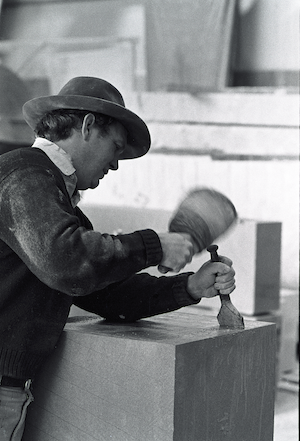


The above photos are by Robert F. Rodriguez
By September 1982, Tim helped set massive limestone blocks on Amsterdam Avenue for Phillipe Petit’s rigging crew to secure guide wires to his overhead cable.

The upcoming ceremony, the setting of the Jerusalem Stone, marked the beginning of construction on the southwest tower.
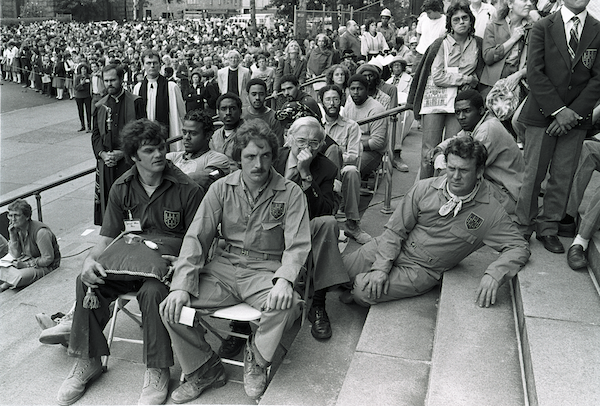
He was up front for the speeches and up top to see Phillip Petit’s high wire walk with the silver trowel.

After three years of cutting stones, there were 4,000 to start construction.

Tim and fellow apprentices, Jose Tapia and James Jamerson, received honors in the Cathedral in May of 1983. They were the first to complete the four-year apprentice program. Tim was a leader in the stoneyard and both a learner and a teacher.


Construction on the tower began slowly after the 4,000 stones were cut, due to budget and equipment constraints. Two crews up top would have been ideal and Tim would have been the obvious choice to head up a second fixing crew. According to construction supervisor, Master Mason Steve Boyle, “Tim had a great deal of work experience prior to the Cathedral which included layout and stonework, specifically dry stone walling at which he was very accomplished. Tim demonstrated this ability when the construction site at the south side was being prepared. the existing landscape was such that it was necessary to grade a gentle slope up to the level of the hoist platform retained on one side by a dry stone wall. It was also necessary to construct a shallow pit which would house the buffer and the drum that collected the power cable for the hoist.
“Tim was assigned this project which he carried out with large offcuts from the stoneyard. All credit to Tim, both the retaining wall and the pit were skillfully built and survived intact for the duration of the project. Tim was also chosen because he was industrious, had a really great, positive can-do attitude and was willing to have a go at pretty much anything. He was happy taking responsibility for difficult assignments but also didn’t shy away from even the most menial tasks. I remember seeing him in my first week with his sleeves rolled up cheerfully taking his turn cleaning out the toilets and lunch room in the stoneyard. He was quite content to grease machinery, move stone around in the stacking area and assist wherever help was needed.”

By 1986, John Walsh, then Clerk of the Works, had procured more equipment, including monorail modifications and an electric hoist. “Tim really came into his own during this period; he headed up a second crew on the East and North elevations and production increased dramatically,” said Boyle.
I’ll always remember Tim for being a kind, positive, reliable, helpful and generous person whose contributions to the Cathedral and Stone Industry were immense. He will be sorely missed.
– Stephen Boyle

On to Philmont
After his years at the Cathedral, Tim and his wife, Laurie, moved to Philmont, New York, where they established T.D. Smith Stonemasonry. Tim literally took a piece of the stoneyard with him. Next to his driveway is a limestone block, WA57. In an October, 2022 interview, Tim explained that two of the same stones were inadvertently cut. Tim felt the other stone, which he did not cut, was cleaner and closer to the template lines so that stone should be the one set on the tower. He took his block home as a keepsake.

Interviewed by the Daily Gazette locally in 2011, Tim spoke of his early stone experience that became a love of stone:
“Without his grandparent’s farm, he would have never learned how to build with stone. There were 40 cows on her farm that had to be milked by the farmer, he said, and he tended to get in the way. I got banned from the barn. On occasion, Smith, as a 10-year-old, would sneak into the barn, and on occasion, the farmer would catch him and bring him outside. ‘He would kickover the stones in this large stone wall and say you can only go back in when you put all of those stones back up.’ That was how he became a mason.
“Tim left the Cathedral with enormous knowledge and experience, but that was not all. He also saw what Bambridge (Master Builder), Bird (Master Mason) and Boyle (Construction Supervisor) did with disadvantaged youths from Harlem, who learned the trade and became successful.”
T.D. Smith Stonemasonry began a program that helped at-risk youths in the area who struggled with school-based education and taught many of them how to survive in life as masons. Tim’s wife Laurie said “The school would drop the kid(s) off in the morning and they’d go back to school in the afternood for classes. They were given credit for working with Tim. It was amazingly successful.”
Tim’s stone restoration work appears all over Columbia County, New York. Several of Tim’s workers recalled how they met Tim and what the opportunity has meant to them.
One 27-year-old worker said he had known Tim since he was 9 years old, when Tim ran a youth center in Philmont. He said, “I got myself in trouble with a few DWIs and Tim gave me a second chance. He gave me my job back.” That man is now an experienced bricklayer and pointer. Another one of Smith’s workers told how a teacher connected him with Tim. “He put me straight to work for six months every day at 8 a.m. When I was in school, I would attend my two morning classes, and then head to the house to work by noon.” He said the work motivated him to attend college and study architecture.
Some 10 years ago, a handwritten letter from Doreen Clark, James Bambridge’s sister came along. She was asking for a memorial in honor of her late brother, the Master Builder. Tim was one of the first apprentices hired by Bambridge for the Cathedral work. Tim designed a memorial tablet in consultation with Doreen, and in a few months, it was completed.

It sat there on his porch in Philmont, N.Y. until a chance conversation with Robert F. Rodriguez. Robert fetched what was now two tablets and brought them to Manhattan, where he and Steve Boyle began to organize a way to get the Bambridge tablet up inside the tower and installed.

In 2024, with the help of the facilities department at the Cathedral, the Bambridge tablet was installed inside the bell ringers’ chamber of the tower that Tim helped to build. Timothy Smith’s connection to the Cathedral is deep and long-lasting.
■
- Divinestone.org blog
- Images provided by Robert F. Rodriguez
- Daily Gazette, Resource Center Opens with Salute to Mason, October 6, 2011.
3 replies on “Remembering Timothy Smith”
A life in stone
Tim was one of a kind, with the biggest heart of anyone.
Oh, I am so pleased and grateful to find this tribute to my first cousin, Tim Smith. He was such an important person for me throughout my life, and especially when I moved to New York in the late 80s, when he introduced me to the Cathedral, which became a very important part of my life there. I remember visiting the stone yard with him and watching the huge saw in action. Amazing!