(This is Part One of two articles on the early work on the Portal of Paradise. They are written by DivineStone co-author, photojournalist and Cathedral Artist-in-Residence, Robert F. Rodriguez. All of the images in the article are those of the writer.) – RM
Stoneyard apprentices contribute solidly to the first phase
Jessica Aujero Lowrie took a slow walk along 112th Street, the looming Cathedral of St. John the Divine getting larger before her. Memories and emotions arose as she neared the steps leading to the Portal of Paradise – a project she worked on over 35 years ago. This was her first visit since.

“I can’t believe we did this work,” she said, scanning the carved monument on three levels. “What a great thing we did.”

In the fall of 1988, Master Sculptor Simon Verity led a team including Amy Brier, Jessica Aujero (now Lowrie), Gabriele Hiltl-Cohen, Joseph Kincannon, Dennis Reed, D’Ellis “Jeep” Kincannon and later Sebastian Casamajor in carving the bases, or pedestals – the lowest level of the three-tier portal. The 12 major-rank figures would stand on these base carvings.
The primary work of this first short season was to start roughing out the eight-foot-tall limestone blocks of the major-rank figures and get a feel for working in situ. Using wide chisels and heavy hammers, the crew started removing the edges of the rectangular monoliths, chipping away at excess material as a preliminary step to carving.
The Portal of Paradise includes 32 carved limestone biblical figures based on the iconography developed by Cathedral architect Ralph Adams Cram and Bishop William T. Manning in 1925. Dean James Parks Morton wanted to make some updates to the original list of figures in consultation with the Rev. Minka Sprague and Rabbi Rolando Matalon, who remembers being summoned to Dean Morton’s office for a late-evening conversation on which figures should be included. From these meetings, a number of biblical women were added to the iconography.
Rabbi Matalon calls the Portal of Paradise “such an amazing, daring and bold work and it was also very inclusive. They (Dean Morton and Bishop Paul Moore) were aware of the Jewish roots of Christianity and they were committed that the link would never be erased. The Portals also reflect that commitment to celebrate the connection between Jews and Christians.”

The first full season of carving the portal began in April 1989. Jessica recalls working on thin and rickety scaffolding, carefully balancing on the planks to start work on her pedestal. She was the only apprentice to carve two bases. Elijah’s ascension into heaven appeared on the north side.

According to the Bible (2 Kings 2:11), the prophet Elijah ascended to heaven in a fiery whirlwind, with his successor Elisha witnessing the event. Amidst Jessica’s swirling-column base, two carved faces barely emerge from the windstorm, almost gasping for air and seemingly caught up in the vortex. Her narrative blends harmoniously with the carving above of the figures of Elijah and Elisha.

Studying her work Jessica says, “I thought I was carving too deep but I see others that are deeper. In stone, you have to think structurally, also, where the (rain) water will land. When the water freezes, will it destroy or crack anything; can the water drip down cleanly. You have to think about those things.” Overall, Jessica feels the work has held up.

Simon Verity, in Jessica’s opinion, was a hands-off teacher. She remembers only doing a few preliminary sketches. “We would run an idea by Simon and he would say ‘go with it,’” which made Jessica feel nervous. “Simon was nearby and we could always ask each other. We had time to think about it while we were (working) – it was a slow process,” she adds.

On the north side of the Portal of Paradise, Amy Brier and Gabriele Hiltl-Cohen’s base carvings flank Jessica’s work.
Amy Brier worked on the base of the major-rank figure of Moses. She recalls, “being Jewish, I thought that was appropriate and I researched into his (Moses’) mythology as a magician (e.g. turning Aaron’s staff into a snake) and the Cabalistic aspects — the mystical side of Judaism.” The Cabala is the mystical writing of the Jews.

“I put the Tree of Life on the base, which is also a kind of feminist statement,” Amy adds. “Traditionally, the Cabala couldn’t even be studied by women, only by men, I think, over a certain age, who were married. I felt like I was putting my mark there.”
One of Amy’s preliminary drawings suggests she wrestled with the iconography for the base. Amy wanted to create a narrative image that expressed the fundamental gesture of Moses’ work and she sought guidance from the Rev. Minka Sprague. “We talked about Judaism and I learned a few things,” says Amy, who remembers Rev. Sprague as “the priest in pink shoes.”

In a December 1988 Cathedral Newsletter article, Rev. Sprague addressed the importance of readings of religious texts. “In case any might feel unequal to Biblical interpretation,” Sprague said, “we’re all unworthy, but we are called on.”
Amy’s finished work shows the Cabala, depicted here using a helix-type figure, one of the Cabala’s several symbols. On the column below someone else started carving chain links that she icorporated into the design, along with the Red Sea, to represent bondage and escape from Egypt.

Samuel, the first of the great prophets since Moses, is the upper major-rank figure on the north side closest to the Bronze Doors. Gabriele Hiltl-Cohen’s task was to carve a complimentary base below.

A Cathedral pamphlet provides more details on the Biblical character Samuel, who anointed Saul as king but warned the people that in choosing a king, they were rejecting God. This could be interpreted as no king is above the law of God.
Trained as a stone carver in Germany, Gabriele read pertinent Biblical passages and focused on Saul disobeying God in two ways: by making a rash oath that led to his soldiers sinning, and by failing to destroy the Amalekites and their livestock as commanded. Because of this disobedience, which stemmed from fear of the people and pride, God rejected Saul as king.

“I compared this to the current political situation,” says Gabrielle, referring to Iran-Contra, a political scandal in the United States that centered on arms trafficking to Iran between 1981 and 1986, facilitated by senior officials of the Ronald Reagan administration. The administration hoped to use the proceeds of the arms sale to fund the Contras, an anti-Sandinista rebel group in Nicaragua. The administration’s justification for the arms shipments was that they were part of an attempt to free seven U.S. hostages being held in Lebanon by Hezbollah.

Gabriele knew she had to be “very clear in (her) story telling.” Carving traditions from the Middle Ages had to be direct and simple when many people were illiterate.
Her carving shows the U.S. Capitol with bombs and hungry people in a depiction of the world gone awry under the wrong leader. For some, this interpretation can easily be applied to the current administration.

Below the Capitol building, a man holds a suitcase full of money that is falling out of the bulging valise. This represents the proceeds from the illegal arms sales. Off to one side, an armed man seems to be guarding blindfolded prisoners. Gabrielle added a number of homeless people pointing to the illegal activity, acting almost as a Greek chorus. She based this grouping on some homeless who frequently took refuge on the steps of the Cathedral.

“It reflected our current state of political and social injustices,” Gabriele reminisces, adding that Master Sculptor Simon Verity liked the idea of Gabriele adding the homeless to her piece.
Jessica said Gabriele’s carving of olive leaves on the slender column beneath her tableau was “beautiful – we were partners during the whole carving process.”

While the apprentices were carving the pedestal bases, Simon plunged into work on the first major-rank figure, that of Melchizedek, a priest and King of Salem. By late October 1988, the facial features and elongated drapery of the eight-foot carving started to emerge. Simon worked tirelessly on the carving until it was time to remove the scaffolding for the season – one of the drawbacks to working in situ versus having the comfort and relative warmth of the carving shed.

The following season, besides continuing work on Melchizedek, Simon also carved two pedestal bases on the north side. Under the major-rank figures of Abraham and Sarah, he carved a depiction of a baby (Isaac, Abraham’s son) emerging from the womb and a spiral representing Abraham climbing the hill to sacrifice him. His other base carving showed Jacob (the father of the 12 tribes of Israel) wrestling with the Angel of God during his dream, below the major-rank figure of Jacob.
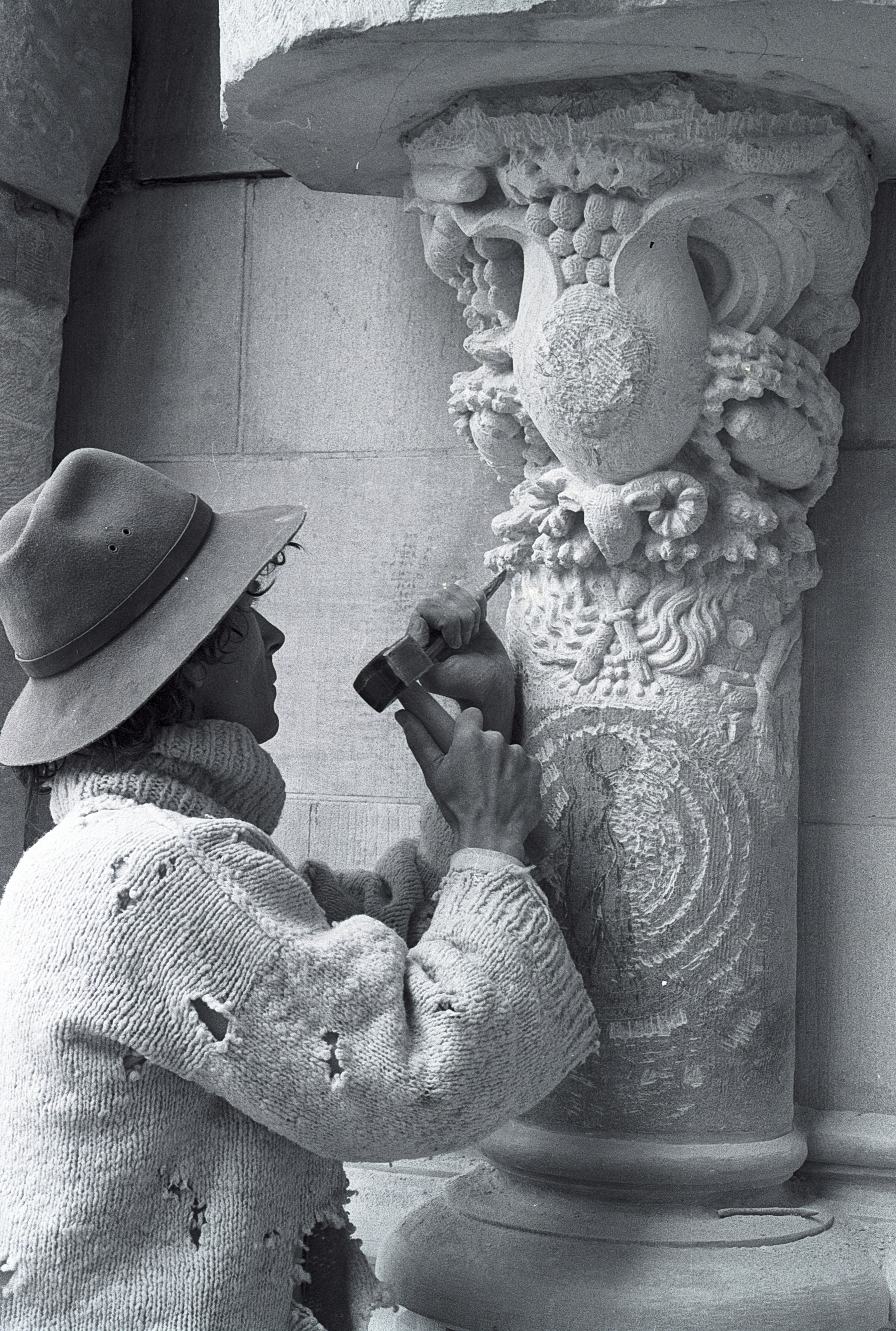
At that time, according to Canon Edward Nason West, if a shed were erected around the portal construction zone, the crew could carve all year round – and keep their work from inquisitive eyes, the sidewalk superintendents as well as the gawkers and photo seekers. However, that did not happen – with Simon and the apprentices becoming part of the never-ending street theater in front of the Cathedral.

■
Sources:
- Cathedral Newsletter Sept 1989
- Cathedral Newsletter Dec. 1988
- Portal of Paradise: A Guide to the Sculptures
- Wikipedia
2 replies on “The Portal Project Begins”
My admiration for these young sculptors and the ambitious Cathedral stone project has increased now that know they researched the Bible stories and designed and carved their own interpretation
Wait for Part 2.