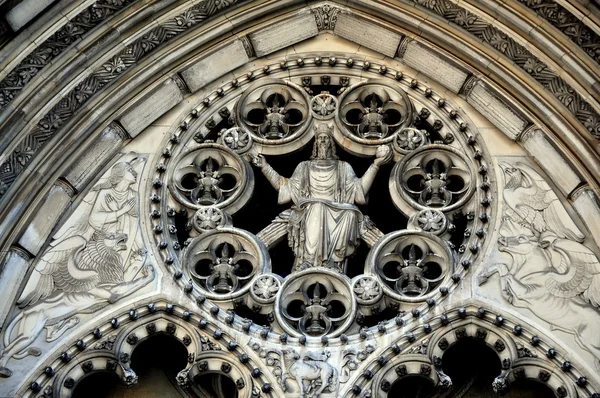
Relief carvings of the Tetramorph surrounding Christ in Majesty, the tympanum above the central portal
The relief carving of the symbols for the four evangelists surrounds the “Majestus” on the west front. The term tetramorph refers to a grouping of four. This is the work of the sculptor Theodore Barbarossa. It was likely modeled by the firm of Rochette & Parzini, and carved by their head carver, Mario Tommasi. The work was executed in the late 1960’s. The specific grouping of four here represents the four evangelists. Regardless of material – stained glass, mosaics, painting or stone – the symbolic representation of the four evangelists usually accompanies the image of the Majestus.
No doubt, Canon West was consulted on the iconography appropriate to the evangelists. From his book, Outward Signs – The Language of Christian Symbolism, we find the following:
“The four evangelists seem to have been the first of the saints to receive some visible token of recognition, becoming identified with the four ‘living creatures’ of Revelation. Although there was originally little agreement as to which creature represented which evangelist, there has been, since about the fifth century, a popular consensus…St. Jerome’s iconographic representation is now common to the whole church, East and West.”
– Canon Edward N. West
St. Jeromes representation:
Matthew – the face of a man
Mark – a lion
Luke – an ox
John – an eagle
The Pilgrims Frieze
Model for the Pilgrim’s Frieze
The frieze immediately above the great bronze doors of the central portal is also by Barbarossa according to the National Sculpture review. We had previously attributed the design to Canon West and undoubtably there was a collaboration of sorts with the sculptor.
Theodore Barbarossa
Theodore Barbarossa – Image Boris, Boston
Theodore “Ted” Cotillo Barbarossa (1906-1992) studied at Massachusetts College of Art and Yale University. He was a fellow of the National Sculpture Society, and a member of the National Academy of Design. Italian stone carving and plaster casting inspired him. Barbarossa worked in bronze, wood and stone. His work is in churches, museums and public buildings throughout the East Coast. As part of President Roosevelt’s WPA New Deal art initiative, Barbarossa created relief sculptures on post offices and other federal buildings depicting national ideals such as industry, education, and agriculture.
National Sculpture Review, Winter 1971-72
Legendary Locals of East Boston, Dr. Regina Marchi
Tom Fedorek, Senior Guide, The Cathedral of St. John the Divine
Only known Photo of all Six Piccirilli’s Brothers. L-R Getulio, Horacio, Masaniello, Attilio, Furio, and Ferruccio. Image – Restored by Eduardo Montes-Bradley, Heritage Film Project
Among the immigrants to the United States between 1830 and 1920 were many skilled artists, stone carvers, and sculptors. Italian stone carvers are a case in point. In the latter half of the 19th century many of the Italian quarries started to go out of business due to foreign competition. Since there was less marble being quarried, there was less of a need for stone carvers and the carving sheds began to close. The social, political and economic upheaval in the Italian marble industry spurred immigration.
The economic opportunities in America and elsewhere would allow them to earn four times what they earned in Italy. Many of these men trained as sculptors at the Fine Arts Academies in Carrara, Florence and Rome. To support themselves and their families while they were establishing themselves in the United States, they carved for others. The following are some key events leading from immigration, through the City Beautiful Movement to the end of WWII.
In the 1880’s, first to the Vermont Marble Company in Rutland and then to Barre to work in granite, the quarry owners recruited the Italian stone workers. This occurred throughout the burgeoning stone quarry sites in the U.S. in places like Marble, Colorado and Sylacauga, Alabama.
Novelli and Corti became Barre’s premiere sculpture and carving studio in the 1900’s. Image – Montpelier Times Argus
The Piccirilli Brothers and the Ardolinos
Others settled in large urban areas and these carvers were associated with many wealthy families, sculptors, politicians and architects. Through varying circumstances, the Piccirilli brothers made their way to New York in 1888 followed by their parents and sister. They soon found enough work to pay the rent and sustain the family. In 1912 Attilio won the commission for the USS Maine monument at the entrance to Central Park at Columbus Circle. This provided them the prominence they sought.
At about the same time, the Ardolino brothers and cousins made their way separately to first Boston and then New York. They became associated with ecclesiastical carvings and the architect Bertram Goodhue and the sculptors John Angel and Lee Lawrie. The reredos at St. Thomas Church at 5th avenue and 53rd was by Rafael Ardolino. Various Ardolinos executed a great deal of the carvings at the Cathedral of St. John the Divine from 1910 into the 1940’s.
Other Stone Carving Immigrants
John Evans (1847 – 1923) was a stone carver and modeler. Born in Caernafon, Wales and trained in England, he settled in Boston in 1873. His company employed 100 workers and did architectural sculpture all over the country. He left an indelible mark on Boston’s buildings and monuments. The work was in granite, marble and sandstone. They did work for Cram, Goodhue and Ferguson and were a favorite of architect H.H. Richardson. They executed the work of sculptor Domingo Mora. The firm also did considerable work on the Cathedral Church of St. John the Divine.
John Donnelly, born in Ireland, the son of a stone carver, came to the United States in 1913. He formed the company John Donnelly & Son. They worked on many buildings in Philadelphia and Washington, D.C. The Donnelly company carved all of the decorative elements on theNew York City Public library with the exception of the lions (done by the Piccirillis).
John Donnelly carvers working on Corinthian Capitals at the Philadelphia Central Library. Image – Free Library of Philadelphia
Donnelly loved the sailboat races Saturday afternoons but was always worried about the carving job on the Vanderbilt Mansion, so he initiated the halfday Saturday for all of his stone carvers. The tradition carried on after the Vanderbilt job. He also mentioned that in 1890 there were only 320 stone carvers in the country, 140 of them were working for him on the Vanderbilt mansion at 5th Avenue and 55th Street, 80% were British and the rest Germans.
“Though Donnelly’s works were often sculptural, he preferred to be known as a stone mason rather than a sculptor or artist”
– John Donnelly, 80, Stone Carver Dies, New York Times obituary
East Pediment of the U.S. Supreme Court Building, signature of carver John Donnelly
Roger Morigi was born in Bisuschio, Lombardy in 1907. He apprenticed under his stone carver father beginning at age 11. Morigi also studied at the Academia di Belle Arts di Brera in Milan. He immigrated to the United States in 1927 and worked with his father. In 1932 the John Donnelly Company hired Morigi as a carver to work on the Supreme Court Building. He worked for the John Donnelly Company on the majority of the seven Federal Triangle buildings. Morigi began work as a carver at the National Cathedral in 1950, and was promoted to master carver at the National Cathedral in 1956. He held that position for 22 years.
Roger Morigi showing pose he did for fellow carver, John Guarente, who created a gargoyle (upper left) on the Washington National Cathedral in his honor. Image – George Thames/The New York Times
Gino A. Ratti and his son Eddie were a smaller company but nevertheless stood out next to all the others for their artistry and carvings. Ratti was born in Carrara, Italy in 1882. He left Italy in 1907 for the United States. Edward Ratti later worked on the Washington National Cathedral.
Gino A. Ratti, carver, puts the finishing touches on “Contemplating Justice” 1935, United States Supreme Court Building. Image – Library of Congress, Harris and Ewing Photographer
The City Beautiful Movement
The City Beautiful Movement was America’s urban planning movement (1890’s-1920’s). The movement gained ground with the World’s Columbia Exposition of 1893 in Chicago. A temporary city was constructed primarily in the Beaux-Arts style. The concept focused on incorporating a civic center, parks and grand boulevards mimicking European cities. The movement happened at a time when the country’s urban population began to out number its rural population. Most cities were considered ugly, congested, dirty and unsafe.
Administration Building, World’s Columbia Exposition, Chicago 1893. Image – University of Chicago Photographic Archives
Once artists, architects and other visitors returned to their cities after the exposition; they realized it was essential to the public welfare of the people to take heed of the urban landscape. Many American cities embarked on public buildings and art projects in order to beautify their cities. New York, Cleveland, San Francisco, Detroit and Washington, D.C. all began these efforts.
European trained sculptors and carvers were instantly prepared to execute these projects. The immigrant carving families and individuals mentioned above were poised to carry out the many projects.
It should be noted that over time the movement’s short comings came to the fore. It became apparent that improvement of the physical city without addressing social and economic issues would not substantially improve urban life.
The McMillan Plan -1902, Washington, D.C.
At the time, Washington, D.C. was no more beautiful than the average American city, with the exception of factories belching soot on the inhabitants. The McMillan Plan was deeply influenced by the City Beautiful Movement as well as the Louvre-Tuileries complex in Paris and the Whitehall area in London.
Additionally, the McMillan Plan sought to restore and amplify Pierre L’Enfant’s original plan for the city with its formal grandeur influenced by the designs of European cities and gardens.
Pierre L’Enfant’s Plan for the Federal City, 1791
Most of the recommendations of McMillan eventually materialized, mostly before WWII. Appropriations were authorized by the Public Building Act of 1926. $50 million was provided for the construction of the Federal Triangle and a new Supreme Court building and another $25 million to buy up the private land required.
The Federal Triangle
The decorative embellishment of the Federal Triangle was one of the last grand examples of the Beaux-arts principles that had swept the country at the turn of the century. The exterior architectural ornamentation for the seven buildings represented the largest concentrated program of its type ever undertaken by the government. Construction began in 1927 with the final sculptural element installed in 1941. The project’s exteriors consisted of 15 pediments with figurative groups, and at least 65 other designs of varying importance scattered throughout the complex of structures. All told, interior and exterior, there were 112 works by 44 sculptors and a vast industry of modelers, plaster casters, studio assistants and stone carvers. The Piccirilli’s, Ardolino’s, John Donnelly & Son and Gino Ratti all worked on the project. John Evans had passed away in 1923.
The Federal Triangle, 1939 Image – The Washington Star
The National Archives Building
Of the seven buildings in the Federal Triangle, the jewel in the crown is the National Archives building. The architect chosen for the building was John Russell Pope. This was not a grand office building but the visual symbol of America’s heritage and its destiny.
Because of the swampy nature of the site with Tiber Creek running under it, 9,000 pilings were used to shore up the ground, September 1932. Image – Office of the National Archives
Proportionately more was spent on architectural sculpture and decorative detail on this building than any other in the Federal Triangle.
The total cost of the decoration came to $360,000 (roughly $6,212,000 today) Of this sum, $190,200 was paid for the models of the three sculptors, $17,557 for the commercial models, and $152,940 for the stone carving
– George Gurney, Sculpture and the Federal Triangle
John Russel Pope selected 3 sculptors for the work on the building. He selected sculptors he knew and worked with and who he felt sure would carry out his vision. The sculptors also had their favorite stone carvers from past associations. There are two major facades to the building. The south facade and main entrance on Constitution Avenue and the equally important north facade on Pennsylvania Avenue. Each side had three major architectural sculpture features, a large pediment (18’6″ X 106′) and two ground level 10 foot statues.
Rough block of Indiana limestone for one of the statues for the National Archives, 1934. It was brought by train on a specially designed flat car. Image – Stone Journal Magazine
All of the carving was done on site. Carving shed for the pediment above and carving shed for one of the statues below, December 1, 1934 Image – National Archives
South Facade – Constitution Avenue
“Recorder of the Archives” pediment. Sculptor – James Earl Fraser, Modeler – Laura Gardin Fraser, Carver. -John Donnelly Company. Image – Wikipedia Commons
“Guardianship” statue. Sculptor -James Earl Fraser. Modeler – Sidney B. Waugh, Carver – Gino A. Ratti Company, Image – Dana Vera
“Heritage” Statue. Sculptor – James Earle Fraser, Modeler -David K. Rubins, Carver – Gino A. Ratti Company. Image – Jeff Reed, National Archives
North Facade – Pennsylvania Avenue
“Future” Statue. Sculptor – Robert I. Aitken, Carver – Piccirilli Brothers Company.
“The Past” statue. Sculptor – Robert I. Aitken, Carver – Piccirilli Brothers Company
“Destiny” Pediment. Sculptor – Adolph Weinman, Carver – Edward Ardolino Company. Image Carol M. Highsmith, Library of Congress. Inscribed along the lower edge of the pediment in the left and right corners respectively are: CARVED by EDWARD ARDOLINO and A.A. WEINMAN. Sc.
The fifty years between 1890 and 1940 saw the heyday of architectural sculpture in the U.S. After World War II architectural trends moved to the modern simplicity of glass and steel. These buildings were cheaper and quicker to erect, with little if any sculptural decorations. Young men and women returning from the war, or emerging from civilian war work, were presented with a myriad of opportunities for their professional lives. The supply of stone carvers dwindled as the demand for architectural sculpture wained.
John Connelly died in July, 1947; Edward Ardolino died in April, 1945; Attilio Piccirilli died in October, 1945; Gino Ratti died in 1937. In the most part, their companies did not survive them. When a skill is not taught or practiced it is known to die out within 3 generations. Consider how Dean Morton went to England in the late 1970’s to secure the help of Master Builder Jim Bambridge at the conclusion of the Liverpool Cathedral building. Consider how Bambridge enlisted Chris Hanaway, Alan Bird, Stephen Boyle and Nicholas Fairplay from England to train a new group of New York apprentices in stone cutting and carving.
In this century, several men and women found their way to work and learn in places like Kincannon Studios and Fairplay Stone Carvers. Today young men and women can train at the American College of the Building Arts with Joseph Kincannon.
■
The Socioeconomic study exploring the Immigration of Artisan Stone Carvers from Italy to the United States of America Circa 1830-1920, Russ Joseph Morris, The College of Staten Island
John Evans (1847-1923) and Architectural Sculpture in Boston, Ann Clifford, 1992, Tufts University.
Tim de Christopher’s route to the stone yard and the following years has been filled with stone. You might say “stone for life” is a fitting title for this story. He became aware of Cathedral Stoneworks as a graduate student at nearby Columbia University. His early influencer was his father, a graphic artist and designer of educational toys. He studied sculpture and began carving in 1978 when attending The Cooper Union in New York City.
After being hired at the Cathedral stone yard, Tim was able to use his experience in sculpture, architecture, model making, mold making, drawing, drafting and graphic design. They hired Tim as an architectural draftsman and “journeyman” carver. At the time, Cathedral Stoneworks was taking in outside work with the goal to generate profit for continued work on the south tower of the Cathedral. Tim carved stone for the Coca-Cola Building and took molds of existing ornamentation on the Jewish Museum. His carved grotesques adorn the new wing.
Tim working on carving for the Jewish Museum building – Image courtesy Tim de Christopher
Entering the north transept of the Cathedral from the stone yard, he would pass the enlarged photograph of one of the Ardolino brothers carving a capital on the monumental columns. Other than two men, working at the Cathedral over 80 years apart, he thought the only relationship was one of stone. Turns out, they were cousins, something Tim would find out some years later.
Cathedral of St. John the Divine -Working On An Angel” 1909 – Image part of the George Grantham Bain Collection, Bain’s News Service, held at the Library of Congress.
The Ardolino – Christofaro Connection
In 1907, Eduardo Ardolino married Nicolina de Cristofaro. Nicolina was the sister of Leopoldo de Christofaro. Leopoldo is the grandfather of Tim de Christopher. All were from Torre le Nocelle, Italy. Like the Ardolinos, grandfather de Christofaro was a stone carver. He emigrated to Philadelphia and carved for the Bryn Athyn Cathedral. In Philadelphia he founded De Christopher Bros. Monuments with Tim’s great uncle Carmine. The business exists to this day. Similarly, Ralph Ardolino formed Long Branch Monuments in New Jersey. The coincidences and similarities are quite striking and there isTim de Christopher engaged in the same work at a cathedral and he also has done memorial work.
Unfortunately, in 1994, funding issues caused the stoneyard to close down. Tim left NY in 1992 and moved to Massachusetts setting up a small carving shed at the Ashfield Stone Quarry. A short time later a call came from Alan Bird, then Clerk of the Works for Cathedral Stoneworks. Bird let Tim know they were cleaning out the yard and if he wanted stone to come and get it. A 20 ton rig was hired and it made 6 trips. Jeep Kincannon helped Tim with logistics in the city. Tim was now owner of 120 tons of stone; stone for life. He and the stone have moved several times between then and his current home in Turners Falls, Massachusetts. There are fewer pallets of stone today.
For me, it was precious cargo, my artwork and my bread and butter.
Tim de Christopher’s stone in one of the early sites he had it stored.
The Professional Stone Sculptor
De Christopher is now a well known New England sculptor, with his work being featured in many solo exhibitions, commissions and public art installations.
Throughout his sculptures there is an incisive sense of humor, and charm, coupled with human empathy which makes his work deeply ‘humanist.’ His pieces reach out to the viewer; they want to be admired, delighted in, and chuckled over.
– Ray Wiggs Gallery, Provincetown, MA
Tim has about 30 tons of stone remaining and plans for all of it. His latest work “Industrial Ark” is part of that.
Tim will always hold the Cathedral and his time there near to his heart and his stone for life is one of the connections.
The Stone Carvers Guild is a group of independent working professional American stone carvers. Some work in one-person shops, others in small dedicated carving companies. Although they compete with one another for jobs, they share the same goals including promoting and preserving the timeless trade of architectural stone carving. Recently the Guild began a monthly podcast featuring interviews with members. The first three members interviewed all are veterans of the stone yard at the Cathedral Church of St. John the Divine in New York City. All have continued their carving journeys around the country.
Episode 1 – Joseph Kincannon, September 2023
Joseph Kincannon carves his interpretation of the nuclear Holocaust around 1989, which includes the destruction of the World Trade Towers. This carving on the Portal of Paradise has become iconic since the Sept. 11 attacks with many Cathedral visitors stopping to see his carving. – Image Robert F. Rodriguez
Joseph went from the Gift Shop to an Apprentice in the stone yard to Lead Carver. He was one of the longest serving stone workers at the Cathedral during the existence of the Stone Yard Institute. In addition to work at Kincannon Studios, he is currently the Chair of Carving at the American College of Building Arts. Listen to the podcast by linking here
Joseph Kincannon Teaching at the American College of Building Arts.
Episode 2 – Nicholas Fairplay, October, 2023
The face of Elijah begins to emerge as Nicholas Fairplay chisels out folds in the robe of the prophet on June 2, 1986. Image Robert F. Rodriguez
At 16 Nick apprenticed with a stone company working on Chichester Cathedral. He went on to work at Westminster Abbey and then received a degree from City and Guilds of London Art School in life drawing and clay modeling. He came to the Cathedral of St. John the Divine as Head Carver and was tasked to teach carving to the most promising cutters in the apprentice program. Listen to the podcast by linking here.
In Cleveland, the Hellenic Preservation Society has commissioned Master Stone Carver Nicholas Fairplay to sculpt a large relief to be installed on the Parthenon Wall of the Greek Cultural Garden featuring dozens of Greek cultural figures. Above, Nick explains his drawing of the relief in Sept. 2022. – Image ClevelandPeople.com
Episode 3. – Amy Brier, November, 2023
Amy Brier intently carves her figure of an Old Testament rabbi on Feb. 29, 1988. – Image Robert F. Rodriguez
After she received her Bachelor of Fine Arts degree from Boston University, Amy went to Pietrasanta in Italy to carve and study at a commercial marble studio. Coming to the Cathedral stoneyard as well as during its exchange program work on the Cathedral in Lyon, France, she learned much and appreciated the place the traditional carver had in the work. After the Cathedral work Amy acquired a MFA in sculpture from Indiana University. Along the way she co-founded and became the Executive Director of the Indiana Limestone Symposium. She continues to teach as Chair of the Fine Arts program at Ivy Tech Community College in Bloomington, IN. Listen to the podcast by linking here.
Amy Brier working on relief for Indiana State Fair Building. – Image courtesy Amy Brier
Wearing her trademark headscarf Arlene “Poni” Baptiste poses for a portrait on Feb. 24, 1981.
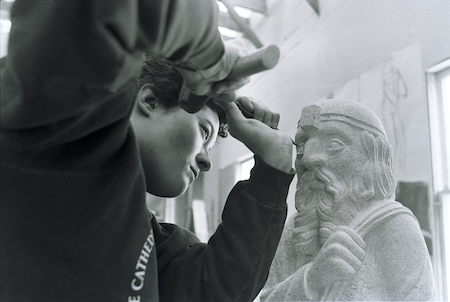
The Cathedral cutting and carving sheds were always filled with the sounds of chisels and mallets chipping away at limestone blocks. And with the chipping, limestone dust filled the air and settled on every surface, especially one’s hands and head. The fashion trends in the stone yard demonstrate some solutions.
Without a hat to protect, limestone chips are caught in Nils Peele’s hair while he works on a stone on Oct. 3, 1980.
Many cutters and carvers resorted to conventional headgear to keep away the dust but some brought style and fashion flair with their hats and scarves. Two trend setters that stood out from the rest were Timothy Smith and Arlene “Poni” Baptiste.
One of the five original apprentice stone cutters, Timothy sported an array of berets, straw hats and baseball caps. Timothy recently said, “I love hats. I see a good hat and I buy it. I just collect them.” He added, “We were always outside and a hat was important.”
Timothy Smith sports a straw hat with wide brim while cleaning out excess stone from a large block on July 8, 1981.
Timothy’s berets often included pins with military insignias that he would buy from Army Navy stores and add to his hats.
Timothy Smith takes a break from cutting stone as he puffs on his pipe on Oct. 3, 1980. The insignia on his hat is from The Gloucestershire Regiment, an infantry regiment of the British Army. Tim said he probably bought the pin at an Army Navy store and added it to his beret.
While many women stone cutters and carvers simply wrapped a kerchief around their heads to protect them from the stone dust,
Jessica Aujero wraps a floral print scarf tightly around her head as she works on her base carving on the Portal of Paradise, seen in August, 1989.
Arlene “Poni” Baptiste was without doubt the stone yard fashionista. She brought an Afro-Caribbean splash of colors and patterns to the long headscarves she always wore. She looked like a Nubian Queen with her elaborately tied scarves that fell onto her shoulders.
Poni explains that the head coverings “often began as just an interesting piece of printed fabric. Some were colorful scarves I bought or was given to me by family and friends because of my well known preference for wearing them.”
“The key is choosing a symmetrical central pattern. A starburst, for instance folded just right yields a radiant crown. Then there is the tying. A knot in the back ain’t quite enough, but twisting the two ends then wrapping and lacing them around my head results in a neat finish.”
And because of the dusty environment she worked in, Poni adds “there is also simply the practical side of it.
My dreads stayed dust free in a stone yard.”
Timothy comments that Poni’s fashion style was “fantastic, so individual and unique. She was also a great stone cutter.”
Arlene “Poni” Baptiste displays an intricately wrapped head scarf while posing with her column base stone on Aug. 13, 1982.
The stone cutting shed could be frigid in winter so the crew employed an assortment of headgear — from tweed caps to hoodies fastened over hats to thick wool knit hats — to keep the body warm. The fashion trends in the stone yard turned practical.
Master Builder James Bambridge looks natty in a tweed hat and sweater Patrick Hall keeps his head warm with a wool cap.Timothy Smith wears a beret and Dean James Parks Morton shows a deerstalker style hat.James Jamerson has his hoodie tied tightly as he works near a heating stove on a chilly Feb. 3, 1983
When work began on the south tower, construction supervisor Stephen Boyle would frequently be seen wearing a hard hat. Others wore them on and off depending upon how hot the temperature got while they were setting stones.
Tower foreman Stephen Boyle cleans the lines of a gablet quatrefoil that the crew just set in September, 1986.
On one occasion hard hats were not meant to keep heads safe from falling objects. The helmets were ceremonial and celebratory on Sept. 29, 1982 when clergy and dignitaries wore blue hard hats to mark the resumption of construction of the tower after a 41-year hiatus. Bishop Paul Moore, usually wearing his imposing miter, swapped it for a hard hat, which he raised in celebration to all assembled.
Bishop Paul Moore doffs his hard hard to the crowd during the ceremony marking resumption of the Cathedral’s construction after a 41-year hiatus on Sept. 29, 1982.
One particular hat had a long life at the stone yard, passing from one stone carver to another. Cynie Linton remembers buying a painter’s style brimless hat at a vintage clothing store in Greenwich Village.
“It was the hat I wore the majority of my eight years as a stone cutter and carver,” Cynie said, the hat “kept stone bits and dust out of my hair.”
Cynie Linton wears an artist’s hat while carving her Pilgrim of Santiago de Campostella buttress gablet stone on June 3, 1985. When she left the Cathedral she handed the hat off to new stone cutter Treese Robb.
When Cynie left the Cathedral for architectural school she passed the hat on to new apprentice Treese Robb. “I don’t actually remember giving it to her…I must have been in a generous and expansive mood,” Cynie said facetiously.
New apprentice Treese Robb carves a foliage pattern on the crocket of a gable stone in Sept. 10, 1986. She is wearing the hat that colleague Cynie Linton gave her when Linton left for architectural school.
Treese remembers, “I admired Cynie’s hat and she had beautiful wavy hair,” adding that Cynie looked “so darling in that hat.”
All these years later, Treese still has the hat.
Note to Treese: Cynie misses that hat and wishes she had it back.
More Fashion Trends in the Stone Yard
While working for several years on the Portal of Paradise Simon Verity always worked outdoors. He often wore floppy wide brimmed hats to keep to sun out of his face.
Yves Pierre wore a variety of caps and hats while working at the stoneyard. Here, he prefers a simple cap to work on a base stone on April 21, 1988.
Cynie and Poni wearing colorful kerchiefs to keep limestone dust off their hair. Angel Escobar sports a high-dome baseball cap Alan Bird, requently wore newsboy hats.Clyde Dickens goes for the Western look with a broad brimmer cowboy hat as he drops mortar into a row of cinder blocks
■
All the images in this article were taken by Robert F. Rodriguez during his decade plus time documenting the activities in the stone yard of the Cathedral Church of St. John the Divine in New York City.