This is the first in a series of articles on the North Portal of St. John the Divine, also known as the Martyrs Portal. It discusses the historical background of the portal, the sculpture of the porch, and the figure of St. Peter on the trumeau. Subsequent articles will cover the eight major figures and their pedestals, the eight sibyls above the major figures, and the twenty-four angels in the archivolts.
Background of the Martyrs Portal
The tradition of cathedral portals flanked by free-standing sculptures of saints began in the twelth century at the Abbey Church of St. Denis, generally considered the cradle of Gothic architecture. Known as “jamb figures” (because they fill the space between each niche’s jambs, or sides), they became a standard feature of medieval cathedrals. Arriving pilgrims would gaze up at them and recognize each one by their attribute, i.e., an object associated with the life of the saint, such as the keys of St. Peter.

The idea of a Martyrs Portal at St. John the Divine appears in a proposed iconographic program for the nave and west front that architect Ralph Adams Cram submitted to the Iconography Committee on March 4, 1927. The committee consisted of Bishop William Thomas Manning, chairman, Cathedral Dean Milo Gates, three other Cathedral officials, Cram, and his intimate friend John Nicholas Brown. Cram drafted the plan in consultation with Brown, a wealthy patron of the arts. Two years earlier, Cram and Brown were among the founders of the Medieval Academy of America.

The portal we see today follows the 1927 proposal with respect to the major jamb figures and the images of the Passion on the tympanum. Cram proposed to fill the small niches above the major figures with “confessors” such as John Keble, a leader of the 19th-century Oxford Movement. Ultimately, the niches were filled with the sibyls that Cram originally proposed for the central portal. The proposal called for 30 angels in the archivolts rather than the 24 we see there today.
The principal donor for the north portal was George F. Baker, a Cathedral trustee and founder of the First National Bank of the City of New York, a predecessor to Citibank. The Laymen’s Club donated the steps leading up to the portal.
John Angel
An April 25, 1927, letter from Cram to Bishop Manning indicates that he was considering assigning the three portals of the west front to three different sculptors: the central portal to Lee Lawrie and the south to John Angel with no final decision as to the north. Cram writes that he reconsidered the three-way division of labor after viewing Angel’s superb work for another Cram project, the Princeton Chapel. He adds: “We believe that by having only two sculptors employed on the three great portals, the central door being by one man, the two flanking ones by another, we shall obtain a greater effect of unity and coherence.”

John Angel executed the north portal sculptures in the early 1930s, completing them by 1935. It is perhaps his most ambitious work. The portal’s major figures, pedestals, tympanum, and archivolts depict a total of 134 individuals.
Angel began each figure with a sketch which he then modeled in clay, first in miniature, later in full-size for casting in plaster. The plaster cast was then duplicated in stone by artisans using a pointing machine, a lengthy and painstaking process. The finished work was then transported to the Cathedral from Angel’s studio over a garage at Lexington Avenue and East 119th Street and installed in the portal. The Ardolino brothers and cousins crafted the finished sculptures, reproducing Angel’s models down to their smallest details.
This rather roundabout process was then customary for architectural sculpture. Contrast the north portal with the neighboring Portal of Paradise, which was carved entirely in situ and from the same stone as the building.
See an earlier Divine Stone post on the north portal for a link to a film of Angel modeling the figures in clay. https://divinestone.org/blog/john-angel-sculptor
As this series of articles continues, we shall have many opportunities to marvel at John Angel’s mastery. Growing up in the shadow of England’s Exeter Cathedral, he fell under the spell of its Gothic sculpture.
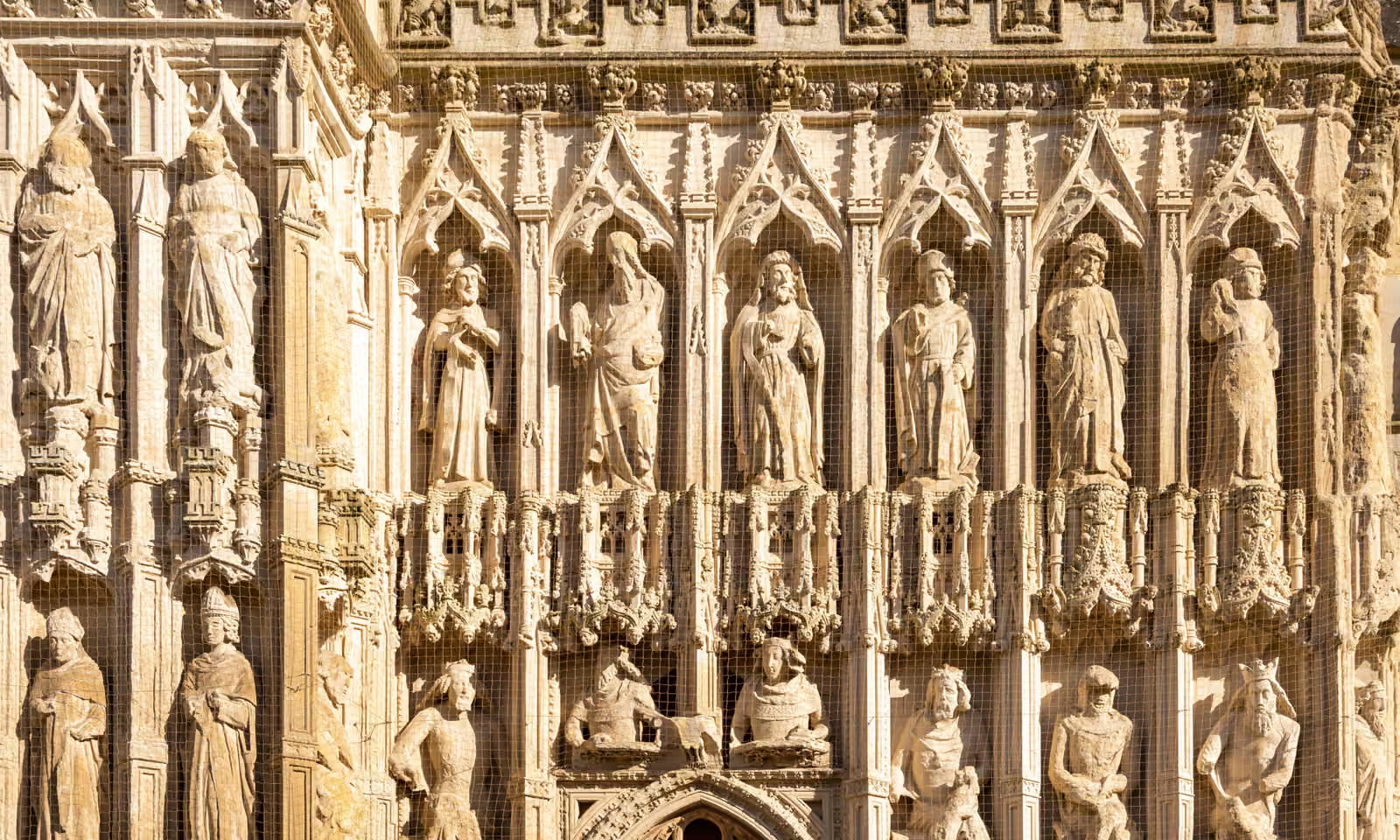
One critic wrote: “The aura of the Middle Ages surrounds John Angel. He almost seems to have stepped out of the medieval past, with the cloak of the later Michelangelo thrown over his shoulders.”
Indeed, his work at St. John the Divine conveys the aura of the Gothic while animating the figures after the manner of the Renaissance masters. Working within the severe limitations of the columnar setting, Angel endows each jamb figure with its own personality through a gesture, a facial expression, a tilt of the head, or a movement suggested by the folds of the drapery.
The North Porch
The portal’s tympanum depicts the Passion of Christ – the exemplar for all who answer the call to bear witness to the Christian faith with their blood.

The Crucifixion in the center has Mary and John at the foot of the cross. The cross is surrounded by a five-lobed frame, five being the number wounds in his hands, feet, and sides. Five is thus the symbol of Christ’s humanity in Christian number symbolism.
Within the porch are two doors that lead into the Cathedral. Above the doors, an entablature with a grapevine theme runs the breadth of the portal. The grapevine is likely an allusion to the passage in the Gospel of John that begins “I am the true vine, and my father is the vinedresser” (John 15:1-11). The vine may also suggest the wine of the Eucharist – the blood of Christ.
Above the entablature, there is a pediment above each door. High-relief sculptures relating to the Passion fill the two pediments.

“The Carrying of the Cross,” the left relief, conflates several of the Stations of the Cross. The fourteen stations are a Lenten liturgy in which worshippers ritually accompany Jesus on the road to Calvary, pausing for prayer at each station. Here, Angel appears to have followed a traditional form of the Stations of the Cross that merges the Biblical account of the Passion with later narratives.
In the center, we see Jesus sinking to his knees beneath the weight of the cross as two Roman soldiers look on impassively (Stations 3, 7, and 9). A woman behind him reaches out to him. She is likely his mother Mary (Station 4). Another woman kneels before him to wipe the sweat and blood from his face (Staion 6). She would be later known as St. Veronica.
In the right relief, Angel employs a pyramidal placement of the figures to fill the arched pediment. “The Judgment of Jesus” has Pontius Pilate, rather than Jesus, at the peak of the pyramid. Beneath Pilate’s feet, SPQR – a Latin acronym for “The Roman Senate and People” – reminds us that he is the governor of the Roman province of Judea.

Pilate is depicted as a weak, unprincipled man – hairless and emaciated with a cynical smirk on his thin lips. Intimidated by the angry mob, he vacillates and equivocates until finally appeasing Jesus’s enemies by releasing the criminal Barabbas.
To the left we see Barabbas grinning gleefully as the crowd howls for Jesus’s crucifixion. To the right we see Jesus with his hands bound behind his back, alone and abandoned, surrounded by the jeering rabble.
Elsewhere on the portal:
The gable above the porch bears an inscription along its edge: For God so loved the world that he gave his only begotten son that whosoever believeth in him shall not perish but have everlasting life (John 3:16).
An angel protrudes from the wall at each foot of the gable, where the slope meets the buttress. Jophiel, the archangel of Eden, is on the left, identifiable by the flaming sword that is his attribute. Raphael, the archangel of healing and pilgrimage, bears a chalice in one hand and a traveler’s staff in the other. Archangels emerge in the same locations in the other two portals.

Atop the gable, the archangel Michael stands with his sword and scales, casting a watchful eye on Amsterdam Avenue.
And since the Tower of St. Peter designed by Cram remains unbuilt, we must try to imagine it soaring above the portal to a height of 254 feet, more than twice the West Front’s current elevation.
St. Peter
John Angel’s jamb figure of St. Peter on the trumeau depicts the saint in the traditional manner – a mature but robust man with a beard, high forehead, and piercing gaze. Angel’s sculpture captures the qualities of the man we meet in the Gospels and the Acts of the Apostles: strongminded, outspoken, impulsive, and fiercely loyal to Jesus.

Simon Peter was a fisherman by trade along with his brother Andrew, also an apostle. He was married (Mark 1:29-31) and had a son named Mark, or so the First Epistle of Peter suggests (1 Peter 5:13). He was part of Jesus’s inner circle along with James and John. In the Acts of the Apostles, he emerges as a leader of the growing Christian community in Jerusalem, where we last see him before the narrative switches its focus to Paul. Peter’s journey to Rome and his martyrdom in that city are not in the Biblical account but are described in other credible sources and widely accepted as factual.

Left – Archives of the Episcopal Diocese of New York and Cathedral Church of St. John the Divine
Right – photo by Robert F. Rodriguez
The keys Peter holds in his hands are a reference to a well-known passage in the Gospel of Matthew where Jesus bestows a new name on the apostle, originally named Simon Bar-Jona (son of Jonah). Jesus renames him Kepha, or Cephas, meaning “rock” in Aramaic and translated as “petra” in the Greek New Testament, hence the name “Petros.” This occurs when Jesus asks Peter: “Who do you say that I am?” and Peter responds: “You are the Christ, the son of the living God.” Jesus then declares:
You are Peter and on this rock I will build my church, and the powers of death shall not prevail against it. And I will give you the keys of the kingdom of heaven, and whatever you bind on earth shall be bound in heaven, and whatever you loose on earth shall be loosed in heaven (Ma . 16:18-19).
The keys are universally understood as the attribute of St. Peter. They are also the symbol of the papacy, for Roman Catholics regard Peter as the first Bishop of Rome and thus the progenitor of the papacy.
The cock at Peter’s feet is a reference to his three denials of Jesus on the night that Jesus is arrested.
The story of Peter’s three denials is told in all four gospels, albeit slightly differently in each. After the Last Supper, Jesus and his disciples all walk together to the Mount of Olives. Upon arriving, Jesus tells them: “You will all fall away, for it is written, ‘I will strike the shepherd, and the sheep will be scattered.’” Peter responds: “Even though they all fall away, I will not.” To which Jesus answers: “Truly, I say to you, this very night, before the cock crows twice, you will deny me three times.” And Peter again: “If I must die with you, I will not deny you.” (Mark 14:26-31)
The pedestal demonstrates Angel’s genius for condensing a dramatic narrative into several key scenes.

On the left side of the pedestal, Jesus (not shown) has just been seized and bound. Peter, bravely but rashly, draws a sword and slices off the ear of a soldier as the apostle John attempts to restrain him. The incident is reported by all four gospels though only John’s account identifies Peter as the swordsman. In all accounts, Jesus rebukes Peter and, in Luke’s version, he miraculously reattaches the man’s ear.
As Jesus is taken away, Peter follows at a distance to the courtyard of the high priest’s palace, where he joins others warming themselves at a fire.
The center of the pedestal depicts Peter’s three denials, conflated into a single encounter. The young woman serving as the doorkeeper recognizes Peter’s face in the flickering fire and says, “This man was with him.” Peter denies it: “Woman, I do not know him.”

We see the woman point her finger accusingly at Peter. A curious detail: two eavesdroppers are listening in on the conversation, one behind the young woman, the other behind Peter. Their stealth suggests a sinister intent. Two more denials follow and the cock crows, as shown on the pedestal:
While he was still speaking, the cock crowed. And the Lord turned and looked at Peter. And Peter remembered the word of the Lord, how he had said to him, “Before the cock crows today, you will deny
me three times.” And he went out and wept bitterly. (Luke 22:60-62)

The scene on the right side of the pedestal depicts an encounter between Jesus and Peter that takes place after the resurrection. Peter stands with downcast eyes and his hands folded over his heart-gestures of penitence. Jesus gently places his left hand on Peter’s shoulder. A lamb stands between them and, in a charming detail, nuzzles Jesus’s right hand. They are engaged in the following conversation (John 21:15-19):
Jesus asks Peter: “Simon, son of John, do you love me?” Peter answers: “Yes, Lord, you know that I love you.” Jesus responds: “Feed my lambs.” The same exchange is repeated twice more, with minor changes of wording. Jesus’s three questions reflect Peter’s three denials, and Peter’s answers affirm his devotion to Jesus and erase the stain of his momentary weakness.
The imperative to feed Jesus’s flock recalls another passage in John’s Gospel where Jesus says: “I am the good shepherd. The good shepherd lays down his life for the sheep” (John 10:11). With the command to feed his sheep, Jesus, as he concludes his earthly ministry, is passing his shepherd’s staff to Peter. But he is also imposing the obligation for Peter to lay down his life for the sheep, as the next passage makes clear:
When you are old, you will stretch out your hands, and another will gird you and carry you where you do not wish to go. (This he said to show by what death he was to glorify God.) And after this, he said to him, Follow me. (John 21:18-19)
“Follow me” can be understood two ways. Follow me as the shepherd of my flock, the nascent Christian community. And follow me even unto death by martyrdom.
The phrase “you will stretch out your hands” refers to crucifixion. A longstanding though non-Biblical tradition holds that Peter was crucified in the Circus of Nero during that emperor’s persecution of Christians in the year 64. The Roman historian Tacitus confirms that Nero did in fact persecute Christians in 64 and with extreme cruelty:
Covered with the skins of beasts, they [Christians] were torn by dogs and perished, or were nailed to crosses, or were doomed to the flames and burnt, to serve as a nightly illumination, when daylight had expired. (Tacitus, Annals 15.44).
Peter was buried in a necropolis on the hill the Romans called Vaticanus Mons. In the second century, a shrine was built over the gravesite. In the fourth century, the Emperor Constantine erected a large basilica on the site, placing the altar directly over the shrine. In the 16th century, Constantine’s basilica was demolished to make way for the current St. Peter’s Basilica, whose high altar stands in the same place as its predecessor.

Photo Nate Bergin via Wikimedia Commons
In the mid-20th century, excavations of the ancient necropolis were conducted deep beneath the basilica’s foundations. They uncovered a grave near a wall with graffiti reading petros eni (“Peter is here”). This and other evidence persuaded the 262nd pope, Paul VI, to authenticate it as the grave of the first. It can be visited by those intrepid enough to take the Basilica’s Scavi tour of the excavations.
St. Peter appears in stone or glass in at least a dozen other locations at the Cathedral. Particularly noteworthy are:
The clerestory window of the Missionary Bay on the south side of the nave. Wilbur Burnham’s magnificent window depicts Peter with an inverted cross, recalling the legend that Peter asked to be
crucified upside-down because he considered himself unworthy to die in the same manner as his Lord. The story first appeared in the apocryphal Acts of Peter (c. 200), whose account adds that he preached a lengthy sermon while in this inconvenient position.
Two sculptures by Gutzon Borglum: one in St. Saviour’s Chapel in a niche on the upper north wall, the other at the extreme east end of the exterior of the apse below the roofline, where red-tailed hawks have built a nest on the canopy just above Peter.
The next installment in this series will cover the four jamb figures on the portal’s north side.
■
Sources:
- Cathedral Archives, Minutes of the Iconography Committee, 1925-27
- Farmer, David Hugh. The Oxford Dictionary of Saints (New York: Oxford University Press, 1982)
- Morciano, Maria Silvia, “A Striking Discovery,” L’Osservatore Romano, June28, 2024
- Walsh, Michael, ed. Butler’s Lives of the Saints (New York: HarperCollins, 1991)
- Watson Ernest W. “John Angel: America’s Cathedral Sculptor,” American Artist, September, 1953.