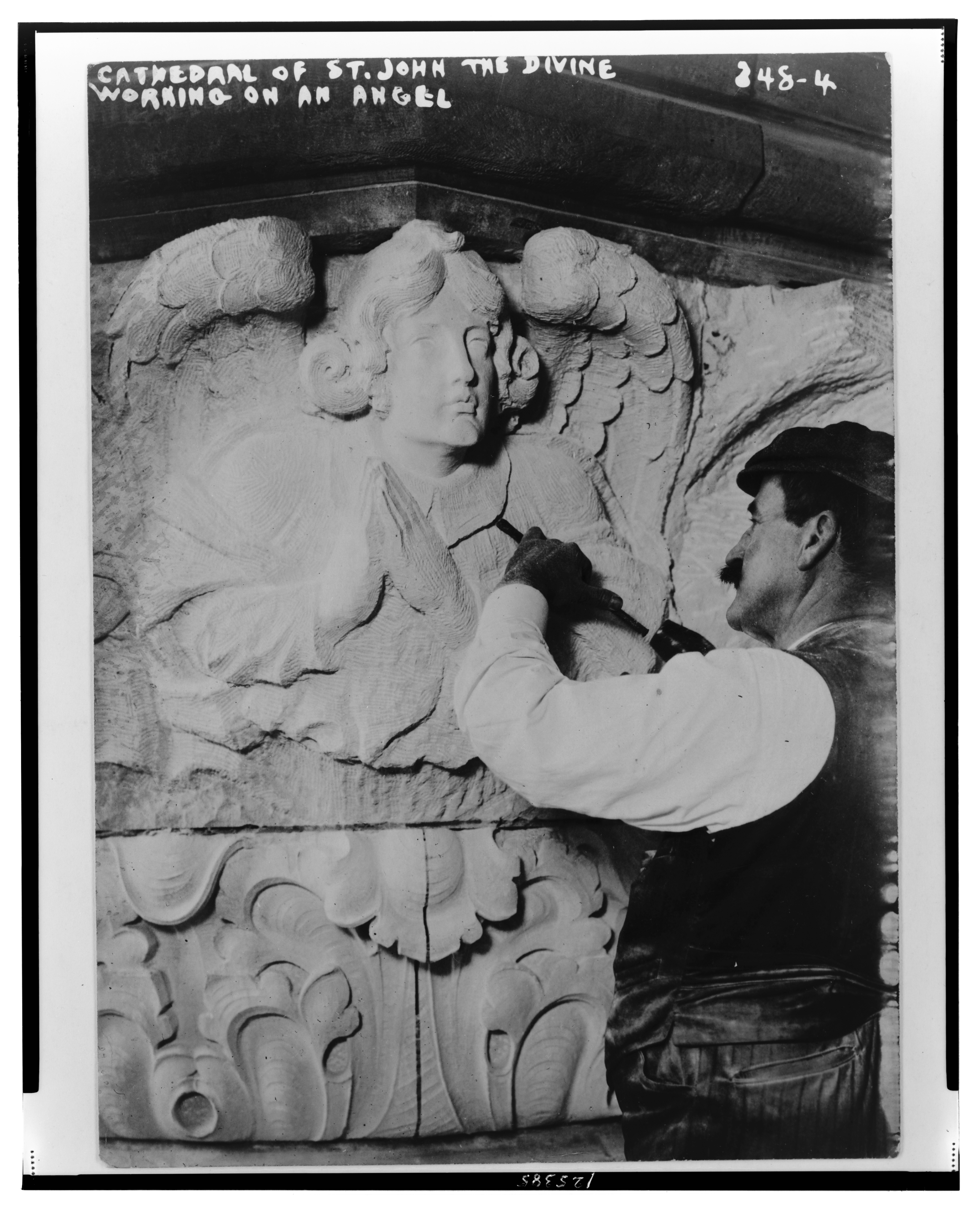
Clamanzio Celestino Ardolino carving a capital for the monumental column in the Chancel in situ. – 1909 photo, Bain News Service
Once the eight monumental columns were in place. The Cathedral rose around them. Atop these columns came the addition of Pierre de Lens limestone capitals. From these capitals, sprung roman arches for the Chancel dome. Then, the carving of the Chancel capitals commenced.
Octagonal capitals were first sculpted in clay by a Mr. Post representing singing angels. This may have been George Browne Post, a prominent New York City architect. He was know for his decorative designs.
Clay model between uncarved capital stones
The carving took place after the capitals were in place. For reference, the carvers had the clay model with them.
Clamanzio Celestino Ardolino is believed to be the man in the famous opening image of this article carving the Chancel capitals. He and his brother Ermalindo Eduardo Ardolino along with their first cousins Rafael and Domenico did a lot of carving at the Cathedral. There will be more about the Ardolino’s in a later post.
Finished Carvings
■
Images of capitals from the New York Public Library, Digital Collections
Image of Clamanzio Celestino Ardolino from The Genealogy of Torre le Nocelle, Italy: The Ardolino Brothers – Working on an Angel.
In early Gothic churches, the fundamental idea of the apse with radiating chapels was Christ in the company of His Saints. The Seven Chapels of the Tongues represent the languages and nationalities most represented in New York City at the turn of the 20th Century. At that time, the majority of the population spoke a language other than English. Furthermore, Ellis Island became the federal immigration station in the United States the same year as the cornerstone was laid, 1892.
Subscriber Funded
Donor subscription and specific donations will fund the construction. The donors could choose their own architect for their chapel. Each chapel has a different style and ornamentation both in the exteriors and the interiors. If they were freestanding anywhere in the country, they would be on the must see list. Begin with a walk around the exteriors and then take in the interiors along the ambulatory. It will be a walk through several centuries of architecture and a trip through several countries and cultures.
The Chapel of St. Saviour, known also by the name The Belmont Chapel. Rectangular plan, cross on gable, statues in niches of buttresses.
The first of the chapels to begin construction was the Chapel of St. Saviour. The chapel is dedicated to the Eastern Orthodox population. The image above shows the completed chapel in 1905. The great eastern arch is complete as well as seven of the eight monumental columns. Construction could move independently of the main Cathedral. St. Saviour Chapel was the gift of August Belmont II. Heins & LaFarge designed this first chapel.
New York Times, May 26, 1900
Frontenac limestone for the exterior of the chapel
The interior walls are of Minnesota dolomite; around their base runs a foundation stratum of red jasper with green serpentine molding.
Chapel of St. Columba
Heins & Lafarge also designed the second of the apsidal chapels. Mary Augusta King donated the funds for the Chapel of St. Columba. The style is Norman/Romanesque with decorated cylindrical pillars that evoke Durham Cathedral. The peoples of the British Isles are the focus of the chapel.
St. Columba (King Chapel) Interior Construction
The interior walls are of Minnesota dolomite separated from a base course of Mohegan Golden granite by a molding of yellow Verona marble. The pavement is a fine-grained gray stone from Illinois.
Statues in the first two chapels
Image by Wayne Pearson
The images above are some of the many carvings or models of statues in these first two chapels. They are shown together because of the common team that worked on these two. The architects were Heins & LaFarge. The sculptor was Gutzon Borglum. The carvers were all with Barr, Thaw & Fraser. We don’t often get the names of the carvers from over a hundred years ago. Happily, the April 1911 issue of The New York Architect lists the names of the carvers who worked on these statues.
Charles Jensen
J.G.H. Hamilton
C. Price
W.T. Scott
L. Lentelli
O. Burdett
We are grateful to know the carvers names and wish we knew of more individuals who worked on the great Cathedral.
In the years to follow these two, five more chapels will be built. Divine Stone will highlight those in a future blog.
■
New York Public Library, Digital Collections for the photos
The Guide to the Cathedral Church of St. John the Divine in the City of New York, Edward Hagaman Hall, Ninth Edition, 1928
Morningside Heights: A History of its Architecture and Development, Andrew S. Dolkart
The Living Cathedral, A History and Guide, Howard E. Quirk
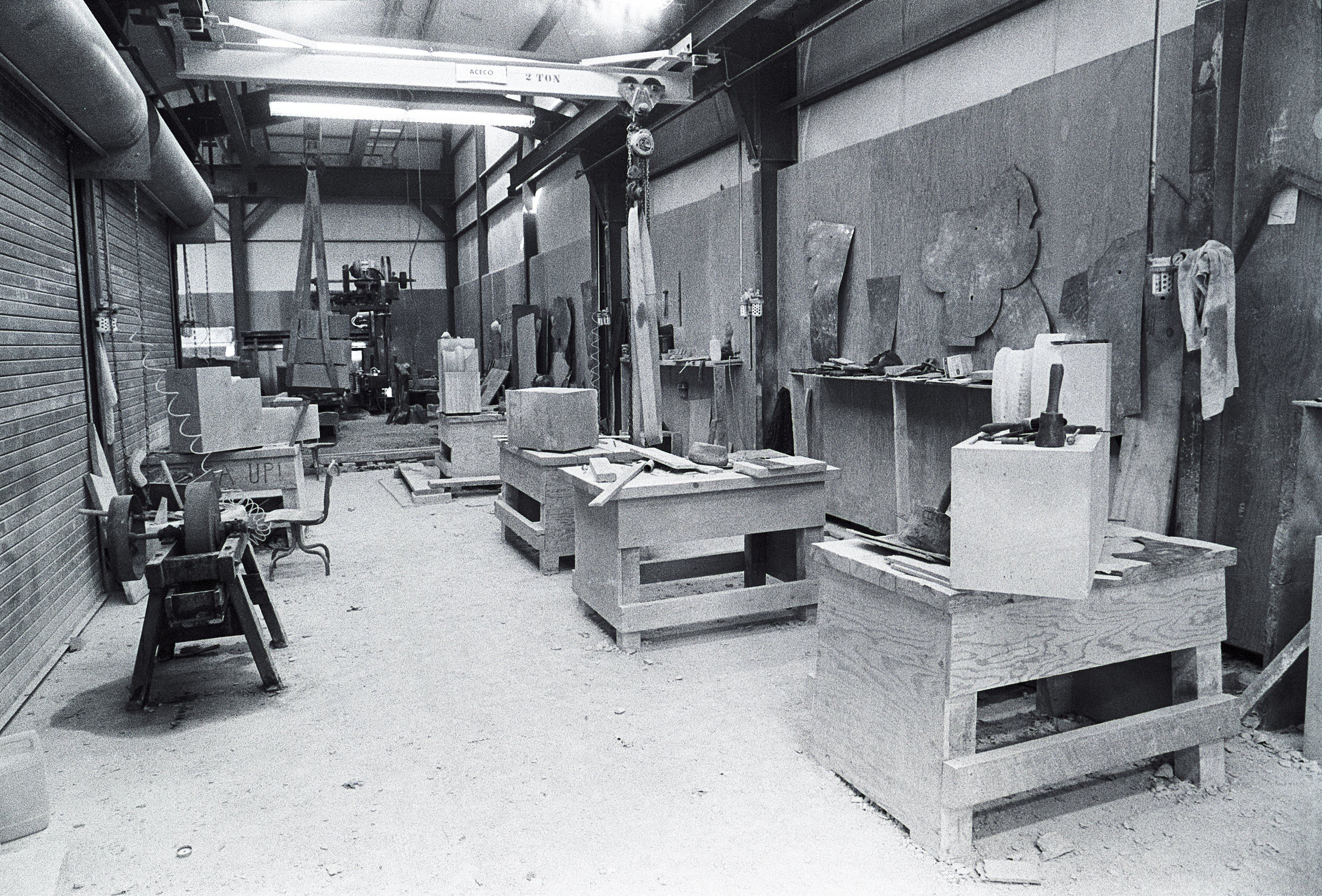
View of bankers in the cutting side of the stoneyard shed on Oct. 24, 1980. On the wall hang a number of zinc templates. Photo – Robert F. Rodriguez
A banker is a bench of timber or stone on which stone is worked. A banker mason carves or cuts the stone using drawings and templates into finished products for installation into buildings. The term “banker”, meaning bench, is Germanic but came into English via Late Latin bancus via Norman French baunk. This means bench, but because the bench is where money handlers sat in the market, bank also came to mean the house of financial transactions in French, Spanish (banco) and Italian. The old bankers above live on repurposed in a new setting.
Granite Sett Makers Bankers, Dartmoor, UK – 1850’s
The bankers above are stone, in this case, a crude work bench for dressing granite for paving setts. It was cheaper to finish the stone on the moor and then cart away the finished product to its destination. Apparently human labor was cheaper than the cost of horse transporting the raw material to a finishing shed.
The Cathedral Stone Cutters
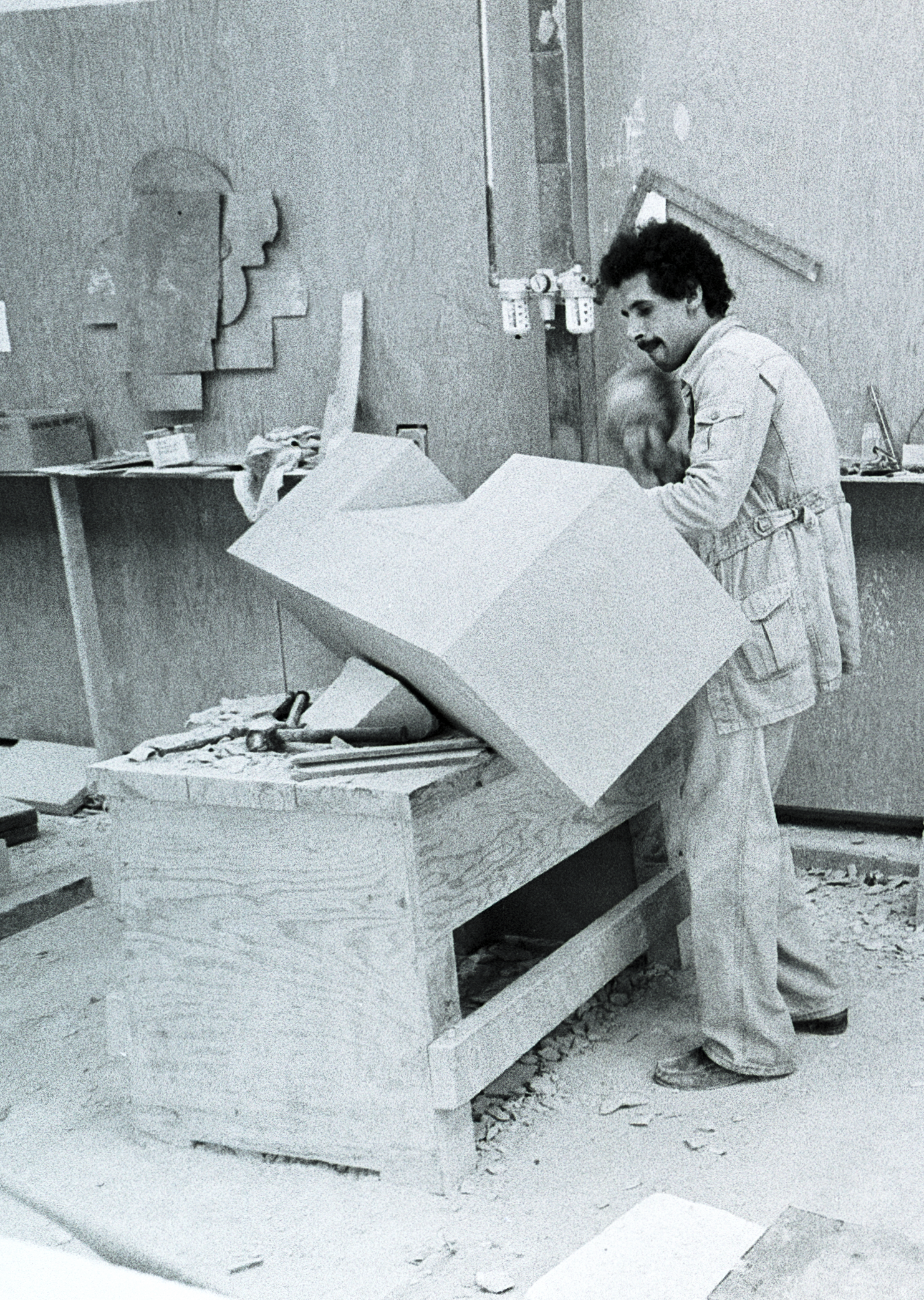
Nils Poole works on a sill skeleton bed mould in the stonecutting shed on Oct. 3, 1980. Photo – Robert F. Rodriguez
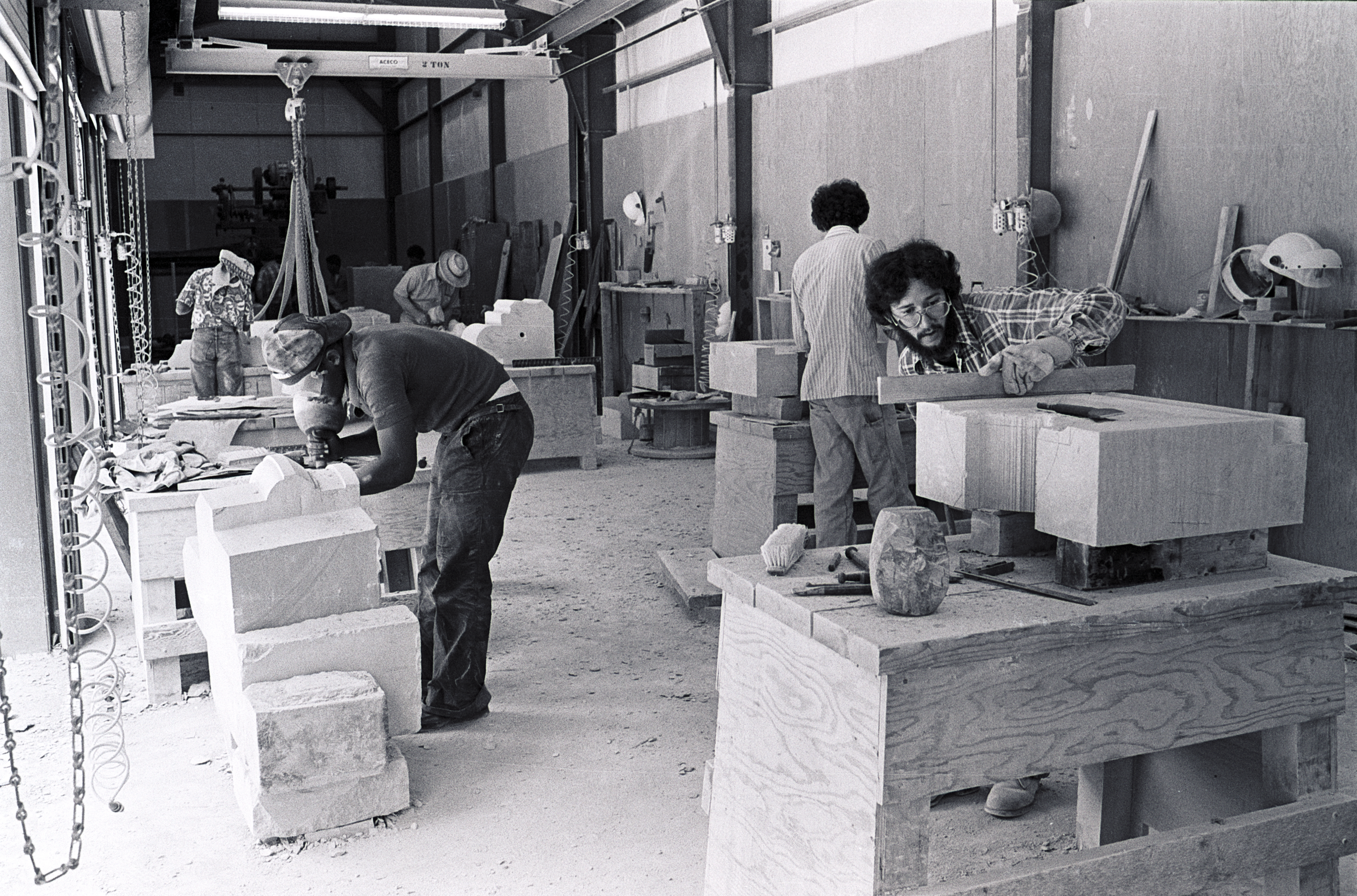
View of the stonecutting area, photographed July 2, 1980. Front left, James Jamerson and D’Ellis “Jeep” Kincannon, front right. Behind them, backs to camera are Arlene “Poni” Baptiste and Nils Poole. In the background is Tim Smith. Photo – Robert F. Rodriguez
Several of these bankers are continuing to serve stone carvers today, 2022. They are used for the Pellittieri Stone Carving Academy, a 501(c)(3) organization They are in the Bronx studio of Chris Pellittieri. When Chris Pellettieri attended the Cathedral School in the late 1970’s, the Cathedral’s then Dean, Reverend James Morton, had begun a campaign to resume construction on the Cathedral building. This renewal of building activity – along with a childhood spent in and around the Cathedral – had kindled a longing in Chris to become a Cathedral builder.
Chris Pellettieri – Apprentice to Stone Carver
After graduating Stuyvesant High School and NYU he returned to the Cathedral and became an apprentice stone carver. After the stone yard closed in 1994, Chris stayed on as a Cathedral Artist in Residence. Chris worked in the shed that had been vacated by the stone program and naturally used the bankers since they were there. When he had to leave, he took one with him and stored two others in the Crypt. These three and three he recently built are used for the Academy’s programs.
forty plus year old banker meets new carver, old bankers live on. – Photo – Robert F. Rodriguez
The Stone Carving Academy
Chris is conducting a two week long workshop for High School students in collaboration between the NYCDoE and his organization. He teaches them to carve a monogram all using the same size piece of limestone. The first day they learn to flatten the stone surface.
Monograms carved by Pellittieri Stone Carvers’ Academy students. – Photo Robert F. Rodriguez
After the monograms, the students were taught to carve a bas-relief portrait.
Chris is instructing a student in the initial stages of the bas relief. – Photo Robert F. Rodriguez
One student’s monogram and bas-relief portrait from the workshop. Photo – Robert F. Rodriguez
Cathedral carvings by Chris Pellittieri in previous Divine Stone blogs Here and Here
More about the Pellittieri Stone Carvers’ Academy Here
The Cathedral School, Alumni News
Thanks to Robert Rodriguez for spotting the story of the bankers.
Tom Murphy at the Cathedral of St. John the Divine – New York Times, March 14, 1983 – Photo Marilynn K. Yee
Liverpool Cathedral appointed Thomas Gerald Murphy chief carver in 1935. In 1904, the year Tom Murphy was born, King Edward VII laid the Foundation Stone for the Liverpool Cathedral. At the official completion in 1978, he had spent 44 years working on the Cathedral. He continued carving for several years as there was always one more detail. Tom Murphy, Master Stone Carver received the honor of Member of the British Empire from Queen Elizabeth on June 26, 1979.
Murphy apprenticed to the firm of Earp, Hobbs & Miller, a highly successful firm of architectural sculptors and stone carvers, from 1919 to 1927, and qualified at Manchester School of Art in 1927. He began work with the firm of H.H. Martyn and worked on the Palace of Westminster between 1928 and 1930. Murphy later assisted with the carving of the Queensway Tunnel Entrance in Liverpool and the Gladstone Dock Development before coming to the Liverpool Cathedral.
The Master Builder Calls For a Carver
Murphy and St. John’s master builder Jim Bambridge spoke often on the phone and corresponded. Bambridge persuaded Tom to come to the Cathedral for two weeks in 1983. He made models and sketches for future carvers. At the time, 3,300 blocks of limestone were cut and finished in 4 years of work. However, there were no carvers. A Gothic cathedral needs carvers. At 79 years old, Murphy had one last carving to finish on the west front in Liverpool, but Jim Bambridge was an old friend and he had some curiosity about St. John’s.
Usually, Tom Murphy, Master Stone Carver worked from a drawing that he or someone else has made. He marked the stone with a compass or pencil to outline proportions. The markings were not intricate, there must be room for inspiration.
There’s a lot more to carving than just cutting stone. If you can’t see it in the block, you might as well go home.
– Tom Murphy
As he did his carvings, he also assessed the work of an apprentice. This apprentice will probably be sent to England to study stone-carving. “It is time,” Bambridge said “to get the new generation started.”
An Apprentice’s Memory
Joseph Kincannon remembers Tom’s brief stay after almost 40 years. “He was the sweetest guy ever. A real craftsman. Typical of carvers, he only used hammers. I remember this seeming strange, as we mostly used mallets which is more of a banker mason’s tool. His accuracy throwing that hammer was noticed, and admired by all. He knocked out a couple crocketts. He worked stone effortlessly, always by hand.”
Tom Murphy carving at the Cathedral of St. John the Divine. Photo: Cathedral Archives
Nicholas Fairplay with his finished work. Photo by Robert F. Rodriguez
Master Builder James Bambridge had in mind to erect the pinnacle on the West Front simultaneous to the Southwest Tower. Based on the Cram designs, this would include the 9 1/2 foot statue of Elijah. On the same level and towards the Northwest Tower would be the same size statue of Moses. Fairplay’s Elijah was carved to meet these designs.
West Front design by Ralph Adams Cram – Circle indicates the statue of Elijah.
Around late 1985, while Nick Fairplay taught carving to the apprentices in the stoneyard, he began carving the statue of Elijah. The process started with a full size model.
Nicholas Fairplay adds clay to the armature of his model on Dec. 12, 1985 that will serve as his guide for his giant Elijah statue. He will carve the nine-and-one-half-foot Elijah from a three-ton block of limestone. – Photo and Caption Robert F. Rodriguez
The stone yard received truckloads of rough quarried blocks from the Indiana quarry. A dimensional block sized for the statue would have been a custom order. Fairplay made due with what was in the yard and that required the statue to be made of two pieces. The head and shoulders are a separate piece of limestone.
View of raw limestone blocks stacked and waiting to be cut, April 13, 1981. The lower stone, third from the right, bears the destination – St. John – written in crayon on the side. – Photo and Caption Robert F. Rodriguez
Nicholas Fairplay rough cuts his three-ton block of limestone on March 19, 1986 from which will emerge his a nine-and-one-half-foot Elijah. – Photo and Caption Robert F. Rodriguez
Perspective and Foreshortening
In his previous training and work on churches in England, Nick had observed the uniqueness of statues that were very high up on the structures. He also found examples inside the Houses of Parliament when he worked on restoration there. Enlarged, often bizarre shaped heads, were made so that the viewer from far below got a normal vision of the piece.
The head of Fairplay’s Elijah would be at an elevation of 250 feet above the bottom of the Cathedral. The best view would be across Amsterdam Avenue and down a bit on 110th Street. Medieval carvers would angle the piece on a hinged contraption, getting the correct degree to correspond with the angle of the most likely view of the person on the ground or floor. The drapery as well will appear flared out from the viewers perspective. Nick placed his stone at a 60 degree angle to get this perspective correct. The statue is a stylized sculpture meant for the viewer on the street.
Nicholas Fairplay works on the folds of his carving of the prophet Elijah on June 2, 1986. Fairplay works on a three-ton block of limestone that will turn into a nine-and-one-half-foot Elijah. To the right is his full-size clay model. Photo and Caption by Robert F. Rodriguez
The face of Elijah begins to emerge as Nicholas Fairplay chisels out folds in the robe of the prophet on June 2, 1986. – Photo and Caption by Robert F. Rodriguez
Nicholas Fairplay works on his nearly completed Elijah on Sept. 10, 1986. He started with a three-ton block of limestone to carve the nine-and-one-half-foot statue. – Photo and Caption Robert F. Rodriguez
Fairplay’s Elijah
Fairplay studied 14th Century sculptures to arrive at his likeness for Elijah. Unlike many of his predecessors at the Cathedral, he created the sculpture and then carved the likeness in stone by himself, by hand. He used a pointing machine to translate the detail of the model to the stone. Climbing up to work on the upper portion, then back down to find another tool, or shifting to the other side added many hours to the carving of this large statue.
Nick Encounters Master Carver Palumbo
Nick told us a story about when John Walsh took the whole stone yard to visit and tour the National Cathedral in Washington, D.C. He found himself in the office of Vincenzo Palumbo, Master Stone Carver, talking about statues. Mr. Palumbo referred to a statue he had carved and was proud to say that he transferred 4,000 points from the model. He asked Nick how many points he used for Elijah. Nick responded that he used 100 points. Mr. Palumbo told him to “get out, and don’t come back”.
Nicholas Fairplay, “Elijah” and Dean Morton
Elijah Not Seen
Due to a change in focus, the pinnacle and tympanum were not built. There was no niche for Elijah. At first, The statue was on view near the Narthex. After some time, Elijah disappeared . We began asking around about the whereabouts of the statue, very few remembered it. Robert Rodriguez remembered Chris Pellettieri pointing at something in the crypt recently and saying “that’s Nick’s statue”. Robert had Chris take him back to the spot so he could document Elijah’s existence.
Elijah – Torso and legs in a crate in the Crypt – Image Robert F. Rodriguez
Elijah – Head and Shoulders, blanket wrapped in the Crypt – Image Robert F. Rodriguez
We are glad this unique carving has been stored and preserved. Hopefully one day the world will see Fairplay’s Elijah in his intended destination.
■
We are grateful to Robert Rodriguez for documenting the creation of Elijah some 36 years ago and his present day location.
Thanks to Chris Pellettieri for remembering where Elijah is resting.