Categories
Profiles in Stone

“Jeep” Kincannon

"Jeep" Kincannon
Jeep Kincannon Carving a Grotesque – Photo Robert F Rodriguez

(This is an encore post following Robert F. Rodriguez’ article on the Kincannon brothers. – The original post appeared December 22, 2021 and was written by Joseph Kincannon.-RM)

Jeep, or rather D’Ellis Kincannon, started his apprenticeship in the stoneyard in 1980 after working in the Cathedral mail room for a year. He came to NYC to go to art school, but found it wasn’t for him. When the stone yard program started up it seemed a perfect fit, and it was.

He excelled as a banker mason. I think it’s fair to say that he and Jose (Tapia) were the top stone cutters. The Cathedral showcased their work for fundraising purposes. They were featured in multiple magazines and news publications.

Dean Morton reminisces about the Stoneyard
Dean James Parks Morton reminiscing about the stunning pinnacle carved by D’Ellis Kincannon during a video inerview on Nov. 19, 2015 at the Interchurch Center in New York City. – Image Robert F. Rodriguez

The Banker Mason

Jeep was also one of the first few to apprentice under Chris Hannaway. He had the highest regard for Chris and was disappointed to see him return to England. He often made reference to Chris’ mastery in banker masonry and anything stone related. Jeep’s prize possession was an old mallet that Chris had given him from his early days in Liverpool.

"Jeep" Kincannon
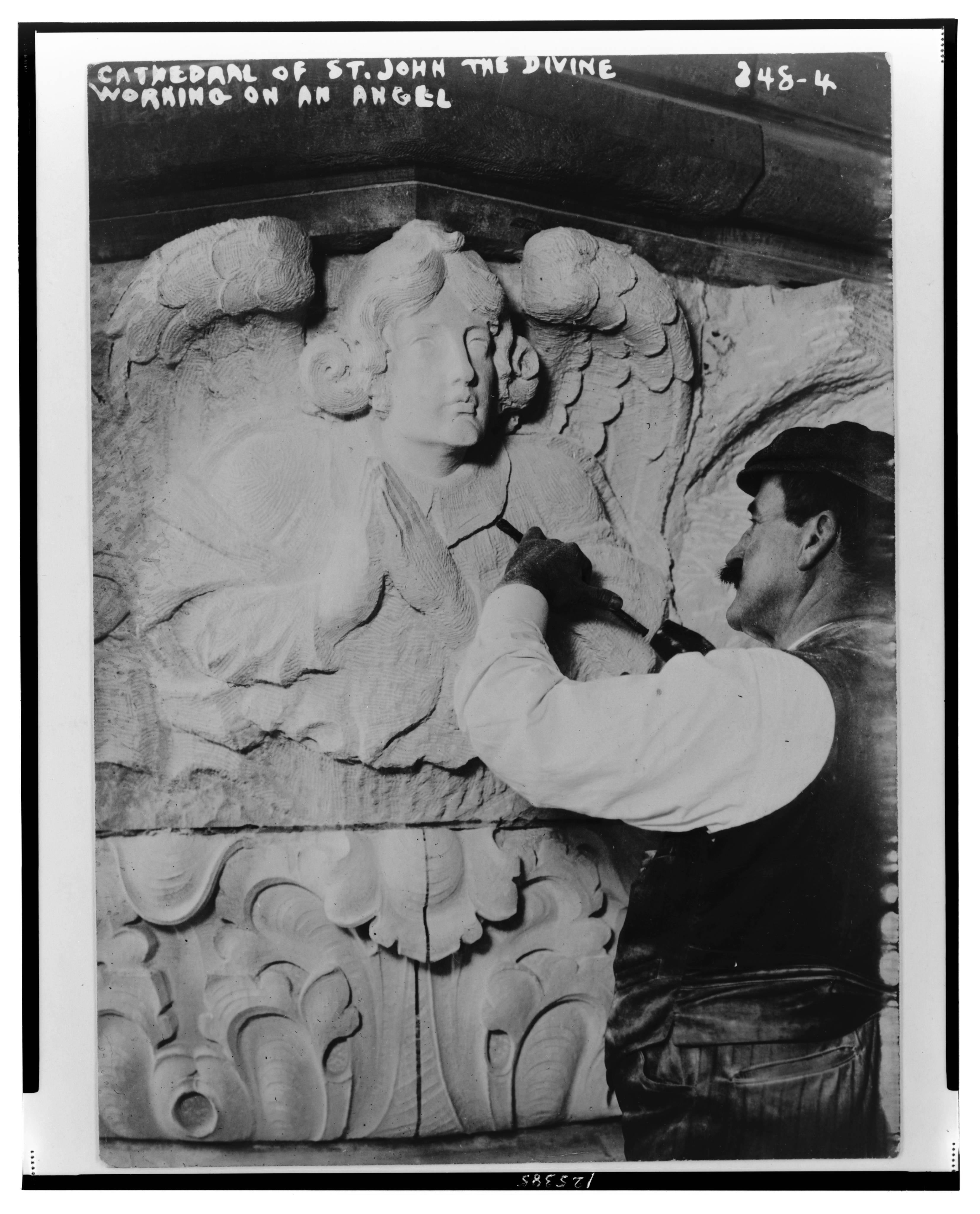
D’Ellis “Jeep” Kincannon carves a sill skeleton bed mould base on April 13, 1981 – Photo Robert F. Rodriguez
Chris Hannaway's Mallet
Jeep Kincannon’s mallet, from Chris Hannaway -Photo Joseph Kincannon

Master Builder James Bambridge was impressed enough with D’Ellis’ work to once state that “his masonry is as perfect as if it had been poured into a mold”. It was obvious that this discipline was one that Jeep immediately embraced. He also had a gift for drafting and setting out. He was a natural at perceiving 3-dimensional intersections.

"Jeep" Kincannon
Jeep’s Pinnacle Carving, Image – Robert F. Rodriguez

To advance Jeep’s skills even further, the Cathedral sent him to the Bath School for Architectural Trades in England. This was very rewarding for Jeep as he completely immersed himself in the trade. Aside from the school, he was taken aback at finding himself in a city that the Romans had built, in part. He was also astounded that one of the local pubs had been in operation since the “Black Death”. This place became a regular haunt for Jeep and many of the other students.

After a year, Jeep returned to NYC and continued working as a banker mason. By this time, Alan Bird had replaced Chris Hannaway and the yard was humming along. Later Jeep advanced into the setting-out shop with fellow apprentice, Cynie Linton. He had real misgivings about leaving banker masonry. I remember him grumbling despite the promotion.

The Setting-Out Shop

Jeep and Cynie worked directly with James Bambridge transferring the original architect’s drawings into full-scale tower drawings that would later be numbered and patterned into various zinc templates for the banker masons’ shop. The masons used to laugh when he would step in to help an apprentice understand the complex templates. “Uh oh, Jeep’s got that look on his face!” This is not a look you wanted to see, as it usually meant an irretrievable mistake had been made in the stone work. If you had trouble understanding the templates he and Cynie were the ones to see.

"Jeep" Kincannon
Jeep Kincannon Setting-out templates for an Ornate Gablet. Image Smithsonian Magazine

As things slowed down in the setting-out shop, a new opportunity arose; a competition for the new carving apprenticeship under the tutelage of Nick Fairplay. Jeep scored in the top five. He served his three years and was later appointed as head carver. During this period, he contributed many celebrated carvings to the tower. Jeep continued on in that position for a year until he was positioned as the head of the drafting and setting-out department.

As Chief Draftsman, Jeep also worked on the tower with Master Mason Steve Boyle, for whom he had the greatest respect. Boyle was not one to embrace the limelight and Jeep ofter commented on how he was the unsung hero who quietly puzzled together the massive stones on the tower, a truly monumental task.

Working on the Tower

"Jeep" Kincannon with Angel Escobar
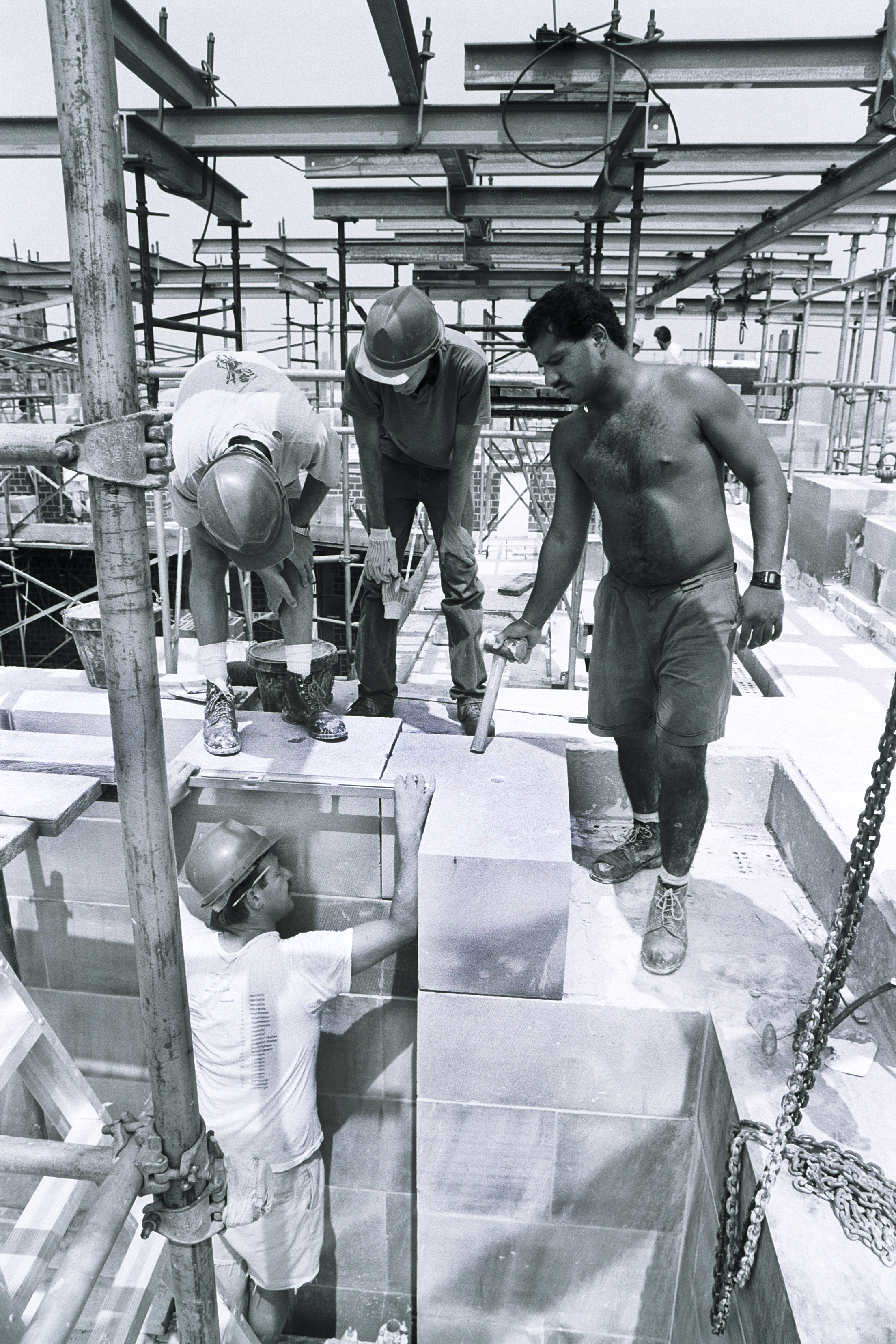
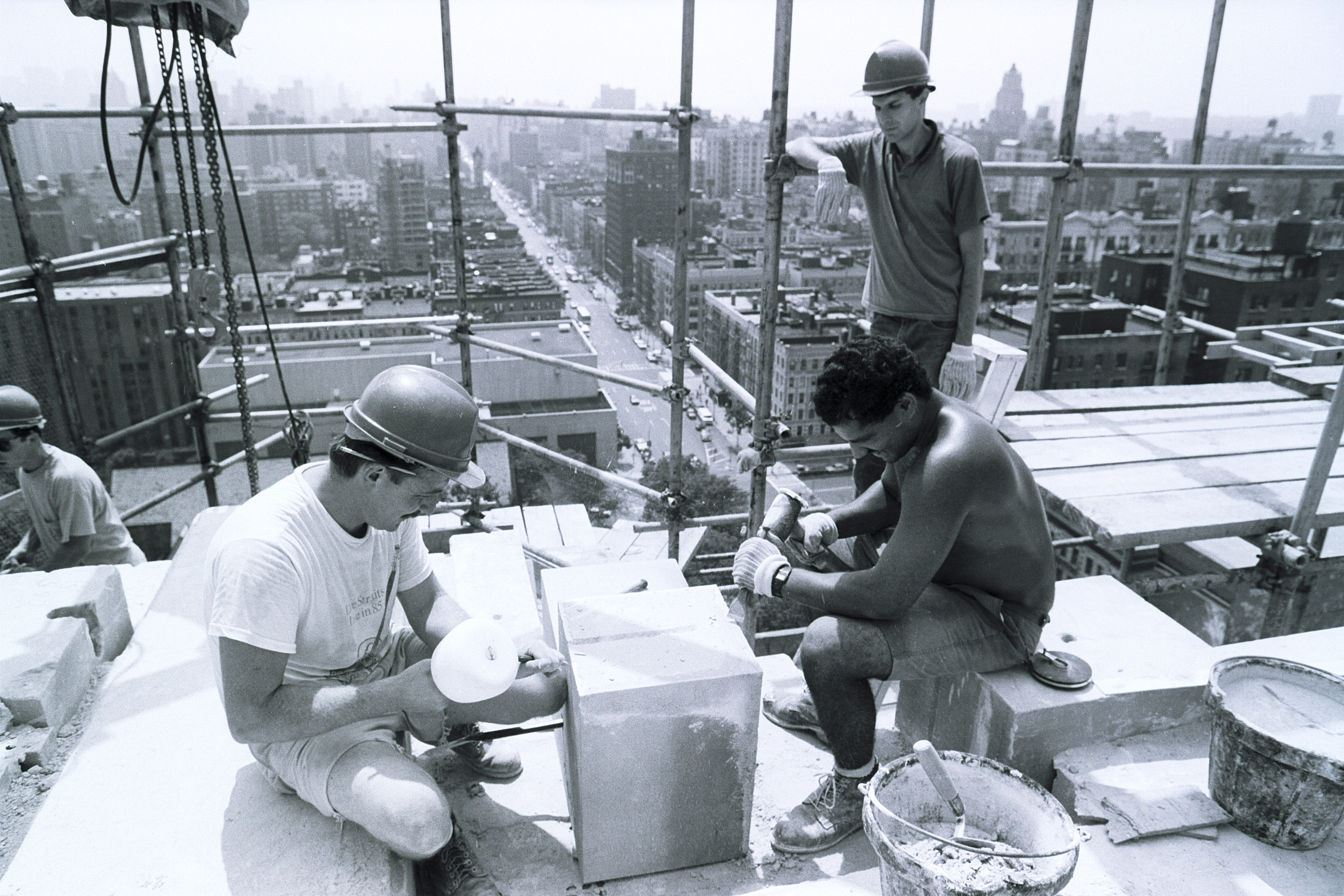
Jeep Kincannon with Angel Escobar up on the Southwest Tower. – Photo courtesy Joseph Kincannon

Steve relayed a story about how instrumental Jeep was in the setting of the first course of stonework:

“It should be mentioned that Jeep deserves credit for the tower actually fitting on the building. Delays in scaffold erection meant that the first stones that we laid were rather hurriedly positioned. The deadline for the installation of the Jerusalem Stone rapidly approached. The setting of this historic cornerstone included a well-publicized ceremony featuring high wire aerialist, Philippe Petit delivering a silver trowel to the Bishop of New York for the official blessing. Since the scaffolding was only partially in place, it hadn’t been possible to lay out all of the building lines as planned before Bambridge had to return to the UK.

This was alarming to me at the time as it meant this task might fall to me. Sure enough, as we began to set more stone it was clear that the first stones had been set too far over to the North resulting in the new stone overhanging by about a half inch. I called Bambridge in the U.K. and he told me I would have to do the setting out. He understood my uneasiness, but told me I could always rely on Jeep for help with this and he was right. Jeep had a thorough understanding of the whole project by this time and knew exactly what to do. Great thanks to him; everything ended up where it was supposed to be”

-Master Mason Stephen Boyle

Cathedral Stoneworks

In 1989, he stepped away from drafting to join the carving team working on the West Front. Work on the Central Portal statuary had recently resumed under the direction of Simon Verity. For Jeep, the carving ended too soon. The Jewish Museum awarded a major contract to the stoneyard. It was an early 20th Century Gothic Revival building on 5th Avenue. The drafting department was about to become a very busy place.

This was the beginning of a new era. A commercial venture was underway with the goal of replenishing the depleted Cathedral coffers by taking on independent projects. It was a good effort, but the partnership with Cathedral Stoneworks ultimately marked the end of the tower project and any dream of completing the Cathedral. Jeep continued working as Chief Draftsman until he left in 1993.

He Wore Many Hats

He was one of the few who wore most of the hats available in the Cathedral stone yard. Those hats included sawyer, estimator, banker mason, setting-out, stone carver and fixer mason (on the tower). He would laugh and say that the only job he didn’t do was to run the planer. That position belonged to Nelson Otero, and to only Nelson Otero.

D’Ellis often expressed his admiration for other modest people who produced great stone work for the tower. He often referred to Yves Pierre and Angel Escobar. He once said that “The very first time Angel picked up a chisel, he knew what to do with it. And, it was a little unnerving.” These guys were natural stone cutters, but not inclined to talk in front of the T.V. cameras.

Beyond the Cathedral, he would spend the next eight years teaching, designing, cutting and carving stone on large public and private projects with Kincannon Studios in Texas until his death in 2001. I can say that throughout this period, as busy as we were, he was ready to drop everything and return to NYC if the team reunited to finish the tower. There’s no doubt about that.

Jeep Kincannon
Dragon by D’Ellis Kincannon – Photo by Robert F. Rodriguez

โ– 

  • The author of this post, Joseph Kincannon, is the younger brother of D’Ellis “Jeep” Kincannon. Joseph is a teacher and architectural sculptor. Professor Kincannon is the Chair of Stone Carving at the American College of Building Arts.
Categories
Divine Stone

Recent Comments of Note

1 reply on โ€œMore John Angel Videosโ€

Tom Fedoreksays:โ€ข Edit

I may be able to shed some light here. 

As for the relief sculptures in video 1, the first one depicts Christ before Pilate (the bald guy). It is in the north portal. The Nativity shown in the film is more elaborate than the one Angel did for the south portal. It may be an earlier version of it, or perhaps a piece he did for a different project altogether.

The figure above St Lawrence seen in the video 2 is the sibyl Cimmeria. Sibyls were oracles, priestesses of Apollo who prophesied at holy sites around the ancient Greek-speaking world. Some of their prophecies were preserved and gathered into books. Christian scholars who studied the Sibylline Books during the revival of classical antiquity in the Renaissance imagined they had discovered prophecies of the New Testament in these pre-Christian writings, just as they found foreshadowings of the New Testament in the writings of the Hebrew prophets. Sibyls appear in Renaissance art, often accompanying the Hebrew prophets, most famously in Michelangeloโ€™s frescoes for the Sistine Chapel.

Recent Comments of Note
Sybil Cimmeria with Horn

The upper rank of the north portal depicts eight of the twelve sibyls, identified below by their names and attributes and listed in order beginning with the panel above St Thomas Becket and proceeding clockwise to the panel above St Denis:

Cumaea (sponge) โ€“ Jesus given a sponge filled with vinegar while on the cross
Europa (sword) โ€“ Herodโ€™s slaughter of the innocents
Agrippa (scourge) โ€“ the scourging of Jesus by Roman soldiers
Libyica (torch) โ€“ Christ the light of the world
Cimmeria (horn) โ€“ Jesus nursed by Mary (the horn was the baby bottle of the ancient world)
Hellespontica (cross) โ€“ the crucifixion
Phrygia (banner) โ€“ the resurrection
Persica (dragon) โ€“ Christโ€™s victory over Satan, sin and death 

Some of John Angelโ€™s sibyls appear with the books of their prophecies.

Not depicted in the north portal: Erythraea, Samia, Tiburtina, Delphica.

Tom Fedorek

2 replies on โ€œVintage Drawing Discoveredโ€

Wayne kemptonsays:โ€ข Edit

The thing that attracts me the most to this layout by Heins and LaFarge lies at the corner of Cathedral Parkway (110th St) and Morningside Drive. It is a dramatic stairway leading from that corner to what would have become the South Transept entrance to the Cathedral. The idea was first floated that people strolling in the northern area of Central Park would look west and see the cathedral. They would then promenade down Cathedral Parkway and up the staircase, creating a natural connection between the two.

Vintage Drawing Discovered
1903 Drawing in Colored Ink, Cathedral St. John the Divine, Heins & LaFarge Architects

Tom Fedoreksays:โ€ข Edit

Kudos to Steve Boyle for his sharp eye and his generosity in donating this valuable artifact to the cathedral archives. It is quite intriguing to see where H&L planned to put the auxiliary buildings. Synod House eventually wound up in the opposite corner of the Close. The Deaconesses Institute (the current Diocesan House) also moved from the north side to the south.

Most interesting is the grand staircase rising from the SE corner of the Close to the south transept. Iโ€™d guess that H&L anticipated that most visitors would travel to the cathedral via the 110th St station of the 9th Ave elevated train, one short block away. The el was the only mass transit serving the area in 1903; the Broadway IRT would not open until the following year and the 8th Ave IND until 1940, when the el was demolished. The staircase may also be a vestige of H&Lโ€™s 1891 design, which had the cathedral on a north-south axis with the main entrance on Cathedral Parkway.

1 reply on โ€œJohn Angel, Sculptorโ€

Tim de Christophersays:โ€ข Edit

Roger,
I donโ€™t know if youโ€™ve gotten my past comments, so forgive me if Iโ€™m being redundant. 

I wrote a while back to say I was employed at St. John from 1990-92. I am currently a full time fine-art sculptor. My Grandfather, Leopold de Christopher (de Christofaro) was a stonecutter from Italy who ended up in Philadelphia. He was from the same town as Eduardo Ardolino, Torre le Nocelle. It turns out I am cousins with Eduardo.


Categories
Profiles in Stone

More John Angel Videos

More John Angel Videos
Using Pointing Machine and Model to Construct an Armature, From Previous Video

We hope you enjoyed the recent video showing the sculptor John Angel working on the statues for the Cathedral. In this post we have two more John Angel videos showing his work. They are digitized copies of original 16mm film taken between 1931 and 1938.

The first one is titled VTS 01 2. It opens with Angel sculpting the Apostle Paul. The finished statue is the trumeau of the South Tower Portal.

More John Angel Videos
St. Paul Sculpture by John Angel, the Trumeau of the South Tower Portal

Next up on the video are two relief sculptures. The theme on the first one seems to be the birth of Jesus. The second one appears to be Jesus appearing before Pilate. They are shaped like they may have been intended to be tympanum above doorways. I do not know where these two ended up in the Cathedral. Perhaps one of our subscribers can shed some light on this.

To view video Click Here. Push back button to return to this post. The video says it is 20 minutes and 25 seconds but it is blank after 9 minutes and 30 seconds.

The Second Video

The second “more John Angel videos” is titled VTS 01 3. It opens with an assistant removing the waste mold from the plaster cast of the statue of St. Vincent (raven on his shoulder). Next, removing the waste mold on St. Denis, revealing the plaster cast. Angel is then seen sculpting the full size St. Catherine in clay and then St. Lawrence. Next, there is the sculpting in clay of the niche statue above St. Lawrence. I do not know which saint or person this is supposed to be. It ends with more waste mold removal on St. Denis.

More John Angel Videos

To View Video Click Here. Push back button to return to this post. The video is 13 minutes and 8 seconds.

The plaster casts were then handed over to the stone carvers. The Piccirilli Brothers carved many of the West Front statues during this period. The Ardolino Brothers may also have contributed some of these carvings.

  • We are grateful to Wayne Kempton, Cathedral and Diocesan Archivist, for providing the digital videos.
Categories
Divine Stone

Vintage Drawing Discovered

Vintage Drawing Discovered
1903 Drawing in Colored Ink, Cathedral St. John the Divine, Heins & LaFarge Architects

A vintage drawing was discovered in a New York flea market by Master Mason Stephen Boyle. Having worked on the Cathedral for many years, he could instantly identify the drawing. This precious artifact is now on its way to the Cathedral Archives, a gift from Steve.

At the time of the drawing, the images below represent what was happening on the ground.

The bold black in the drawing represent the foundation piers in place in this plan view in 1903.

Vintage Drawing DiscoveredFoundation Piers in place at time of drawing.

The Cathedral Close turned out differently as did the the Cathedral. A shift occurred around 1911. The brief love affair with the eclectic Byzantine/Romanesque/Gothic design elements faded in favor of French Gothic and many changes occurred. In plan view, you can see one of them, the length and width of the Nave.

The vintage drawing discovered by the Master Mason is a valuable record for the history of the Cathedral.

Heins & LaFarge

The pair met at M.I.T. during their studies. They established their partnership in New York in 1888. The young firm won the commission for the Cathedral in 1891. Heins was the field man, the builder. LaFarge was the principal designer.

In its design for the Cathedral, Heins and LaFarge employed a centrally massed plan. It consisted of a prominent crossing tower, an apsidal end, apsidal chapels and rounded transepts. The exterior combined round-arch Romanesque and Byzantine elements with Gothic Details. The interior contained many Richardsonian Romanesque touches, named after their mentor Henry Hobson Richardson.

Heins and LaFarge’s inspiration was Santa Sophia in Istanbul, St. Mark’s in Venice and St. Front in Perigueux, France. The design epitomized the eclecticism that defined the architecture of that era, which favored the exotic over the didactic to solve contemporary design dilemmas. It tried to capture some of the character of European cathedrals which were built over long periods of time and contained elements of many styles.

Categories
Profiles in Stone

John Angel, Sculptor

John Angel Sculptor

John Angel, Sculptor (1881 – 1960), created various works at the Cathedral from the mid 1920’s through the decade of the 1930’s. He was a British-born architectural and ecclesiastical sculptor. At the age of 14, he entered a 5 year apprenticeship with an English firm specializing in ecclesiastical carvings and restoration. He received formal training at the Exeter School of Art, the Lambeth School of Art and the Royal Academy School. The Royal Society of British Sculptors elected Angel to membership in 1919 when he was 30 years old.

In 1925, he brought his family to the United States. The architect Ralph Adams Cram had invited him. Cram would write later…

“John Angel had come to America for a visit, and we had induced him, rather against his will I fancy, to do for us…Out of the blue, so to speak, had fallen upon us the very sculptor we had dreamed of but hardly dared hope for.”

-Ralph Adams Cram

The Bapistry

His earliest work, may well have been on the Stuyvesant Bapistry which Cram & Ferguson designed. There are 8 statues in a frieze high up around the octagonal room. John Angel modeled these statues. Eduardo Ardolino was possibly the carver of these pieces. Ardolino was an Italian-born American stone carver and architectural sculptor. There are 6 prominent Dutch figures and two English figures that taken together form a history of the Netherlands including Peter Stuyvesant the Governor General of New Netherlands. Construction on the Bapistry began in 1924 with the consecration held on Easter Sunday 1929. The Stuyvesant family heirs funded it. From then on Angel became a vital part of Cram’s organization. He was at once assigned all the sculpture for the two tower portals of the west front of the Cathedral.

John Angel Sculptor
Bapistry – Upper Frieze contains John Angel statues, one on each side of octagon
Stuyvesant Baptistry
Bapistry – Photo Wurts Brothers Photography, April 15, 1929, Museum of the City of New York
Peter Stuyvesant by John Angel

The Trumeau of the Main Portal

The trumeau, or center post of the Portal of Paradise is the statue of St. John. The namesake of the Cathedral is front and center at the main entrance. It is 8 1/2 feet tall and was dedicated in 1935. Below the figure of St. John is a unique pedestal featuring the Four Horsemen of the Apocalypse. Angel’s method involved sculpting a small model in clay, then enlarging it to full size in clay. A plaster cast was then created. At this point it was handed over to the stone carver with Angel putting finishing touches on the piece. Contrast this method to the work of Simon Verity, some 40 years later. Verity’s jamb statues and pedestals on either side of the Angel piece were done by the direct carving method. Verity was assisted by Jean Claude Marchionni, and carvers from the Stoneyard Institute at the Cathedral.

St. John by John Angel
Four Horsemen by John Angel
Four Horsemen of the Apocalypse by John Angel

The North Portal – The Martyr’s Portal

The sculptor John Angel’s largest work at the Cathedral was the grouping of statues at the North Portal. The trumeau is of St. Peter pictured below.

St. Peter, Trumeau (Center Post) of North Tower Portal by John Angel
St. Peter, Trumeau (Center Post) of North Tower Portal by John Angel – Photo Tyko Kihlstedt

The jamb statues are as follows; they are 8 feet tall.

Jamb Statues on Left Side of the North Portal by John Angel
Jamb Statues on Left side going in to the North Tower Portal by John Angel. Left to Right – St. Thomas a Becket, St. Catherine, St Stephen, St. Alban
Jamb Statues on RIght Side of the North Portal by John Angel
Jamb Statues on the Right Side of the North Portal. Left to Right St. Lawrence, St. Vincent, St. Joan of Arc, St. Denis – Photo Robert F. Rodriguez

It is likely that the carving of the full size models for the North Tower Portal were done by the Piccirilli Brothers of Brooklyn. Seeing these images, we are longing for a Tom Fedorek guide to the liturgical symbolism of all these carving.

John Angel, Sculptor – Archival Footage

Cathedral and Diocesan Archivist, Wayne Kempton has made available on YouTube, digital copies of 16mm movie footage of Angel creating the full size clay model.

John Angel Sculptor - Video

In this video we see John Angel completing the head of Joan of Arc, the detail of a pedestal from beginning to end, construction of an armature, working on St. Vincent, use of a pointing machine to enlarge from a smaller model, finishing Thomas a Becket. Click HERE to view video

Two additional digitized films of Angel’s work, modeling the carvings of the North Tower Portal will be in a future post.

John Angel Sculptor

John Angel was held to be one of America’s foremost sculptors. Many thought him unrivaled and compared him to the finest sculptors of the Middle Ages.

It is said his style preserves the principals of Medieval art with a quality of contemporaneousness, a modern quality that makes it not archaeology but living art.

Angel’s honors nationally and internationally were numerous. His work incudes the Exeter War Memorial in the UK and the Founders Memorial at Rice University. Many of his ecclesiastical works dot the country through his association with Ralph Adams Cram. The six bronze doors at St. Patrick’s Cathedral were also Angel’s.

Of his own work, Angel described the style as mostly ersatz 13th Century Gothic. Ever self-deprecating, he said “I never went to school; I’m an ignoramus.”

  • Cram, Ralph Adams (1936), My Life in Architecture
  • Time Magazine, June 2, 1947, Art: Gothic with a Difference
  • Wayne Kempton, Cathedral Archives, John Angel Film
  • A Guide to the Cathedral Church of St. John the Divine in the City of New York, Hall, 1928
  • Remarks by Dr. Ralph Adams Cram at the unveiling of Mr. John Angel’s statue of the Founder, June 8, 1930, Rice University