We have finished year two of the Divine Stone blog. We are looking back at the last year and looking forward to the stories for the next year. Twenty new stories relating to the stone work on the Cathedral of St. John the Divine were posted in the last year. These, along with the first 52 stories, can all be accessed through our archives. Divine Stone’s second anniversary is a time for us to reflect on the 100 plus years of stone work embodied in this wonderful Cathedral.
Looking Back
Last year we predicted a certain number of stories we were going to be posting. Some of them we got to, others we’re still looking forward to finishing. As the late Mary Bloom told me; “Sorry for the delay, but life got in the way.” Barbara and I moved from our perch high above Barton Creek in Austin to a little spot next to the Santa Fe River in Northern New Mexico. You can connect to last year’s predictions HERE.
Going Forward
There will always be stories from the Dean Morton era stoneyard and the Southwest Tower. We also want to get a perspective from David Zatz, blacksmith and tool-maker. The Nave construction will be reviewed as well as some carvers from the 1930’s and 1940’s.
During the last year we were privileged to connect with two experts currently at the Cathedral – Wayne Kempton, Archivist and Tom Fedorek, Senior Guide. We thank them for their support and contributions. Mark continues to work a broad agenda of national magazine articles and discussions with individuals about grant money for travel and research. He also has had discussions with a screenwriter very interested in the story and she suggested bringing the idea to Lin-Manuel Miranda of Broadway fame whose birthplace was Spanish Harlem. Mark keeps finding things for us to dream about.
We always welcome our readers’ comments, guest authors and storytellers.
Jose Tapia, friend and co-worker of so many at the stoneyard of the Cathedral of St. John the Divine is in hospice care. His family is close by. Many of his associates at the Cathedral have posted their memories and appreciation to their friend, Jose, in these “Letters to Jose”along with photos supplied by Robert Rodriguez.
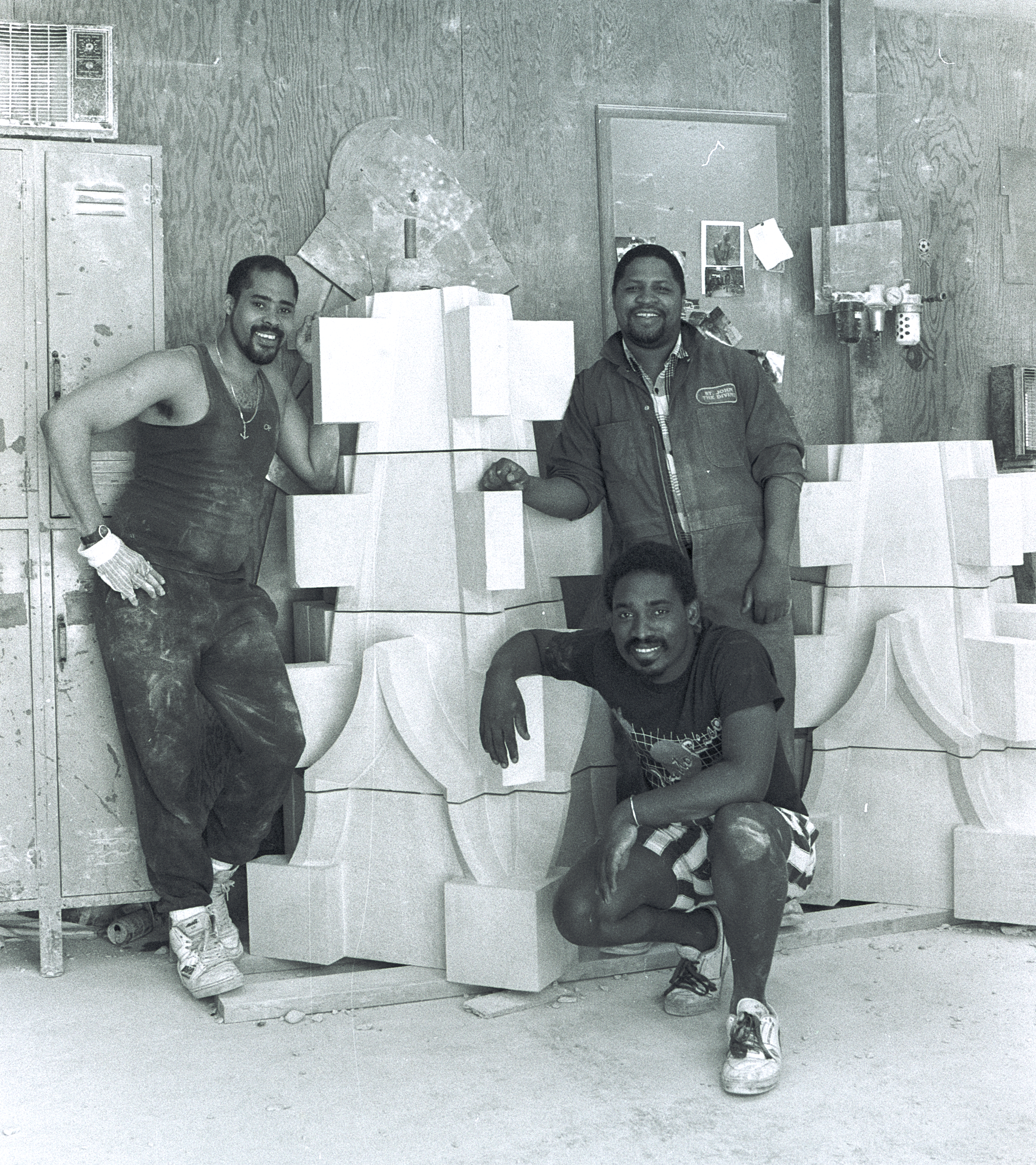
Eddie Pizzaro, Angel Escobar and Jose Tapia, kneeling, pose next to a pinnacle under construction on July 11, 1988. – Photo Robert F. Rodriguez
Back in The Day …
Jose always stood out as a genuine person. There was an innocent earnestness about him that would quickly put people at ease. He was generally an easy going individual, but would let you know when you were out of line. He was charismatic and friendly, but direct in his instruction.
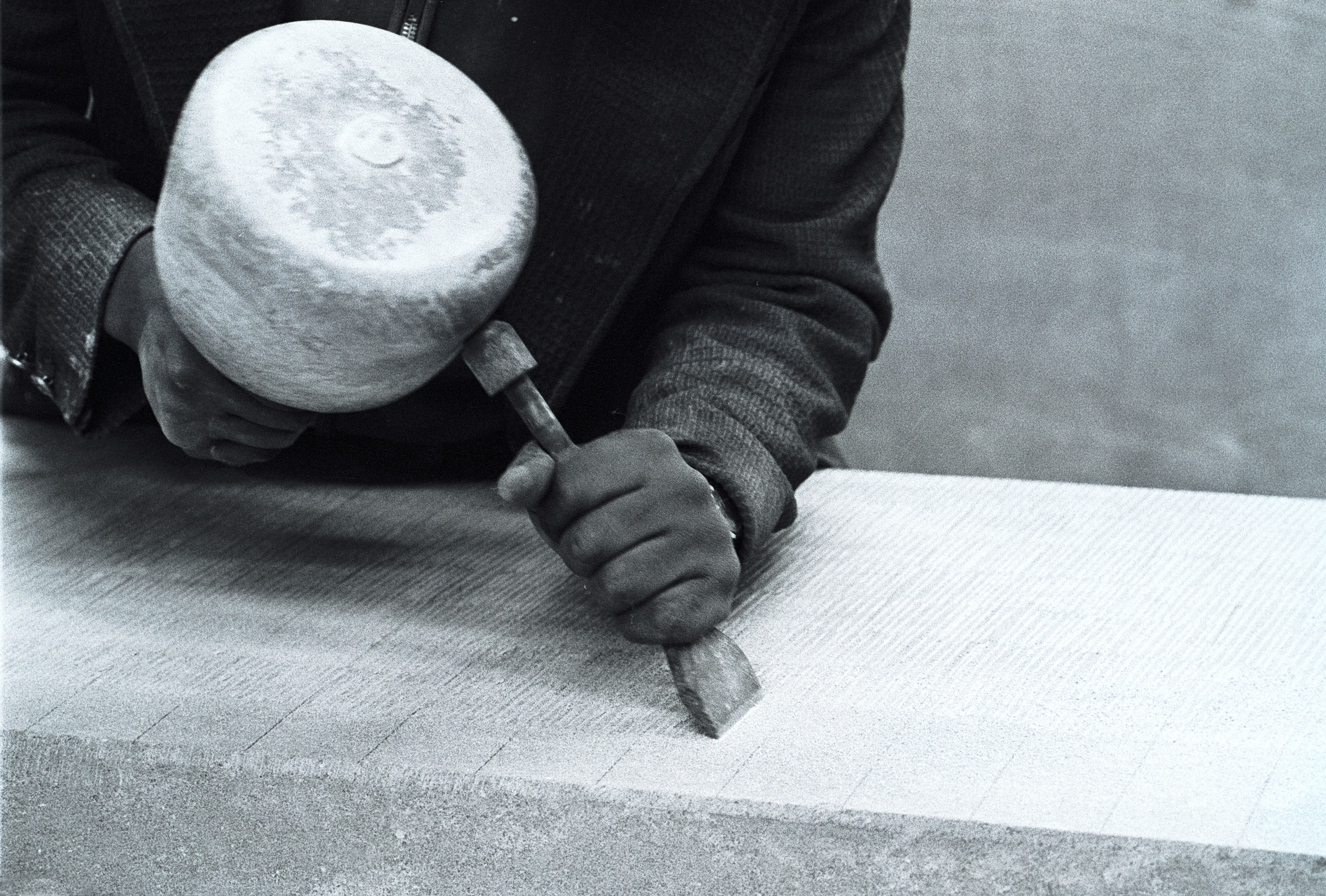
When he was cutting stone his concentration level was all-consuming. He was a hard worker who would lose himself in the stone work. Naturally gifted at working with his hands, people often stood and watched Jose’s skillful chiseling technique. He was a no-nonsense stone cutter. He cut stone with an unhurried ease, and his finished work stood apart in its quality and grace.
Jose was also generous with his knowledge, and on hand to instruct those willing to work hard and learn. He was very patient which was a gift in this arduous trade, and his general knowledge of the workings of the stone yard was valued, and depended upon. Jose would often give helpful advice to the new sawyers, or anyone who needed guidance.
Aside from his stone cutting skills, he also had a steady hand in the construction of the tower:
Master Builder James Bambridge keeps an eye on Jose Tapia’s progress on March 17, 1981. – Photo Robert F. Rodriquez
Jose,
You were probably the most productive out of all of us at the Stone Yard, not only in cutting stones but setting them too. From the first day up on the tower you were all business and it was soon clear that fixing as many stones as quickly as possible was your aim and you were most successful in accomplishing that. You took great pride in your work at the Cathedral and rightly so.
One of my favorite memories is when you boasted that gablet springer with your 1/2″ chisel. That stone stood boldly apart from the others which had the standard 2″ tool marks and it looked fantastic though I was unsure how the master builder would receive it: as it turned out, his eyebrows were indeed raised but the stone made its way up to its place on the tower. You certainly left your mark on the cathedral and your colleagues, and your contributions to the Stone Yard and Tower are invaluable.
-Steve Boyle
Jose Tapia poses next to a tracery stone on April 24, 1986. He joined the Cathedral program when he was 19. – Photo Robert F. Rodriguez
Jose,
If it wasn’t for you, I don’t think I would have stayed that long at the yard.
It was with your help that I was able to build up my confidence and perseverance. Remember Jose when I purchased that Dodge Dart with a slant 6 engine? My very first car. I think at the time you had the LeMans, the mistress on the street you would say.
One day Betsy (my Dodge) wouldn’t start but I remembered what you told me to do in that case. Place the screwdriver against the firewall and the poquito to start old Betsy up. And I have to say that my friends were all very impressed. Funny though now I know it’s called the starter. You have always been a kind and gentle person, always the first to reach out to help someone with anything.
-Poni Baptiste
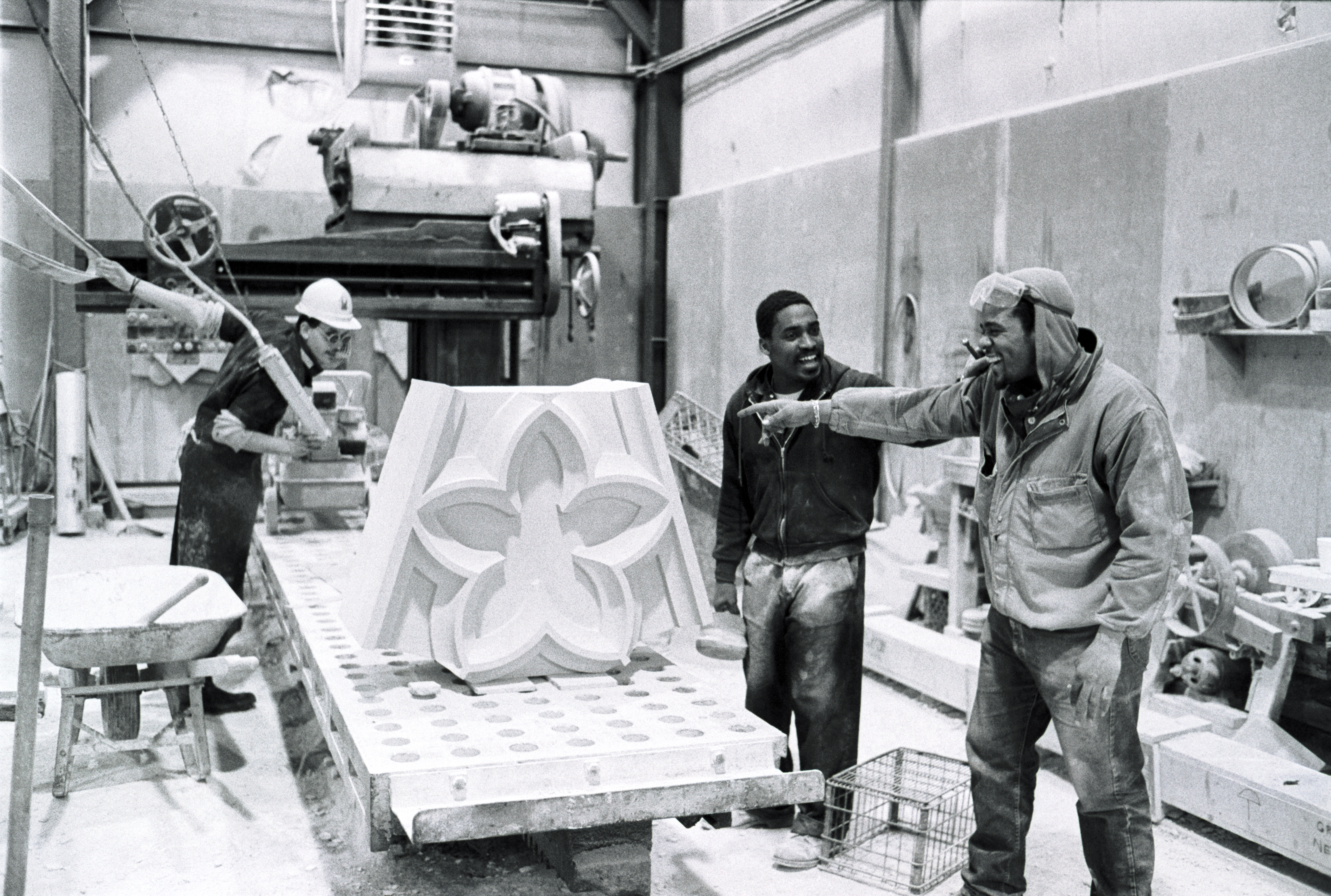
All Rivera, Jose Tapia and James Jamerson laugh over a tracery stone on April 24, 1986 – Photo Robert F. Rodriguez
Jose,
When I came off of the saw and first started cutting, with mallet and chisel, you took me under your wing and showed me how to use the pneumatic hammer (gun). You were generous with your tools and really pushed me forward. I had struggled mightily up to that point and, because of your encouragement, finally felt that I was moving forward as a stone cutter, part of the team. You pulled me out of a rut. Later, Bambridge took me off the gun and put a mallet back in my hand, so I went back to struggling, but at least I had the much needed self- confidence to forge ahead – due to your patient guidance. I’ll always appreciate the ladder you lowered down to me.
-Joseph Kincannon
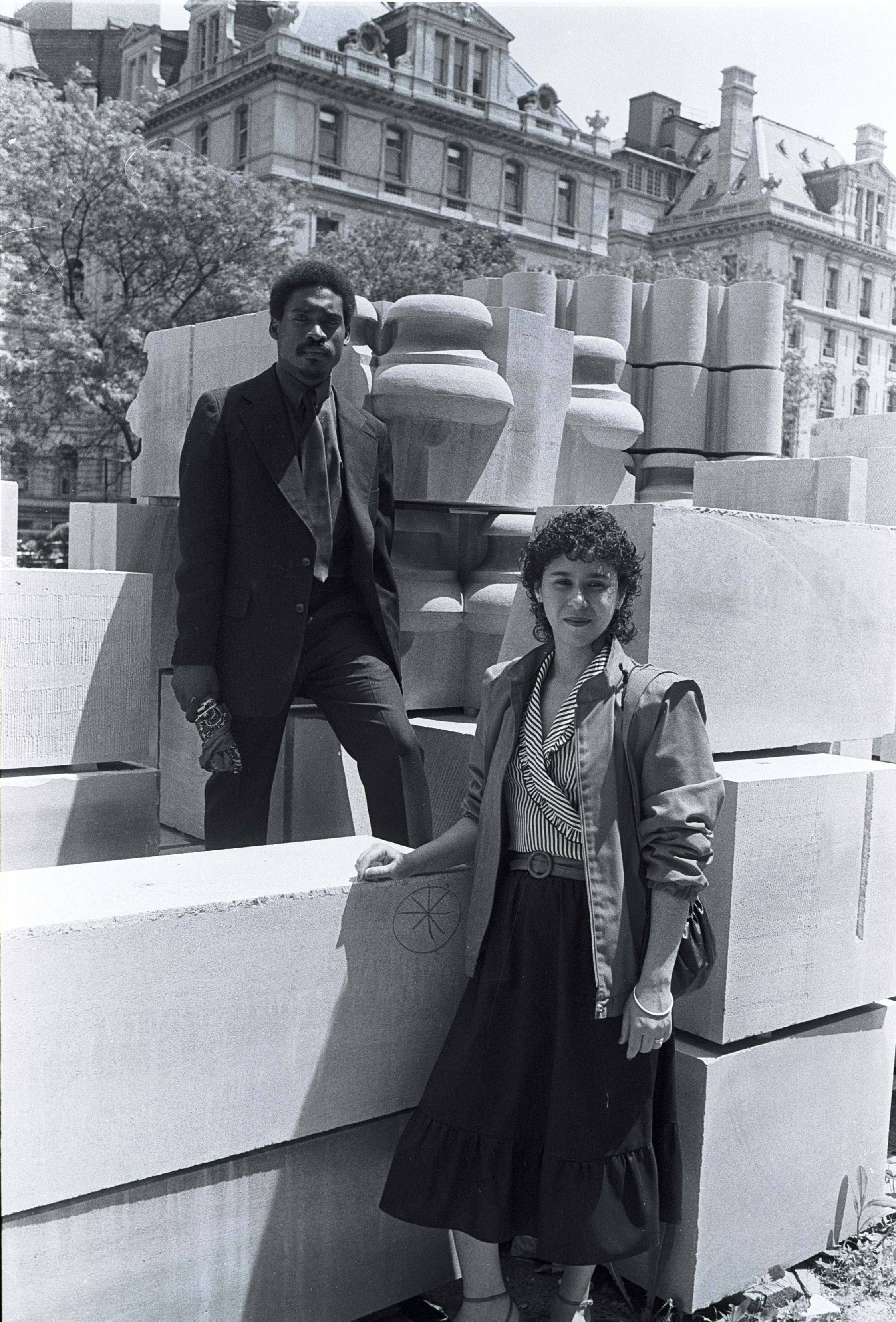
Jose Tapia poses with his wife Doris Torres on a stack of stones following the apprentice ceremony at the Cathedral on June 8, 1983. Jose, James Jamerson and Tim Smith represent the first class of stonecutters to complete the four-year apprenticeship program. – Photo Robert F. Rodriguez
My Uncle Jose
I can’t remember how old exactly, maybe around 6. He was a very young child, along with his brother. They came from P.R. to NYC to live with their aunt (my dad’s mother) because his parents had died from a car accident,
My dad said that my uncle was into a lot of things in his younger years:
He was a good swimmer. He was really into baseball. He has a passion for music and loved DJing at special events. He passed it onto his son. He also loved flying birds ever since he was a young boy. He would go up to the roof and fly and train pigeons.
He was always good with his hands and always loved construction and building homes, building whatever he could be handy with.
Jose has always been into having and maintains his huge fish tanks. He would love to watch them for hours. He had all types of fish. Especially, his piranhas. He loved those things.”
-Angela Garcia (Daughter of Angel Escobar)
Jose Tapia’s Guild Certificate
Hello Jose,
I have been thinking so often of the Stoneyard group at the Cathedral. Such a wonderful company of men and women with wonderful skills which Jim Morton admired so much. He was devoted to you and the Work you did from the very beginning. Here we all are these many years later and how great it is that all of you keep in touch. I am honored that I am included in the group! And I am sending you many wishes for good days in North Carolina and all my affectionate greetings,
-Pamela Morton
Apprentice Jose Tapia’s First Stone
Dear Jose,
We so recently got back in touch, it was wonderful to have contact again and know that some relationships endure. You were a leader at the stone yard. I admired you and felt that you had my back, for whatever reason. With love.
-Amy Brier
A proud James Bambridge discusses this stone with the cutter Jose Tapia – Image Robert F. Rodriguez
For Jose
When I was accepted as an apprentice, Jose was the first person to embrace me. He was like a little brother. I was extremely nervous but he kept telling me I would do well. If I wasn’t certain about something he was there to guide me. I would observe how he cut stones, and I tell you, it was like magic! One minute there was a giant piece of stone, and the next minute, it was like a beautiful figure had formed. He is one of the best people I know. He is also a great family man. The love Jose showed for his wife and son was that of a proud man. He used to bring them to work from time to time. Now Jose was not without laughter. Sometimes if I became frustrated, he would laugh but then he would help me out because there was no room for errors, in the Stone Yard.
-Carol Hazel
Group Shot
For Jose,
When Dean Morton set out to build the tower, he was also building a community; Jose rose to the challenge on both counts. He was the keystone of the stone yard, without his dedication, hard work and generosity, that arch would have failed. He was the rock that we all leaned on. In our innocence, we were all brothers building a Cathedral; and I was happy to call him – FRIEND.
— Nick Fairplay
Stonecutters Jose Tapia, Tim Smith and James Jamerson pose by cut stones in May, 1983. The three are the first to complete the four-year apprentice program and were honored in June with a ceremony in the Cathedral
For Jose,
You get what you give. So I always wished that Jose’s kindness, patience, and respect that he showed to all his apprentices would come back to him tenfold. God bless you, man
-Joe Chiffriller
■
The Divine Stone Project has had occasion over the last two years to post several times about Jose and his work. We also have been the grateful recipient of his efforts to bring his colleagues in touch with us. Thank you Jose for all your contributions. Below are some links to other posts involving Jose.
“An annotated memoir of the life and work of James Parks Morton for his family, friends and colleagues.”
-Pamela Morton and Polly Barton
The multifaceted Dean Morton takes us on an inspirational journey recounting his extraordinary life and many causes. The memoir is available for download HERE. And yes…there is a chapter on the stoneyard.
Of the many passages and stories to be enjoyed is the one where he saves the great Guastavino Dome. A committee had deemed the dome unsafe after mortar began falling to the floor of the Crossing. Their vote to tear down the dome and build a tower was imminent. Dean Morton, very early in his position, asked Bishop Moore to stall the decision. He had an engineer friend in Chicago who he called in to evaluate the situation. The engineer concluded that the problem was the difference in contraction and expansion between dissimilar materials – the clay tiles in the dome and the granite columns and arches. The solution was simple insulation for the roof of the dome and netting below for extra insurance. The 3 million dollars saved could then go to the future Stoneyard Institute.
Gazing at the Dome
“I looked up at the dome again. Amazing. I thought back in 1909, it was supposed to be temporary, and it had stood all this time. I marveled at the craftsmanship of Guastavino tile. It had been laid without scaffold or support. The architect in me rebelled at the idea of tearing it down.
But something else began to happen in me as well. Later I would learn that it happened to many of the men and women who became my colleagues. None of us is really able to describe the experience. It isn’t exactly awe, and it isn’t that the place talked to any of us. Maybe it was that the place seemed charged with an energy that was calling out to be used before it was lost for good.
Whatever it was, I knew after a few minutes gazing, that I would never permit that dome to be torn down. Furthermore, I vowed to start building the Cathedral again and to fill it with activity, life, and light. White elephant, nothing. We would use its vast scale to move even a city as big as New York to action, healing and communion.”
– James Parks Morton, 1972, from the book, With Companions for the Journey
Before the memoir, I wished I had known him. After the memoir, I regret I had not.
■
A special thanks to Pamela Morton and Polly Barton making the memoir accessible.
The Compass Rose is located on the pavement of the Choir. It is the official emblem of the Worldwide Anglican Communion. This iteration of the emblem in stone and brass was designed by John Barton in the late 1980’s. John was an architect at the Cathedral and received his Masters in Religion from Yale University.
Various similar Compass Roses are installed in many churches including the Cathedral Church of Christ Canterbury, England and in the Cathedral Church of Saint Peter and Paul (National Cathedral) in Washington, D.C. The center of the Compass Rose contains the cross of St. George. The text surrounding the central cross is in Greek. It translates as: “The truth will set you free.” The points of a compass reflect the spread of the Anglican Christianity throughout the world. The mitre at the top indicates the role of Episcopacy and Anglican Order that is the heart of the traditions of the Churches of the Communion. The emblem was originally designed by Canon Edward West of the Cathedral of St. John the Divine, New York.
Canon Edward West
Canon Edward West
The Rev. Dr. Edward Nason West (1909-1990) was a theologian, an author, an internationally known iconographer, an expert in the design of church furnishings, and an authority on liturgical art. As Canon Sacrist he presided over and organized all ceremonies large and small for more than 40 years. His ashes lie below the Compass Rose. The Archbishop of Canterbury dedicated the Compass Rose on September 20, 1992.
“At the service, Dean Morton told a story about the time he asked Canon West where he’d like his final resting place to be. West, who served under five different bishops at the cathedral, replied ‘Just put me where the bishops can still walk all over me.’ So there he lies where the grand liturgical processions he was so skilled at orchestrating do, in fact, walk all over him.”
– Tom Fedorek, Senior Guide
The Pavement
Choir Pavement – Compass Rose now in center
Unique stones from around the world make up the Choir pavement. The risers of the steps leading from the Crossing to the Choir are of yellow Numidian marble (Algiers and Tunis) and the treads of green Pennsylvanian marble. The style of the pavement of the Choir is Romanesque and Byzantine. It contains inlays with Numidian, Swiss and other marbles and Grueby Faience tiles. The steps to the Presbytery are marble from Hauteville, France.
In the center of the floor of the Presbytery is a beautiful mosaic “rug” of tiles and stones. It is 32 1/2 feet long and 10 feet wide with smaller patterns at the ends. Black Belgian marble surrounded by Italian violet marble created the central oval. This is now the placement for the Compass Rose. Grueby tiles of many colors and Grecian, red Numidian and other marbles form the rest of the design.
■
John Barton, AIA
New York Times, Jan 5, 1990, Edward West, Retired Canon And Author, 80
Guide to the Cathedral, Hall, 1928
Tom Fedorek, Senior Guide, Cathedral of St. John the Divine.
Evans & Tombs crew on location in St.Paul, MN, Circa 1889. John Evans can be seen in background, seated at a small table.
John Evans (1847-1923) was born in Caernarvon, Wales. He trained as a stone carver under his father in England before arriving in New York in 1872. After a year in Chicago after the big fire he returned to the East. He settled in Boston in 1873. Initially Evans worked out of his house and studio near Copley Square. In 1880 he moved to a studio/shop on Huntington Avenue and joined in business with carpenter and wood carver Richard J. Tombs. The company initially known as Evans and Tombs became the John Evans & Company in 1890. Later the firm became John Evans & Son. His reputation as the finest carver of his time was widespread. Evans became one of the country’s leading wood and stone carvers and modelers. As a result, the firm specialized in ecclesiastical commissions. His services were in demand by the most prominent architectural firms of the day.
The architect Ralph Adams Cram knew well of Evans’ firm. Evans had a professional partnership with Henry Hobson Richardson from 1873 until Richardson’s death in 1886. Richardson’s successor firm continued to use the John Evans Company. Cram valued craftsmen who could carry out his designs whether in stained glass, stone, wood or textiles.
Synod House
The firm of Cram, Goodhue & Ferguson finished the design for Synod Hall in 1912. This was to be the first of the Cathedral’s auxiliary buildings. Furthermore, the building’s site had a prominent position facing Amsterdam Avenue like the Cathedral itself. The auditorium would provide seating for over 1,000 and the building would house committee and conference rooms as well as Bishop’s offices.
The Gothic Revival style Synod House is clad in a unique quartzite from Kingwood, West Virginia. It also features a steeply pitched roof covered in slate. Buttresses flank inset arches pierced by doors and windows, lancet-arched windows, turrets, label lintels, and a central gabled section having monumental arches. Cram indicated he…
” wanted to make this Hall the most beautiful thing in New York…with a color combination that would be unique, and at the same time strikingly beautiful.”
– Ralph Adams Cram
A train load of the Kingwood Antique Yellow Quartzite for the new Synod House of the Cathedral of St. John the Divine – Image Stone Magazine, 1912
Evans’ Carvings
The Synod House front facade is elaborate and highly ornamented. The projecting Gothic arched entrance portal’s carvings are the work of the John Evans & Company.
Synod House Entrance
The archivolts contain three ranges of 36 figures that illustrate the progress of civilization and Christianity. Accordingly, the Apostles of Christianity, the arts and sciences, and crafts and industries are portrayed. In the tympanum are relief figures of Christ sending his disciples to preach. Flanking the entrance doors are seven figures of famous Christian rulers, including George Washington in the center.
Synod House Entrance Figures Explaned
The “Architecture” archivolt uses Ralph Adams Cram as the model.
Detail of Archivolts at the Entrance to Synod House Carved by the John Evans Company – images by Tyko Kihlstedt
The official completion of Synod house was May of 1914.
The Potter Memorial Pulpit
The pulpit, designed by Henry Vaughn, is near the entrance to the Choir on the Crossing. The dedication took place on Sunday, September 10, 1916. The John Evans Company carved the marble as well as the quarter sawn oak canopy. The stone is Tennessee Marble, “an uncrystalline limestone favorable for very fine work”.
The Potter Memorial Pulpit Carved by John Evans and Company – Image courtesy Wayne Kempton, Cathedral Archives
This description is from STONE, Sept. 1916…
“The structure has six sides, and is eleven feet high and fifteen feet long and six and one-half wide. On the upper part are carved these scenes from the life of Christ, enclosed in Gothic portals: The Nativity, Christ questioning the doctors, The Crucifiction, The Resurrection and The Supper at Emmaus. The backgrounds are in bas-relief and depth and space are given to the subjects. Single figures of saints and ecclesiastics stand in small niches at the angles.
On the base between the slender flowered pillars are the symbols of the Evangelists: The angel, the lion, the ox and the eagle. The central column is formed by five flat Gothic portals. The shield of the church and the sacred flowers ornament the lowest part of the base. Statues of St. John the Baptist and Isaiah stand on the posts of the balustrade of pierced tracery. The faces of all of the figures have an animation which is not often found in modern church sculpture. The sounding board is carved in exquisite Gothic ornaments.
Side View and Rear View of Potter Memorial Pulpit
Amidst the grandeur of the Cathedral, this intricately carved pulpit is worth a close-up look.
The Historical Parapet
The Historical Parapet or Choir Parapet is at the entrance to the Choir. John Evans & Co. carved the figures. Symbolically, it represents outstanding characters of the 20 centuries of the Christian Era. Cram & Ferguson designed the Parapet. Installation occurred in 1923.
Febo Ferrari (1865-1949) modeled the first 19 figures. Ferrari was born in Italy and later studied at the Royal Academy of Art in Turin. He worked in Paris and Buenos Aires until he came to America in 1903. He had a studio in New Haven, Conn.
It is in two sections, one on each side of the steps leading from the Crossing to the Choir. Each section of the Parapet is 18 1/2 feet long and 4 feet high. The main stone used is Champville marble from France. The overall style is French Gothic.
Columbia University Libraries
Columbia University Libraries
The 20th stone remained uncarved until the end of the Twentieth Century. Eventually, the committee chose four individuals to represent the most recent century. Chris Pellettieri was to do that carving.
Martin Luther King, Jr., Albert Einstein, Susan B. Anthony, Mahatma Ghandi. Carving by Chris Pellettieri
The Open Air Pulpit
The Open Air Pulpit stands in the midst of the Cathedral Close. Specifically it is an open work Gothic spire 40 feet high. The pulpit carving is of Daytona Stone. The usual symbols of the four evangelists appear on its four sides. It is purported to be a work of the John Evans Company. No installation date is available.
Open Air Pulpit Carved by the John Evans Company
John Evans – Carver, Modeler, Teacher
Evans’ architectural sculptures in stone are numerous, including many in granite. He worked in wood as well as being one of the very few names associated with carved brick. By the mid 1880’s his time was eventually spent in modeling works that would be executed by others in his employ.
Over his career Evans employed a large number of young craftsmen in his studio. Without doubt he was a strong supporter of the apprenticeship system. He worked to spread his craft outside the studio as well. In 1877 he became director of the School of Modeling and Sculpture at Boston’s Museum of Fine Art, teaching both men and women. Twenty years later he would go on to oversee a system of workshops for the first Society of Arts and Crafts in America. He and his partner Richard Tombs were both founding members.
For nearly five decades, Evans engaged in stonework on hundreds of buildings in the East and Midwest. Those of national importance are, of course, St. John The Divine as well as Washington Cathedral and Trinity Church, Boston. Upon his passing, many acts of personal kindness were noted by the local union’s Corresponding Secretary. This is recorded in the Stone Cutters Journal.
■
Stone Cutters Journal, Vol. 37, No. 1
STONE magazine, Sept. 1916
American Architect, Dec. 17, 1913; April 3, 1912
Architecture and Building, Synod Hall, Nov., 1913
Cathedral Church of Saint John the Divine and the Cathedral Close, Designation Report, NYC Landmarks Preservation Commission, Feb 21, 2017
Charitably Speaking, Massachusetts Charitable Mechanic Association, MCMA History – John Evans, Author-John Moriarty, December, 2013
John Evans (1847-1923) and Architectural Sculpture in Boston, Ann Clifford, 1992