Anna Hyatt Huntington in 1930 Film, Sculpture in Stone, from the Boston Museum of Fine Arts
In 1922, the statue of Joan of Arc installation in the Chapel of St. Martin de Tours occurred. It is a delicate, linear piece in the Medieval style. The acclaimed sculptor brought a familiar statue subject to the French aligned chapel at the Cathedral.
Statue of Joan of Arc in the Chapel of St. Martin de Tours at the Cathedral of St. John the Divine.
Anna Hyatt Huntington (1876-1973) was among New York City’s most prominent sculptors. At a time when very few women were successful artists, she had a thriving career. She exhibited often and traveled widely. She received critical acclaim at home and abroad, and won awards and commissions. In 1912 she was one of only 12 American women earning over $50,000 a year.
In 1915, Hyatt Huntington created the first public monument in New York City by a woman. Her bronze Joan of Arc, located on Riverside Drive at 93rd Street is also the city’s first monument to a historical woman. It is one and one third life-size. The same prestigious committee that sponsored this monument was instrumental in getting the acclaimed sculptor to add a statue to the Cathedral chapel.
Hyatt Huntington’s Legacy
Hyatt Huntington’s work is now displayed in many of New York’s leading institutions and outdoor spaces. These include Columbia University, the Metropolitan Museum of Art and the National Academy of Design. As well, they are at the New York Historical Society, the Hispanic Society, the Cathedral of St. John the Divine, Central Park, Riverside Park and the Bronx Zoo. Despite the presence of her sculptures throughout the city, Hyatt Huntington is not well-recognized today. An exhibition at Columbia University’s Miriam and Ira D Wallach Art Gallery has focused on her New York career.
It is 1901 and Heins & Lafarge hire a young 34 year old to oversee the sculptures at the Cathedral of St. John the Divine. John Gutzon de la Mothe Borglum became the Cathedral’s first sculptor. He was born in Idaho Territory in 1867 to Danish immigrants. Gutzon Borglum studied at the Mark Hopkins School of Art in San Francisco in the 1880’s. Eventually, he lived, worked and studied in Paris. In Paris, From 1890 to 1893, he studied the academic approach to sculpting at the Academic Julian and the Ecole des Beaux Arts. Auguste Rodin was a major influence on his work. By 1896, Gutzon exhibited both painting and sculpture in London and Paris.
In 1901, when Gutzon moved to New York he was commissioned to create sculptures for the Cathedral. Sculpture had overtaken all his artistic pursuits. The Metropolitan Museum of Art purchased his piece “Mares of Diomedes”. It was the Museum’s first purchase by an American sculptor. This officially sealed his fame. The commission included the Belmont Chapel and the statues for the remainder of the Cathedral. To be the Cathedral’s first sculptor to work on a building whose construction would extend over several generations of artisans was an awesome, exciting project for a young artist.
Carvings at the Entrance to the Chapel of St. Saviour (Belmont Chapel) – Photo by Wayne Pearson
The inside entrance to the Chapel of Saint Saviour is bordered by twenty carvings of angels representing the heavenly choir. On the exterior of the Chapel are two life-size angels, The Angel of the Nativity and the Angel of the Resurrection.
Gutzon Borglum Carvings of the Angel of the Nativity and the Angel of the Resurrection on the eastern exterior of the Chapel of Saint Savior
The Angel Controversy
A small conflict arose from these two carvings. The building committee chair told Borglum that he believed the heads and figures in general should be made:
If not distinctly masculine, at least not distinctly feminine
– Dr. John Peters, Canon of the Cathedral
After letting Dr. Peters know that art and tradition largely depicted angels as women, Gutzon complied. This was fairly easy since the angels were still in clay form. This should have been the end to it except a reporter who followed events at the Cathedral asked Gutzon what happened. The reporter listened to the explanation. However, controversy sells more newspapers than facts and the next day headlines read “Borglum Smashes His Lady Angels in Anger”.
Believed to be the original Angels of Nativity and Resurrection
It was a story that went viral and soon everyone had an opinion on the sex of angels. Poems were written, clergy weighed in with serious opinions, jokes flourished and debate went on for a few weeks. Gutzon stated he didn’t know if angels were women, but he did know women were angels. The sculptor retained the somewhat feminine angels in the chapel. He applied more manly countenance to the two outside the church.
The Volume of Work
During the span of several years, The Cathedral’s first sculptor was responsible for modeling approximately one hundred sculptures in various chapels and the apostles on the roof. As the Cathedral’s first sculptor he designed and modeled bishops, saints, and scholars. The firm of Barr, Thaw and Fraser of Hoboken, N.J. copied his models in limestone. They carved the work on site in a carving shed at Gutzon’s insistence. This followed a centuries old tradition from European cathedrals.
Apostles being carved from models by the sculptors of Barr, Thaw & Fraser
Barr, Thaw & Fraser employed the following stone carvers for the Cathedral work: Charles Jensen, J.G.H. Hamilton, C.Price, W.T. Scott, L.Lentelli and O. Burdett.
Two of the Apostles, St. James and St. John, rest in canopied niches near the top of the turrets and buttresses on the exterior of the Chancel area.
The Chapel of Saint Columba, The Chapel of Saint Boniface and the Chapel of Saint Saviour contain many examples of Gutzon’s work. Outside are the nine-and-0ne-half foot statues of the Apostles and Gabriel, the Angel of the Annunciation, blowing his trumpet from the roof.
Later Life
In later years, Gutzon was involved in many public commissions and several projects of enormous proportions. One, at Stone Mountain Georgia ended badly and caused his connection to the Ku Klux Klan to haunt his reputation. The design and supervision of the work at Mount Rushmore was more rewarding.
The undertaking was remarkable, given the tools and technology available. To ensure correct scale, a protractor was attached to the top pf each head, with a 30-foot arm traversing this arc and extending out over the face graduated in feet and inches. A 1/12 scale model of each head had a similar set up so that plumb lines could be dropped from the arm in any place. Measurements taken from the model were then expanded 12 times to indicate the amount of rock to be removed. Each face had a measurement made every 6 inches, vertically and horizontally. This information was painted on the spot so that inexperienced work crews could simply follow the information and remove the correct amount of granite. They went through about 400 pneumatic drill bits a day. Each one was taken down to the blacksmith’s shop to be heated, sharpened, re-heated and tempered.
The New York Architect, Vol. 5 Issue 1, 1911
Gutzon Borglum & His Life Work, Robin Borglum Kennedy
A few more stoneyard scrapbook photos from the many we have received. Thanks to all for digging into the boxes on the top shelf to come up with these.
Poni Baptiste with quintuple base stone
Poni working on her first stone
Poni Baptiste was the second woman apprentice hired.
Angel Escobar – Photo Robert F. Rodriguez
Gabriele’s Stone – Crockets in progress on Gablet
Drawing of “B” Zone, South Elevation – Courtesy of Timothy Smith
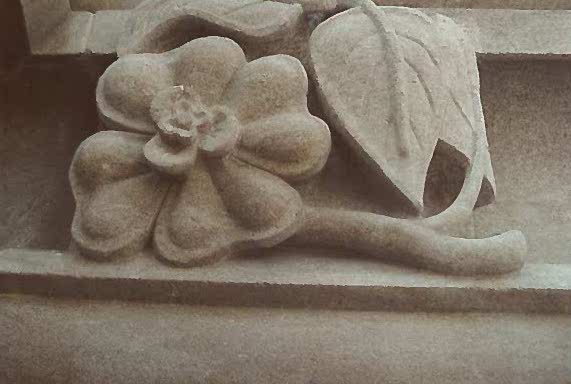
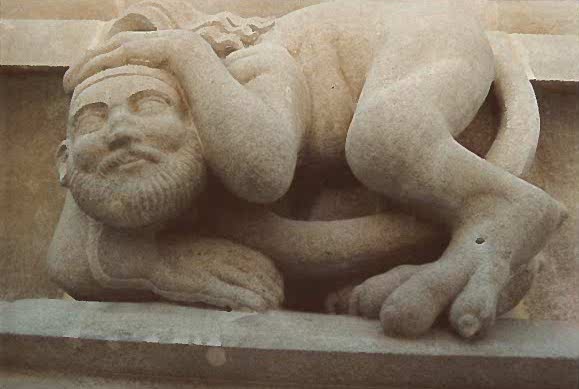
String Course Carvings
Chris Hannaway (center) with mates at Liverpool Cathedral
A proud James Bambridge discusses this stone with the cutter Jose Tapia.
Thanks for more stoneyard scrapbook photos from Jose Tapia, Poni Baptiste, Gabriele Hiltl-Cohen, Linda Peer, Eddie Pizarro, Timothy Smith, Amy Brier, and Angela Garcia (Angel Escobar’s daughter)
Lately we have had the good fortune to receive a multitude of photographs from the cutters and carvers. We also have had the pleasure of speaking with and exchanging emails with many of you. I will tell you that the majority of this has been due to the hand of Jose Tapia, and we thank him. While it will take us some time to organize and archive the abundance of material, we thought we should share a sampling of the snapshots in the Stoneyard Scrapbook II.
New Apprentices D’Ellis “Jeep” Kincannon and Arlene “Pony” Baptiste join the crew.
Chris Hannaway at Liverpool Cathedral
Gabrielle Hiltl-Cohen carving
Carvings from the string course
Eddy Pizarro on tower
Machine Area
Gabriele Hiltl-Cohen
Group Photo
Angel Escobar – Photo Robert F. Rodriguez
Thank you to Jose Tapia, Gabriele Hiltl-Cohen, Linda Peer, Eddie Pizarro, Timothy Smith, Amy Brier, and Angela Garcia (Angel Escobar’s daughter) for sending these photos for the Stoneyard Scrapbook II.
Al Rivera keeps a stone aligned as it is sawed on April 24, 1986. – Photo Robert F. Rodriguez
Before a stone gets to a banker mason, it gets to the machines. In the setting out shop the stone is added to the saw schedule based on the construction drawings. A job ticket is also prepared and sometimes a zinc template. Therefore saw schedules and job tickets were an integral part of the stone cutting process at the Cathedral.
Saw Schedule for North Elevation, “C” zone, Tower of St. Paul
The work on the tower was divided into 10 zones, A, B, C, D, E, F, G, H, I, J, K, and FP. Each zone had a North, South, East, and West elevation and stones were prefixed with the orientation and zone letter. The first stone listed above, NC 112, denotes a particular stone on the North elevation of C zone. It indicates it is a base stone with its overall dimensions. The zones were logical or manageable divisions. The “A” zone started at the cornice/roof level and ended at the top of the columns at the start of the gablets. The “B” zone comprised the gablets and terminated at the cornice where the “C” zone began comprising the sill/weathering courses and window elements.
Job Tickets
Closeup of a job ticket for a pier stone which gives it outline, dimensions and it specific unique number, photographed July 2, 1980. – Photo Robert F. Rodriguez
Job tickets were created in the setting out shop at the same time as the templates and schedules. They were issued to the stone cutters and sometimes sawyers when they started on a stone. The ticket would usually have a sketch of the finished piece along with the overall dimensions. It also provided a record of who had worked the stone and when.
Sawyer Robert Stanley moves a limestone block along the track of the circular saw on July 2, 1980. – Photo Robert F. Rodriguez
Thanks to Stephen Boyle for the original saw schedules and the information of job tickets.