Categories
Divine Stone

The Bells that Never Rang: Part 2

(This is Part 2 of a two part story about the bells by Divine Stone co-author Robert F. Rodriguez)

Several decades (and two bishops) passed with no plans to resume construction at the Cathedral. Bishop Horace Donegan, like his predecessor Bishop Charles Gilbert, said that no further construction would take place during his episcopate. 

The climate changed in 1972 with the investiture of Bishop Paul Moore, who brought in James Parks Morton, who studied architecture at Harvard, as the new Dean at the Cathedral of St. John the Divine.

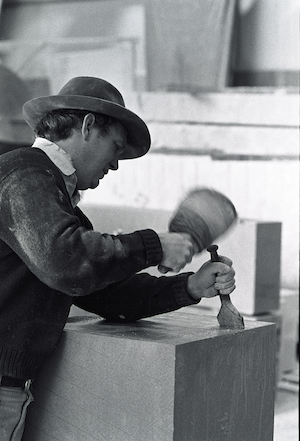
Both the Bishop and Dean felt the time was right to resume construction following New York City’s tumultuous 1960s. The Dean moved forward with a plan to employ traditional medieval building methods and train neighborhood men and women from Harlem to raise the towers and, hopefully, install a grouping of bells. 

John Taylor and Co. furnished a diagram for a circular layout of a ringing peal of 12 bells and a Bourdon bell in June 1977, two years before the first stone was cut by the new apprentices.

Tower Bell Diagram
This June 24, 1977 schematic from John Taylor and Co. shows the layout for a peal of 12 bells and a bourdon for the Cathedral of St. John the Divine. Courtesy John Taylor and Company Archives

A December 15, 1978 letter, between Payne Studios, a New Jersey-based installer, and John Taylor and Co. expressed concern about how the 13-bell proposal would fit into the planned bell chamber. Payne Studios felt there would be inadequate space for 13 bell ringers and urged John Taylor and Co. to revise the plans. The letter ended on an upbeat note: “We are getting all excited here.”

The new plan came in less than two weeks and proposed a peal of eight bells and a tenor bell weighing 2.1 tons and measuring just over 5 feet in diameter.

The number and size of the bells seemed to change once again a few years later with still another plan for a Bourdon bell surrounded by the ringing peal. 

An April 1980 letter from the general manager of John Taylor and Co. to Dean James Parks Morton describes a 7’7” diameter Bourdon bell surrounded by a ringing peal. The letter adds, “I feel that it is important that this decision be made at an early stage so that the design work for the tower can proceed without alteration.” Prophetic words as will be seen in later correspondence.

As of November 1980, “present-day” prices were furnished to the Cathedral. The “present-day” qualifier may be due to the fluctuating costs of metals for casting the bells. The ringing peal and Bourdon would cost $372,225.92 and the ringing peal only, $225,926.14.

Bell Price proposal, 1980
This Nov. 27, 1980 price sheet from John Taylor and Co. shows the costs for a ringing peal of 10 bells with bourdon bell or for the ringing peal of 10 bells only. Courtesy John Taylor and Company Archives

A fundraising brochure prepared by the Cathedral Development office, probably from around 1980, listed $250,000 as the suggested donor contribution for a “Peal of Twelve Bells, plus the Thirteenth, or Bourdon, ‘Great William,’ in honor of William Thomas Manning, Tenth Bishop of New York.”  It did not specify the size of the Bourdon bell.

The flow of letters between the Cathedral and the bell foundry seemed to halt as construction of the southwest tower proceeded in fits and starts during the early 1980s. 

A December 1986 Cathedral Newsletter gave an overly ambitious 1994 projected completion date for both towers, at a point when the southwest tower was barely one-quarter completed.

Tower Construction Timetable
The tower construction timetable is seen in a December, 1986 Cathedral of St. John the Divine newsletter.

“The entire St. Paul’s tower is expected now to soar 323 feet above Amsterdam Avenue by 1992, the centenary of the laying of the cornerstone of the Cathedral,” the article states.

Tower construction was at a crossroads in the mid-1980s and a decision had to be made whether any kind of bells would ever resonate in the tower. 

This responsibility fell on the shoulders of John Walsh sometime in 1986.

An August 2021 Divine Stone article provides the background: “Walsh, Master of the Works, came to the stoneyard during a rocky period. Master Builder Jim Bambridge had gone back to England. Master Masons Alan Bird and Stephen Boyle had also left. Money was tight and morale was at an all-time low. John Walsh’s main role to begin with was to stabilize the program, get a handle on finances and chart a way forward.”

Much of the design work was complete but there were several major items outstanding, including the fabrication and installation of the steel bell frame and setting the concrete ring beam that was to tie the masonry of the tower together directly below the base of the bell frame. 

In April 1988, Walsh moved ahead with the pouring of a four-foot deep concrete ring beam to strengthen the southwest tower, support the potential weight of bells and serve as a base for the bell frame.

Ring Beam Poured
A heavy layer of cement, several feet deep, was poured on St. Paul’s tower in April, 1988 to form a ring beam, prior to erecting the steel bell frame later in the year. Photo by Robert F. Rodriguez

The cement may not have been dry on the ring beam when a John Taylor and Co. interoffice memo from April 6, 1988 revealed: “JOHN WALSH RANG.

1) THEY DO NOT have money to buy the ring of bells.

2) They do not have money to buy the carillon.

3) He has the configuration drawings of the carillon – could they put the frame in now for the largest 14 bells only?

4) Wants engineer’s drawings and quickly – wants to set in and close walls around the structure.”

Walsh indicates no funds for the bells but needs the frame built now, needs engineering drawings.
This April 6, 1988 interoffice memo reports there were no funds for bells nor for a carillon at the Cathedral. Courtesy John Taylor and Company Archives

The memo adds that John Walsh “did not appear at all optimistic about getting the money — as he has before – he sounded almost desperate when he was on about the framework.”

Yet, the bell frame was erected.

Master Mason and tower construction supervisor Stephen Boyle was on the tower in September 1988 when the bell frame was assembled. He speculates, “I think it was a ‘now or never’ call, hoping the money for the bells would materialize later. It would also have much been harder to build the rest of the frame once the stone tower walls had risen further.” 

Steel Bell Complete
Master of the Works John Walsh and Dean James Parks Morton pose near the completed steel bell frame on Sept. 4, 1988. Photo by Robert F. Rodriguez

Construction continued on the tower for a few more seasons and the limestone rose to cover most of the steel frame, but work ended before the frame was completely walled in and a roof added above.  Around 2007, after years of inactivity, the rusting scaffolding and the upright beams of the bell frame were removed. 

Stone were set around the bell frame
Stephen Boyle pounds a block into alignment along a line of weathering stones in front of the bell frame in August, 1989. Photo by Robert F. Rodriguez
Bell Frame Dismantled
The bell frame on the southwest tower is dismantled on May 14, 2007. Photo by Stephen Boyle

Additional information provided by John Taylor and Co. confirms that the bell frame erected on the southwest tower was the company’s design for a carillon. They did not manufacture this frame—they believe their design drawings were sent to a U.S. firm that manufactured the frame locally to Taylor’s specifications.

John Taylor and Co. also stated that the plan for the two towers was for the change ringing peal to go in the southwest tower, then under construction, and the carillon to go in the northwest tower.  

This turned out to be the reverse of what actually happened, as John Walsh may have felt his best option was to erect the bell frame for the carillon in the southwest tower. 

While no bells were ever ordered, Cathedral docent Tom Fedorek recalls, “During my first years as a cathedral guide in the 80s, visitors would ask if there would ever be real bells. One of my fellow guides told me that the bells had already been manufactured and were sitting in a warehouse in the Netherlands pending completion of the tower.” Wishful thinking or an urban legend.

Anyone walking near the Cathedral these days will hear bells ringing, but the sound comes from a speaker mounted on the southwest tower. Douglass Hunt, the Cathedral organ curator, explained, “The Cathedral’s bells are a Schulmerich Carillon. It is a digital instrument — the bell sounds were sampled from cast bells and are digitally generated by the carillon’s electronics. Not a recording per se, but rather a digital tone generator system.

“We have always kept the instrument to playing clock functions (hourly rings), as well as calls to worship for Sunday and other major services. On a rare occasion, I’ve been asked to program a toll (for a solemn occasion) or a peal (for a joyous one),” he continued.

“It was once said to me that the installation of an electronic carillon had been done years ago as a way of getting the sound of bells into the neighborhood atmosphere, in preparation for the completion of the west facade and towers.”

Aside from bells proposed for the tower, Stephen Boyle points to blueprints that indicate a few unusual items. Plans included an elevator running on the exterior of the tower’s east side with a narrow entry to the tower base. A small tapered passageway inside the tower leads to a blank wall that would have been opened to accommodate an elevator. This lift would save the bell ringers and /or carilloneurs the steep climb up a spiral staircase to the floor of the tower and allow visitors to the belfry. 

Opening for future elevator to bell chamber
A narrow opening on the tower’s east side leads to the wall where an elevator was planned to bring visitors and bell ringers to the bell chamber. Photographed June 18, 2024 by Robert F. Rodriguez.

There are also four corbels in the tower carved in the likeness of several major supporters and benefactors, looking down from near the top of the chamber’s ceiling. A corbel is a bracket that projects from within a wall to support a weight, although these four corbels might have been purely decorative. 

Carved corbel to honor Re. Dr. Ray Parks.
This is a view of the finished carved corbel set in the bell chamber to honor the Rev. Dr. Robert Ray Parks, Rector of Trinity Church, a major supporter of the Stoneyard Institute. Photographed Feb. 25, 1987 by Robert F. Rodriguez

One such corbel honors The Rev. Dr. Robert Ray Parks, Rector of Trinity Church. Rev. Parks was a member of the Cathedral Board of Trustees and the Chairman of the Fabric Committee when tower construction was under way. Rev. Parks stood atop the tower in 1982 for the dedication ceremony and saw Philippe Petit cross Amsterdam Avenue on a high wire.

Cornerstone Laying with Rev. Ray Parks
From left, the Rev. Dr. Robert Ray Parks, rector of Trinity Parish, Wall Street, Philippe Petit, Bishop Paul Moore and Dean James Parks Morton gather around the Jerusalem corner stone after it was set into place on Sept. 29, 1982.Photo by Robert F. Rodriguez

Today, the bell chamber sits as quiet as a catacomb; the only sounds piercing the stillness are the rumbling of buses and ambulances on Amsterdam Avenue below. 

Bell Chamber
The bell chamber of St. Paul’s Tower at the Cathedral of St. John the Divine is seen on Jan. 29, 2024. Photo by Robert F. Rodriguez

Sources:

  • Special thanks to John Taylor and Co. Archives and Tim Barnes at Trinity Chuch
  • Riverside Church
  • Andrew Dolkhart – Morningside Heights
  • American Bell Festival
  • Cathedral of St. John the Divine archives
  • Cathedral Newsletter
  • Schulmerich Carillons
  • Cathedral Docent Thomas Fedorek
  • Central Council of Church Bell Ringers
  • New York Magazine, May 26, 1980

List of carillons in the United States – Wikipedia

Yale Guild of Carillonneurs

Categories
Divine Stone

The Bells That Never Rang

(This is Part 1 of a two part story about the bells by Divine Stone co-author Robert F. Rodriguez)

This is a story of “what if”… “what should have happened”… “what didn’t happen.” 

The bell chamber in the unfinished southwest tower of the Cathedral of St. John the Divine is dark and eerily quiet. Limestone blocks and red bricks form the walls, punctuated with soft light filtering through several louvre grates. Above, a series of heavy steel I-beams span all sides of the tower, and above that, a corrugated roof keeps out the elements.

Tower Bells
The roof of St. Paul’s tower is supported by the steel beams installed for the bell frame that was later deconstructed. Photographed Jan. 29, 2024 by Robert F. Rodriguez

The visible steel beams are from the base of a bell frame, which would have…could have… supported a number of harmonious ringing bells, breaking the silence in the tomb-like lower level of the tower.

Plans for at least a dozen bells and perhaps more than 50 date back almost a century.

Correspondence between Cathedral officials and bell foundry John Taylor and Co. tells the story of the numerous proposals and various configurations of bells for the towers. These historic letters and other documents from the company’s archives were recently shared with me.  

Let’s go back a century to put the timeline and narrative in order.

In 1925, the project to complete the Cathedral was coming together. Under Bishop William T. Manning, major work on the Cathedral had resumed that year. A young Franklin Delano Roosevelt, less than a decade from the White House, spearheaded a $15,000,000 capital campaign to revive construction, which later included enough additional money to build the west façade, and possibly the towers. 

Bishop Manning
The Right Rev. William T. Manning was the driving force behind the second phase of the Cathedral’s construction that started in 1925 which saw the building of the nave and the West facade. Undated image courtesy of the Archives of the Episcopal Diocese of New York and Cathedral Church of St. John the Divine

Architect Ralph Adams Cram, who oversaw the transformation of the Romanesque style of architects Heins and LaFarge to a more traditional English/French Gothic design, had plans in place. The foundation for the nave was finally prepared. The central crossing and chapels to the east looked like a stubby domed box sitting atop a carpet of concrete – waiting for construction of the nave to start. 

West Front Rendering
Rendering from a brochure showing the finished West facade with both towers completed. Undated image courtesy of the Archives of the Episcopal Diocese of New York and Cathedral Church of St. John the Divine

News of resuming the project at the Cathedral reached across the Atlantic Ocean and in 1926, the Cathedral architect received a letter from John Taylor and Co. in Loughborough, UK. The company dates back to 1839 and today is the last remaining bell foundry in England.

Having installed 10 bells at Yale University’s Harkness Tower a few years prior, John Taylor and Co. was doing well with new orders from the United States. In that light, the company sent a May 12, 1926 letter to Cathedral architect Ralph Adams Cram. The sales pitch proposes: “ I suppose the West towers will some day be completed, and if I may make a suggestion at this very early stage, then I recommend that the grandest ringing peal in the world should be placed in one tower, and a carillon in the other, the pièce de résistance being of course the ringing peal. The ringing peal must then possess a grandeur unparalleled by any other in existence.”

Letter suggesting bells fro each west front tower, 1926
This is a paragraph from a May 12, 1926 letter to Cathedral architect Ralph Adams Crams from the John Taylor and Co. bell foundry. Courtesy John Taylor and Company Archives

“What is advisable for St. John the Divine?” the effusive letter posed. “I suggest and recommend a ringing peal of twelve, with the tenor weighing not less than 100-cwts.”  

Bell weights are often expressed in hundredweights (cwt.), quarters (qtr.), and pounds (lbs.). 

The National Bell Festival website explains that the tenor bell is the heaviest bell within a change ringing peal or carillon or chime. Consequently, it sounds the lowest tone or note of the instrument. 

IF…the bells for the Cathedral had been cast, Tim Barnes, the Ringing Master at Trinity Church in Lower Manhattan, notes that the tenor bell would have been “the largest in the world for a change ringing peal, coming in at 11,200 lbs. or 5 tons. “It was the Roaring 20s,” Barnes continues, “and apparently nothing was too ambitious!”

Taylor and Co. had experience with transporting these behemoth bells. To move the 16.7 ton “Great Paul” Bourdon bell from the foundry in Loughborough to St. Paul’s Cathedral in London, the company first considered using a team of elephants but decided upon a more practical custom-built steam powered trolley.

Bourdon Bell for St.Pauls
A specially constructed steam-powered trolley transports the “Great Paul” bourdon bell from the foundry in Loughborough to St. Paul’s Cathedral in London. Photo courtesy John Taylor and Company Archives

The price quoted for the Cathedral’s ringing peal was $53,520 – with free delivery!

proposal for 12 peal bells
This May 11, 1926 letter to Cathedral architect Ralph Adams Cram from the John Taylor and Co. bell foundry lists the price for a ringing peal of twelve bells at $53,520. Courtesy John Taylor and Company Archives

Tim Barnes contacted Taylor & Co. for an updated price and, a century later, the cost estimate would be about £495,000 or $650,000 for a new ring of 12 change ringing bells. The change ringing bells, or a peal of bells, swing full-circle, as opposed to being in a fixed position, and are used for change ringing – sounding the bells by pulling on ropes 

In the 2025 estimate from John Taylor and Co., the size of the tenor would be reduced from the original 100 cwt. to about 40 cwt. — 4,480 pounds or 2 tons.

For comparison, the current tenor bell at the Washington National Cathedral weighs 32 cwt. (3,584 lbs. or 1.6 tons) and the Trinity Church tenor weighs 24 cwt. (2,688 pounds or 1.2 tons.)

The National Bell Festival explains, “change ringing bells are mounted on wheels (secured by a cradle) in a room directly above the ringers. The change ringing bells begin their swing from a mouth-upward position and rotate full circle before reaching the balance point and then, by the pulling of a rope by the ringer, swing back in the opposite direction. The sequence of which bell to ring comes under the direction of the ringing master and there are thousands of variations possible.”

Three of the peal bells at Trinity in full swing
Three of the ringing peal of bells at Trinity Church are in full swing on April 23, 2025. Each bell is controlled by a bell ringer in the chamber below. Photo by Robert F. Rodriguez

Tim Barnes adds, “Change ringing involves a set number of bells (usually 6, 8, 10 or 12 bells), numbered from the highest note to the lowest note” and each bell rings once, as part of a predetermined ordering of the bells (the peal of bells), before any of the bells ring again. Patterns known as ‘methods’ are rung and these methods generate different permutations (i.e. orderings) of the bells. 

A recent visit to the Trinity Church tower helped me to understand the bell ringing process. After a 99-step climb to the base of the belfry, a group of “ringers” gathered for an evening practice.

Trinity Church Bell Ringers Practice
Tim Barnes, the Ringing Master at Trinity Church, far right oversees a practice for bell ringers on April 23, 2025. Photo by Robert F. Rodriguez

Trinity has a “ring” of 12 and the bells came from John Taylor and Co.

Click the link Ringing at Trinity Church, Wall Street, NYC on Vimeo to hear a ringing peal of bells – change ringing bells.

IF…the bells for the Cathedral were cast, the ringing peal would have been only the second in New York City. Today, Trinity Church has the city’s only change ringing or ringing peal installation.

John Taylor and Co.’s four-page 1926 letter to Ralph Adams Cram goes on to detail the proposal for a carillon of 56 bells for the other tower: “In view of the extreme importance of the building I recommend as ideal a Carillon of fifty-six bells. The cost of the carillon would be $250,040.” (Also with free delivery). Remember, this is in 1926 dollars. Tim Barnes contacted  the bell foundry and the cost of the carillon today would be around $2,000,000.

The letter did not specify which tower would house the peal of bells or the carillon.

The 56 bells proposed would have been larger than Yale University’s 54-bell carillon, also cast by John Taylor and Co. 

Carillon bells at Riverside Church, NYC
Some of the carillon bells are set in racks at Riverside Church, photographed May 2, 2025. Photo by Robert F. Rodriguez

How does a carillon work? The National Bell Festival explains: “A carillon is a musical instrument of bells, consisting of at least 23 harmonically-tuned bells. The cup-shaped bells are hung fixed in a frame – “dead” rather than “swinging”. Seated in an enclosed space within the tower, a carillonneur then operates a console – a clavier – with batons (for the hands) and pedals (for the feet).The bell clappers are connected by means of wires and a tracker system to the “baton clavier” that enables the player to control both the rhythm and dynamics of playing. The deeper notes are sounded by means of foot pedals similar to those on an organ. 

Robert F. Rodriguez with clavier at Riverside Church
Robert F. Rodriguez examines the clavier used to ring the carillon bells at Riverside Church on May 2, 2025. Photo by Stephanie Azzarone

Hear the carillon at Riverside Church – The ringing of the Riverside Church carillon

IF…the proposed bells had been cast, the Cathedral’s carillon would have rivaled that of neighboring Riverside Church. Built in 1930, the Riverside Church carillon was a gift from John D. Rockefeller, Jr. in memory of his mother. The world’s largest carillon by weight, the Riverside array contains 74 bronze bells primarily cast by the Gillett & Johnston bell foundry in the UK.  The Bourdon bell at Riverside, weighing over 40,000 pounds — 20 tons — is the second largest tuned bell in the world.

Hear the Bourdon Bell at Riverside Church (16) Video | Facebook

Riverside Church was completed in just over three years, at the same time as the Cathedral was constructing the nave. A Cathedral fundraising brochure states: “Even the Great Depression did little to dampen the spirit of civic pride engendered by the building of the Cathedral. Then as now, the building of the edifice was to give heart to a depressed city and provide work for those seeking jobs.”

The Second World War brought the Cathedral’s building phase to an abrupt halt, with no work started on the west towers. The dedication of the nave took place seven days before the U.S. entry into the war. 

Photographs from that period show a boxy metal frame rising on the west façade tower bases and spanning the pointed roof of the completed nave – probably used for lifting stones and other materials to the upper reaches of the building. 

1952 view of Cathedral
This is a 1952 view of the Cathedral of St. John the Divine. Work was halted in 1941 at the start of the U.S. entry into World War II. Angelo Rizzuto/ Library of Congress

Aside from the initial 1926 letter from John Taylor and Co. to Ralph Adams Cram, no other correspondence was uncovered from the bell foundry’s archive concerning this construction phase. It could be that Bishop Manning needed to focus his attention on building the nave, transepts, the narthex, west façade and tower bases before he could turn his attention to specifications for bells.

After the Second World War, there was a brief attempt at fundraising to resume construction but money was more urgently needed on numerous rebuilding programs throughout the Episcopal diocese. In addition, Bishop Manning retired at the end of 1946 and his successor, Bishop Charles Gilbert, felt that continuing to spend large sums on the construction of a grand edifice while poverty increased in the surrounding neighborhoods was inconsistent with Christian charity and faith, according to Andrew Dolkart in his book Morningside Heights.

Categories
Divine Stone

The Historic Stones of St. Ansgar’s Chapel

Endurance, constancy, continuity – these are the virtues that stone structures possess, cathedrals most abundantly. 

As if to implant these qualities in the walls then rising, St. John the Divine collected stones resonant of its Anglican heritage during the years it was under construction. Some came from historic British cathedrals – Canterbury, York, Lincoln, Bristol, Norwich, Southwark, St. Alban’s, Worcester, Ely – others from the sites of historic monasteries – Westminster Abbey, Bury St. Edmunds, the island of Iona – and one from William Shakespeare’s parish church in Stratford-on-Avon.

The intent was to integrate the historic stones with the freshly-cut limestone and granite of the fabric as a palpable sign of the new American cathedral’s kinship with its British predecessors and its devotion to the Anglican expression of the Christian faith. Ultimately, only a few of the historic stones were set in the walls. 
The Chapel of St. Ansgar, designed by Henry Vaughn and consecrated in 1918, houses stones that medieval masons cut eight centuries earlier for two of England’s majestic cathedrals: the Cathedral Church of Christ and Blessed Virgin Mary in Worcester and the Cathedral Church of the Holy and Undivided Trinity in Ely, hereafter referred to as simply “Worcester” and “Ely.” 

St. Ansgar Chapel
The Chapel of St. Ansgar, Niche is far left. Photo: Tom Fedorek

The Worcester and Ely stones comprise the niche in the left wall of the chapel’s apse, added in 1921. The color of  the unpainted surfaces comports with that of Anthony Trollope’s fictional Barchester Cathedral – “that rich, yellow grey which one finds nowhere but in the south and west of England.” The topmost stone, from a blind arcade in Worcester, bears an ogee arch enclosing the top half of a trefoil. The stones below, also from Worcester, are textured with curvilinear forms and scoring.

St. Ansgar Niche

Niche with inscription. Photo: Tom Fedorek

A squarish stone from Ely, seen below, projects from the base of the niche. Its original function may have been as a wall-mounted pedestal. It is inscribed ELY 1320. The inscription may have been added long after the stone was originally cut; the numerals are in a font that, to my eye, is more modern than medieval.

Ely Stone inscription
Ely Stone inscribed ELY 1320. Photo: Tom Fedorek

The small corbel beneath the shelf displays the “stiff leaf” foliage characteristic of the dialect of Gothic architecture known as Early English, prevalent during the late 12th to mid-13th centuries when most of Ely was constructed.

Eky Stone Corbel
Ely Stone with corbel. Photo: Tom Fedorek

The paint on the stones is curious – scarlet and lemon yellow on the ogee arch from Worcester, lime green, white, and gold on the Ely pedestal. There is only one other instance of painted stone in the Cathedral’s interior –  the sixteen shields bearing symbols of the apostles and evangelists in the Baptistery adjacent to the chapel. When and why were stones painted? I suggest a possible answer at the end of this article.

The niche and the chapel itself (now the Cathedral’s columbarium) are a memorial to William Reed Huntington, rector of Grace Church, longtime Cathedral trustee, chairman of its Committee on the Fabric, and a driving force behind the first phase of the Cathedral’s construction. The inscription that flanks the stones reads: 

These Stones from the Cathedral of Christ and St. Mary the Virgin Worcester England are Memorials to William Reed Huntington Sometime Rector of All Saints in Worcester Massachusetts.

William Reed Huntington
William Reed Huntington. Photo: Wikipedia

The inscription seems incomplete, for it does not mention Huntington’s long service to the Cathedral. Neither does the inscription acknowledge the Ely stone, nor do the relevant minutes of the Cathedral’s Committee on the Fabric record any reference to it. The Ely stone may have been added later as an afterthought, but when and why is a mystery.

The Worcester and Ely stones were the gift of George William Douglas, a Cathedral canon from 1904 to 1913 and an honorary canon from 1920 until his death in 1926. The 1924 edition of Edward Hagaman Hall’s guidebook provides the following account of how Canon Douglas procured the Worcester stones:

Some years ago, when Canon Douglas was visiting Worcester Cathedral, England, Canon Wilson pointed to a spot in the wall where an ancient carved stone had been replaced by a modern stone, and said: “A good while ago a man of the name of Huntington, who introduced himself as Rector of a church in Worcester, Mass., begged me to give him a bit of carved stone as a symbol of the ties between England and America.” This led Canon Douglas to ask for a similar gift to be placed in St. Ansgarius’ Chapel, which is a memorial of Dr. Huntington, in a House of God where Englishmen and Americans often meet and where members of the Daughter Church have constant occasion to recall their indebtedness to the Mother Church of England.

Worcester Cathedral - Chapter Minutes
Entry in Chapter Minutes. Courtesy of Worcester Cathedral & Archive. Photo: Dr. David Morrison, Cathedral Librarian

An entry dated November 21, 1911, in Worcester’s Chapter Minutes confirms that Canon Wilson and the Dean were approved to select the stones to be sent to “the Cathedral of New York.” 

That Huntington had earlier sought out an historic stone for his parish in Massachusetts suggests that he may have initiated the collection of such stones for St. John the Divine.

I was unable to obtain similar documentation for the Ely stone. The available records indicate that Canon Douglas obtained three stones from Ely, only one which was incorporated into the fabric of St. John the Divine. 

The Lady Chapel - Worcester
The Lady Chapel, Worcester Cathedral. Photo: Arthur de Smet

Worcester’s Lady Chapel, the source of the niche’s stones, was built between 1224 and 1250. With its sharply-pointed arches and “stiff leaf” foliage on the capitals of its columns, it is a superb example of Early English Gothic. The bases, colonettes, and capitals of the columns are of dark Purbeck marble – a dramatic contrast to the pale limestone. 

The Lady Chapel houses the effigy of Margaret de Say (c.1182-c.1242), Baroness of Burford, who provided much of the funding for its construction. 

Effigy of Margaret de Say
Effigy of Margaret de Say, Lady Chapel, Worcester Cathedral. Photo: Chris Guy. By permission of the Dean and Chapter of Worcester Cathedral.

Relief - Lady Chapel
Relief of benefactress and stonemason, Lady Chapel, Worcester Cathedral. Photo: Chris Guy. By permission of the Dean and Chapter of Worester Cathedral.

The charming relief seen above is on a spandrel in the Lady Chapel. We see a benefactress, perhaps Margaret de Say herself. She is shown in profile, dressed in the height of thirteenth century fashion. Facing her, in three-quarter view, a stonemason perches on the side of the arch, cradling his calipers with his left hand. His chisel sits alongside him. The lady is placing something into the mason’s right hand – a bag of coins, most likely. The mason’s relaxed posture suggests that he is at ease in the lady’s presence despite the difference in their stations. He seems quite confident that the quality of his work is worth the full value of the payment he is receiving. 

Of special interest to Divine Stone’s stonemason readers: Worcester is one of a small number of English cathedrals with its own team of on-site stonemasons. Worcester also offers training in stonemasonry, as St. John the Divine did at one time. You can learn more about Worcester’s program here:

https://www.worcestercathedral.org.uk/heritage/stonemasonry

Returning to the question of the painted stones, I detect the hidden hand of architect Ralph Adams Cram. As I trawled through the material in the Cathedral’s archives relating to the period of the niche’s creation, I came across a letter from Cram to Dean Howard Robbins, dated February 7, 1923. Of the chapels, Cram wrote:

I think the whole tendency in these chevet chapels is towards coldness and austerity. Personally, I should like to see much more gold and color in all of them … Somehow these chapels ought to be made very personal and intimate, so that they would draw people there for private devotions just by the force of their intimate quality.

Cram singled out the Chapel of St. Boniface as “very dead and lifeless,” recommending color and gold for the reredos. For the Chapel of St. Martin, his own design, he recommended painting the three tympana of the arcade in gold and “a very dark greenish blue with the fleur-de-lis gilded and burnished.”

No action was taken on Cram’s proposals for those two chapels. But could the painted stones in the niche be a response to Cram’s observations, and likewise the polychrome shields in the Baptistery? It is inconceivable that paint could have been applied to anything in the Cathedral without the approval of the autocratic Cram.

A final note – You may be wondering what became of the historic stones that were not integrated with the fabric.  For many years, they were displayed rather randomly around the Cathedral – on a ledge here, in a corner there. On December 18, 2001, a fire devastated the gift shop that then occupied the unfinished north transept. Firefighters successfully contained the blaze, but ash and soot coated virtually every surface of the Cathedral’s interior. To facilitate cleaning and restoration, the historic stones were taken to the crypt, along with most of the artwork and other movable objects. 

There the stones remain to this day. Should the Cathedral ever revive the construction of the western towers, I would hope there might be some consideration of the original intent of integrating them with the fabric.

My sincere thanks to Dr. David Morrison, Worcester Cathedral Librarian, for his invaluable assistance with the research for this article. Dr. Morrison is the current successor to James Maurice Wilson (1836-1931), Worcester Cathedral’s first librarian and the same Canon Wilson who enabled Canon Douglas to obtain the Worcester stones. 

Thanks as well to Wayne Kempton, diocesan archivist, for providing a complete list of historic stones and granting me access to the papers of the Committee on the Fabric. Also, to Jim Patterson, the Cathedral’s facilities director, for confirming the current location of the historic stones.

SOURCES

Cathedral of St. John the Divine, Committee on the Fabric, Minutes 1918-1925 ● Hall, Edward Hagaman. Guide to the Cathedral Church of St. John the Divine (4th edition, 1924). ● Milburn, R.L.P. The Pictorial History of Worcester Cathedral (London: Pitkin Pictorials, c. 1960). ● Suter, John W. Life and Letters of William Reed Huntington: Champion of Unity (New York: Century Co., 1925) ● Worcester Cathedral website https://www.worcestercathedral.org.uk/  

Categories
Divine Stone

The Cornerstone – Part 2: The Stone Within the Cornerstone

Solemn ceremonies have always accompanied the laying of a cornerstone. In ancient cultures, the ceremony might involve the sacrifice of animals or even humans. In early Christian churches, there was often a cavity within the stone to preserve relics of saints and martyrs. 

St. Ambrose
St. Ambrose laying the cornerstone of the Basilica Sant’Ambrogio in Milan. Chapel of St. Ambrose, St. John the Divine. Ironwork designed by Carrere & Hastings and executed by E.F. Caldwell Co., 1944. Photo: Tom Fedorek

In the image above, St. Ambrose lays the cornerstone of the fourth-century Basilica of Martyrs in Milan, now known as the Basilica di Sant’ Ambrogio. St. Augustine recounts how Ambrose translated the relics of local martyrs to the new basilica (Confessions IX.7).

Sealed inside a copper box within the Cathedral’s cornerstone is a kind of relic – a fragment of stone or, more likely, Spanish brick, a remnant of the church where the Christian faith was first practiced in the Americas, built by Christopher Columbus on his second voyage in 1494. 

This post tells the story of how and why this object came to rest in the Cathedral’s cornerstone, followed by thoughts on how we in the 21st century might regard this “relic.”

La Isabela

The fragment within the  cornerstone dates from the second and longest of Columbus’s four transatlantic voyages (1493-96), when he traveled to what is now Cuba, Jamaica, Puerto Rico, and the Lesser Antilles – all the while believing he was somewhere in Asia. He set out from Cadiz in September 1493 with a fleet of seventeen ships bearing more than a thousand crew along with building materials, provisions and horses. With colored pennants streaming from their masts, the galleons and caravels in the argosy would have been a stirring sight – unless you were one of the Jews whose property had been confiscated by the crown and mortgaged to fund the voyage.

Arriving at the north coast of the island of Hispaniola in late November 1493, Columbus found the small fort he had built on his first voyage burned to the ground and its occupants vanished. Sailing eastward along the coast, he came upon a site with a suitable harbor, a freshwater lake fed by neighboring mangrove swamps, fertile soil, and an abundance of timber. He set about building a fort, a church, a storehouse for provisions, huts for settlers and a stone house for himself. He named the new settlement La Isabela after the Queen of Castille. 

The church – La Iglesia de Santa Maria de la Incarnación – celebrated its first mass on the Feast of the Epiphany, January 6, 1494. Archaeological excavations conducted in the 1980s determined that the church was a “simple, single-naved, monastic-style church with a bell tower, campanario, on one side, a pattern that was to become standard throughout the Spanish frontier mission territories of the sixteenth century.” 

The church was approximately fifty feet long and thirty feet wide. The east and west facades were of limestone, the walls of tapia valenciana – rammed earth reinforced with brick, a common building material of southern Spain. The roof was thatched rather than tiled. Today, only the church’s foundations survive.

Church in La Isabela
Foundations of the church in La Isabela, now a National Historic & Archaeological Park and UNESCO World Heritage Site in the Puerta Plata province of the Dominican Republic. Photo: Laura Casado via TripAdvisor

La Isabela lasted for only a few tumultuous years before it was abandoned, having been decimated by disease, famine, mutiny, quarrels among settlers and battles with the Indigenous Taínos. The surviving settlers relocated to Santo Domingo. The site remained deserted for the next four centuries and acquired a reputation for being haunted. Samuel Hazard, a historian of Santo Domingo, wrote about his visit to the site in 1872:

There was absolutely nothing to repay me for my trouble, the place possessing no natural beauty and the few ruins remaining having no particular form or meaning, being mostly covered with running vines and vegetation. With much difficulty can be made out where has originally run a small village street.

The USS Enterprise Expedition

The USS Enterprise
The USS Enterprise. Drawing by Fred S. Cozzens. Credit: U.S. Naval History and Heritage Site

Hazard’s book, Santo Domingo, Past and Present, was read by George Partridge Colvocoresses, a lieutenant aboard the sloop-of-war USS Enterprise as it cruised off the coast of Santo Domingo in the spring of 1891. As he recounts in his handwritten memoir:

I had seen a notice in a newspaper that it was proposed to send an expedition to the West Indies for the purpose of visiting the places associated with the voyages of Columbus and collecting any relics that might be found. This was to be done by the Latin-American Dept. of the Columbian Exposition, then preparing in Chicago for the 400th anniversary of the discovery of America. Realizing that we were quite near Isabella, I suggested to the Capt. that I be permitted to explore that region for our own satisfaction, and that so doing might possibly forestall the Enterprise having to return for that purpose. Capt. C. cordially approved.

Commander George Colvocoresses
Lt. Cmdr. George P. Colvocoresses, 1897 Credit: AHEPA History

Lt. Colvocoresses conducted an examination of the ruins of La Isabela on May 14-16, 1891, accompanied by a surgeon, a cadet, two volunteers from the Enterprise, and a local wood-cutter who was familiar with the site. The following are excerpts from the report that he submitted to the ship’s commander:

Tradition points to this little plateau as the site of the ancient city and here we found scattered at intervals various small ill-defined heaps of stones, remnants of walls built of small unhewn stones, evidently laid in mortar, pieces of old tiles and potsherds, some of the latter glazed, and fragments of broad, roughly-made bricks. There was a half-dozen or more blocks of dressed limestone that may have been part of the walls of buildings somewhat finished and permanent in character. The trees, matted roots and trailing vines overspread the ground and rendered progress slightly difficult. 

It should be stated that the piles of stones that we saw convey very little idea of the forms of the structures to which they belonged and give no indication of their uses.

We overturned all the cut blocks of stone and examined them carefully in the hope of finding some marks or dates, but without success … Of the surface remains at Isabella, it is our opinion that there is nothing of sufficient interest to be removed, except, perhaps, the few blocks of cut limestone, and there is nothing that would convey an idea of the architecture and workmanship of the buildings erected by the first settlers.

The artifacts that the expedition took from the site were not exhibited at the Columbian Exposition. How did one of them make its way to the Cathedral?

Walter Mclean
Walter McLean as a rear admiral. Credit: Library of Congress via Wikipedia.

Lt. Colvocoresses’s report notes that two volunteers from the Enterprise accompanied him. One of them was Lieutenant Walter McLean. Lt. McLean had a brother in New York City, Malcolm McLean, a medical doctor. Dr. McLean was a member of St. Andrew’s Episcopal Church in Harlem, serving as its senior warden. Both brothers are identified as donors of the fragment in the available documentation. I would speculate that while Lt. McLean was assisting at La Isabela, he collected a few stones as souvenirs and later shared one with his brother, who then gifted it to the Cathedral. 

Are we sure that the stone is really from the church and not another building at La Isabela? We are not. The Colvocoresses report makes clear that the expedition could not distinguish specific building types. The details about the church were discovered decades later through meticulous archaeological investigation. 

The Columbus Quadricentennial

When the Cathedral’s cornerstone was laid on December 27, 1892, only three months had passed since the October 12 kick-off of the year-long commemoration of the quadricentennial of Columbus’s first voyage. The exuberant celebration was impossible for New Yorkers to avoid, the jubilee so ubiquitous that it was probably inevitable that it would impinge upon the cornerstone ceremony. 

Every New Yorker attending the ceremony would have seen the patriotic banners hanging throughout the city or watched one of the parades, or enjoyed one of the musical events, such as the cantata “The Triumph of Columbus” at Carnegie Hall. They would have read flowery editorials in their newspapers and listened to bombastic oratory lionizing Columbus as the embodiment of the American spirit of quest and boldness.

Two views Columbus from New York’s 1892 Columbus celebration. Left: Columbus the great Italian navigator atop a 60-foot column in (where else?) Columbus Circle. Marble. Artist: Gaetano Russo, 1892. Photo: Brecht Bug via Flickr. Right: Columbus the apostle of Spanish Catholicism in Central Park. Bronze. Artist: Jerionimo Sunol, 1892. Photo: NYC Dept. of Parks.

Churchgoers would have heard sermons hailing the Genoese navigator as the apostle who first planted the cross of Christianity in the New World. American Catholics even launched a short-lived campaign for canonization. Rabbis delivered their own laudatory sermons, tactfully sidestepping the quadricentennial of another historic event initiated by King Ferdinand and Queen Isabela – the Alhambra Decree of 1492 that expelled the Jews from Spain. 

While New York made merry, Chicago was constructing the Columbian Exposition of 1893, a panorama of America’s progress in science and technology. The exposition’s Great White City was the dawn’s early light of what would come to be known as “the American Century,” when the United States would take its place as a world power on an equal footing with the mighty colonial empires of Europe.

Goodbye Columbus

Brilliant navigator, bold visionary, apostle of Christian civilization – that was the prevailing view of Columbus at the time the Cathedral’s cornerstone was laid. Those present at the cornerstone ceremony would have shared this view and revered the Isabela stone as a kind of relic, for Columbus himself might have touched it.

Columbus in Historical Parapet
Columbus in the Historical Parapet, Great Choir, St. John the Divine. Stonework by John Evans Co. Photo: Tom Fedorek

This bygone view of Columbus persisted through much of the next century. You can see it expressed in the three places his image appears in the Cathedral, all dating from the first half of the twentieth century. You will find him in the Historical Parapet, flanked incongruously by two martyrs of the English Reformation, John Wycliffe and Thomas Cranmer. He appears again in a window in the Chapel of St. James, and in the window of the nave bay devoted to American history (not pictured here).

Columbis in Stained Glass Window, Chapel of St. James
Detail from the east window in the Chapel of St. James, St. John the Divine. Artist: Henry Wynd Young, c. 1930. Photo: Tom Fedorek

By the time the Columbian quincentennial arrived in the postcolonial world of 1992, images like the one above had become quaint. A new generation of historians was examining the Columbus narrative from the perspective of the Indigenous peoples that he encountered. In this view, Columbus was merely the first in a series of European adventurers who inflicted slavery, brutal exploitation, and genocidal epidemics on the native peoples of the Americas, facilitated in no small part by the priests and friars who accompanied them.

With Columbus deposed from his saintly niche, how might we regard the Isabela stone today?

We might start by considering why Bishop Potter decided to place it in the cornerstone. Was it merely to capitalize on the public interest in the Columbus quadricentennial? While that may have been a factor, there is good reason to that believe that Potter had a more substantive purpose, one that had nothing to do with the glorification of Columbus himself.

From the time that he revived his predecessor’s intention to build a great cathedral in New York, Bishop Potter sought to distinguish it from the cathedrals of the Old World. He was emphatic that it should have a distinctly American character. By placing a stone from the first church in the Americas within the cornerstone, Potter was branding St. John the Divine as an American cathedral, with core values both Christian and American.

Potter was a proponent of the American value of inclusiveness, as evidenced by his long involvement with the settlement house movement that assisted recently-arrived immigrants. In his 1887 “Letter to the Citizens of New York,” he set forth his conviction that the proposed cathedral should be “a people’s church …. [whose] welcome would be for all men of whatsoever fellowship.” As an “exponent of those great religious ideas in which the foundations of the Republic were laid,” its pulpit would be open to “the strongest and most helpful minds of the age.” 

The decision to build seven chapels where immigrants could worship in their native tongues would further distinguish St. John the Divine from Old World cathedrals. Four decades later, the windows of the nave would feature representatives of the trades and professions that funded the construction of the bays rather than the lives of the saints to whom they are dedicated, as was the medieval custom. The nave’s windows thus reflect the bedrock American belief in the dignity of labor and the worth of the common man and woman. 

The day after the cornerstone was laid, the New York Times editorialized:

A building on this scale is no longer the work of a denomination; the Episcopalians are merely the initiatory force. It appeals to the whole city, without distinction of sect or religion; nay, to the whole country, for its completion in the most beautiful and splendid way reflects glory on every person who is proud to call himself an American.

Perhaps we should regard the remnant within the cornerstone not as a relic, but rather, a seed that planted in the soil of the Americas yielded a bounty far different from what the Europeans who planted it ever imagined.

Sources

Carletta, David M. “The Triumph of American Spectacle: New York City’s 1892 Columbian Celebration” in Material Culture (Spring, 2008). ● Colvocoresses, George Partridge. The Personal Recollections of George P. Colvocoresses, v. 1, 1847-1907. Handwritten manuscript accessed via the Norwich University Archives Digital Collection. ● Deagan, Kathleen and Jose Maria Cruxent. Columbus’s Outpost Among the Taínos: Spain and America at La Isabela 1493-1498 (New Haven: Yale University Press, 2002). ● Moody, Michael. “Isabela Revisited” in Journal of Popular Culture (Fall, 1989). ● Moody, Michael. “Isabela Revisited” in Journal of Popular Culture (Fall, 1989). ● Ober, Frederick A. In the Wake of Columbus (Boston: D. Lothrop Co., 1893). ● “Report of Lieutenant George P. Colvocoresses to Commander G.A. Converse, USS Enterprise” in Thacher, John Boyd, Christopher Columbus: His Life, His Work, His Remains” (New York: Putnam, 1903). ● U.S. Naval History & Heritage Command. “USS Enterprise” at https://www.history.navy.mil/our-collections/photography/us-navy-ships/alphabetical-listing/e/uss-enterprise–1877-1909-0.html ● “New cathedral planned: Bishop Potter asks the city for aid,” New York Times (June 2, 1887). ● “From the First Church,” New York Times (December 23, 1892).

Categories
Divine Stone

The Cornerstone – Part 1 -Laying the Cornerstone

(This is a continuing series of articles by Tom Fedorek, Senior Guide at the Cathedral. They explore significant historic and unusual stones in the Cathedral. – RM)

The sky was crystalline and the air frigid on the Feast of St. John, December 27, 1892, the day appointed for the laying of the Cathedral’s cornerstone. But inside the vast cruciform tent on the northeast quadrant of the Cathedral’s site, warmth, illumination, and music were provided by steam radiators, Edison light bulbs, and an organ supplemented by a brass choir and harp. Above the tent, a blue silk banner bearing the arms of the Diocese of New York wafted in the breeze. The hundreds of invited guests filled the seats well before the start of the service.

The Cornerstone
The Cornerstone Ceremony. Drawing by Thure de Thulstrup. Credit: Harper’s Weekly

All eyes were on the platform in the center of the tent. There sat the cornerstone of Quincy granite, four feet and four inches square, incised with a cross and inscribed: I.H.S. St. John’s Day, December XXVII, A.D. 1892. Alongside the stone sat a wooden mallet and beside the mallet, a trowel of gold-streaked ebony with silver mountings, crafted by Tiffany & Co. and inscribed: Behold, I lay in Zion for a foundation stone, a tried stone, a precious cornerstone, a sure foundation (Is. 28:16). 

The cables that would lower the stone into place were hanging from the derrick above. Beneath the platform, the foundation’s massive granite blocks lay atop the bedrock in anticipation of the setting of the cornerstone.

At three o’clock, the procession of three hundred clergy and dignitaries entered the tent, having donned their vestments in the old Leake & Watts orphanage building. For the next two hours, hymns were sung, psalms chanted, scripture proclaimed. Melville Fuller, Chief Justice of the U.S. Supreme Court, read the epistle. The Bishop of Albany, William Doane, preached the sermon. A seventy-voice choir sang an anthem composed especially for the occasion.

The only glitch occurred when four trustees came forward to collect the offering only to find only three alms basins at hand. The fourth trustee, undaunted, passed his silk top hat to gather the greenbacks that were then cascaded upon a golden platter atop the cornerstone. The collection totaled $20,000, an amount insufficient to cover the cost of the elaborate ceremony – a portent of the funding shortfalls that lay ahead.

The Cornerstone
The laying of the cornerstone. Bishop Potter with trowel accompanied by architect George Heins and J.P. Morgan (in top hat). Credit: Cathedral Archives

The late December daylight was fading as Bishop Potter mounted the platform accompanied by J.P. Morgan, a Cathedral trustee and its most generous benefactor, David H. King, the building contractor, and architect George L. Heins (whose partner, Grant La Farge, was conspicuous by his absence).

Cement was spread on the stone. With the point of the trowel, the bishop traced a cross in the cement at each corner. The derrick then lowered the stone into place. Standing before the stone, the bishop exclaimed: “In the name of the Father, the Son, and of the Holy Ghost, Amen” – striking the stone with the wooden mallet as he named each person of the Trinity – and continuing: 

I lay the cornerstone of a church to be here builded under the name of the Cathedral Church of Saint John the Divine: and to be devoted in the service of Almighty God as a house of prayer for all people in accordance with the doctrine, discipline, and worship of the Protestant Episcopal Church in the United States of America. Other foundation can no man lay than that is laid, which is Jesus Christ.

The Harper’s Weekly account of the ceremony expressed an optimism that was doubtless shared by those who attended the ceremony:
This cathedral will not linger in completion as long as the Old World churches did … The last work on the lofty spire will probably be done before the young architects who have designed the cathedral will have advanced to middle age.

Those who went home that day confident that they would be greeting the twentieth century with a brand-new cathedral would be disappointed when it arrived eight years later, as shown by the photo below, taken a month before the turn of the century. 

Cathedral building November 1899
Eastern end of cathedral under construction, November 24, 1899. Credit: Cathedral Archives.

The summer after the cornerstone ceremony, the excavation commenced and quickly hit springs and soft stone instead of bedrock schist. There was talk of starting over elsewhere on the site, though some feared it would be “unpropitious” now that the cornerstone was in place. The cost of the excavation absorbed the entire building fund. J.P. Morgan donated $500,000 to “get the cathedral out of the hole,” as he famously put it. Once the above-ground construction was underway, monolithic columns fractured into duoliths, funding ran dry, and workers went on strike.

Notwithstanding Harper’s prognostication, architect George Heins was already well into middle age when he died unexpectedly in 1907. His death left La Farge to struggle alone as the project, plagued by multiple setbacks, ran catastrophically over budget and behind schedule. Bishop Potter died in 1908. His funeral had to be held in the crypt because the choir was still unfinished, the crossing roofless, and the nave and transepts not even begun. His successor, David Greer, would preside over the consecration in 1911.

La Farge did not attend the consecration. Shortly afterward, he was dismissed and the original design abandoned. Today, only the kaleidoscopic marble and ceramic floors in the choir and sanctuary suggest what might have been had Heins & La Farge been able to realize their vision of a dazzling Byzantinesque interior, while passages of unfaced masonry betray the corner-cutting occasioned by evaporating funds.

Ralph Adams Cram took over from La Farge. One of his first assignments was to complete the seven chapels, of which only two were standing. He designed the Chapel of St. Martin himself and farmed out the remaining four to other architects: St. Ambrose to Carrère & Hastings; St. James, St. Boniface, and St. Ansgar to his fellow neo-Gothicist, Henry Vaughn.

The erection of the northern chapels swallowed the section of the wall with the cornerstone. Today, it sits high above the floor of the crypt of the Chapel of St. Ansgar. The stone and its inscription are only partially visible.

The Cornerstone
The cornerstone. Crypt, St. Ansgar’s Chapel, Photo: Douglas Hunt

The crypt of St. Ansgar’s Chapel is now the organ curator’s workroom. Hardly anyone ever gets to see the cornerstone. And nobody has ever seen the very special stone hidden inside the cornerstone – the subject of the next installment in this series on the cathedral’s historic stones. 


Special thanks to diocesan archivist Wayne Kempton for his kind assistance and to organ curator Douglass Hunt for the photo of the cornerstone.

Sources
Dolkart, Andrew S. Morningside Heights: A History of its Architecture & Development (New York: Columbia University Press, 1998). ● “The Cathedral Corner-Stone,” Harper’s Weekly (January 7, 1893). ● “Cathedral of St. John the Divine: Laying of the Corner-Stone,” The Living Church (January 7, 1893). ● “From the First Church,” New York Times (December 23, 1892). ● “The Cathedral of St. John: Its Cornerstone to be Laid Tuesday,” (December 25, 1892). ● “The Story of the Ceremony,” New York Times (December 28, 1892). ● “Laid With Costly Stones,” New York Times (December 28, 1892). ● “Great Work Well Begun,” New York Times (December 28, 1892). ● “The Cornerstone Laid: Ceremonies at the Cathedral Site,” New York Tribune (December 28, 1892). “Its Foundations Rising,” New York Times (August 13, 1895).