Categories
Divine Stone

St. Joan of Arc: Superstar

Joan of Arc:Superstar
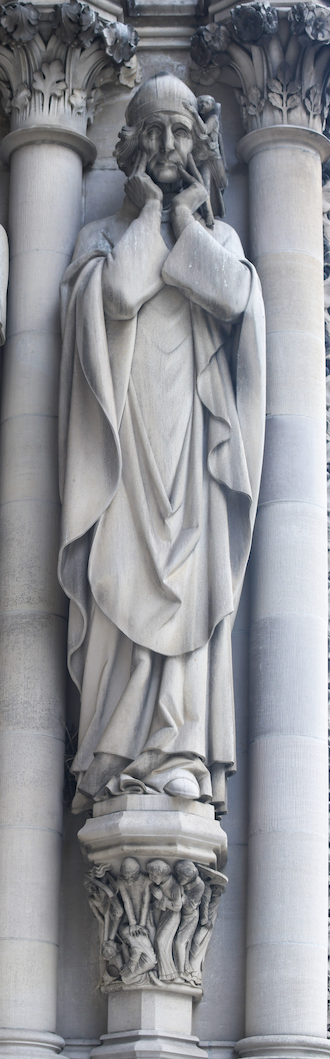
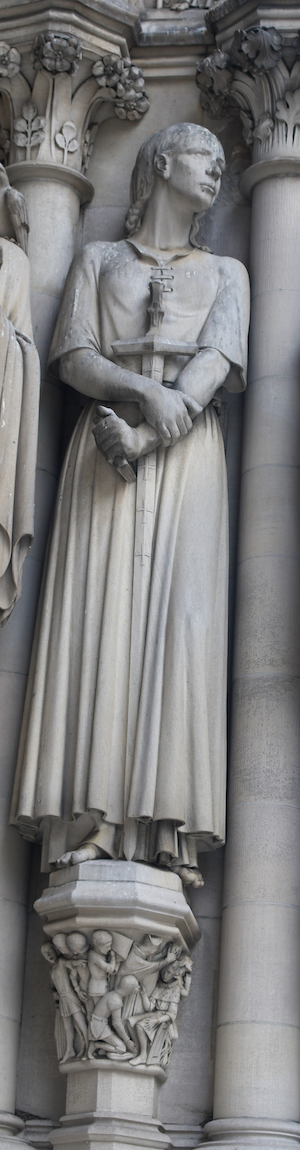
Joan of Arc, the third niche on the south side of the Martyr’s Portal. Photo: Robert F. Rodriguez, 2026.

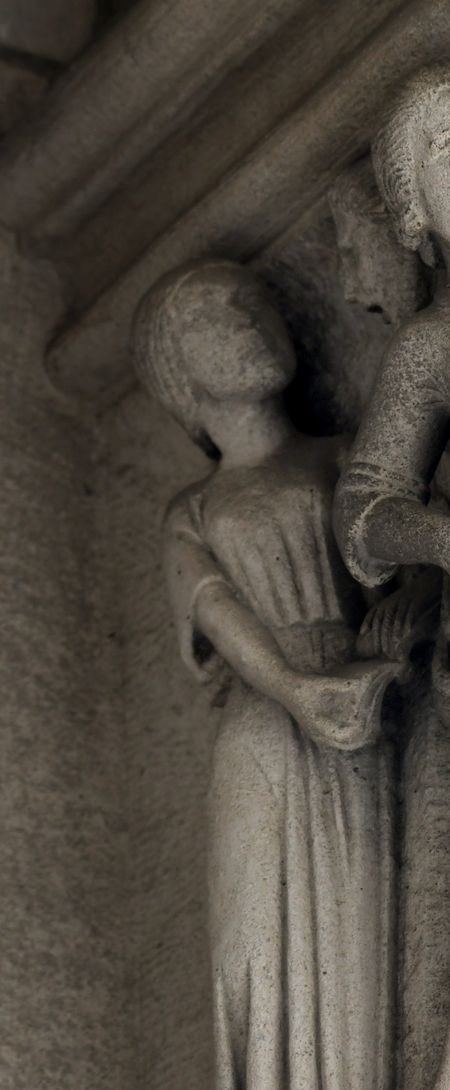
St. Joan of Arc occupies the third niche on the south side of the Martyrs Portal.

She stands erect, like the soldier she became, gazing outward from her niche with an expression of intense concentration. She is listening, raptly, to the voices that spoke to her from age thirteen until her martyrdom at age nineteen. She believed them to be the voices of the archangel Michael, St. Margaret of Antioch, and St. Catherine of Alexandria, whose image faces her from across the portal.

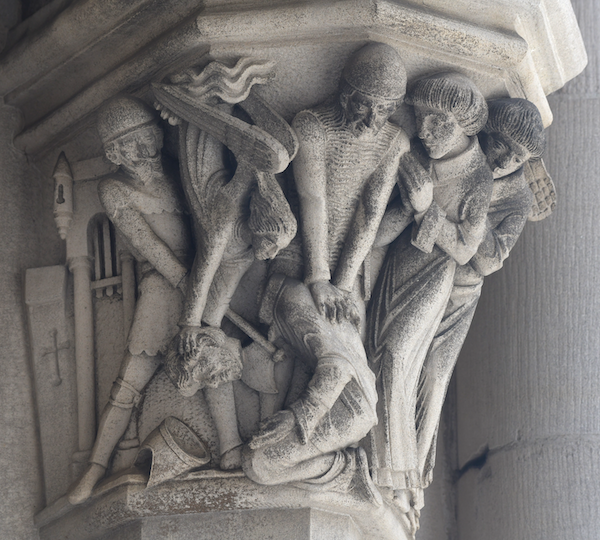
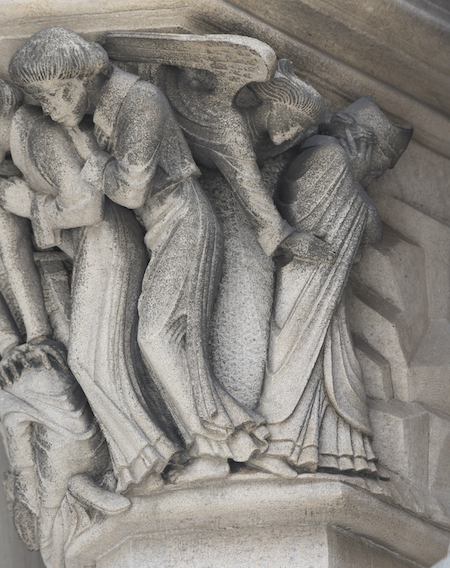
The pedestal beneath the full-length figure is a panorama depicting four scenes from Joan’s life with ten individual figures, four of whom are Joan herself. Sculptor John Angel confronted a daunting challenge in composing a visual narrative of Joan’s eventful life within a severely limited amount of space. He accomplished this without overcrowding the surface or disrupting the narrative’s flow and clarity. The pedestal is a tour-de-force for John Angel, who modeled it in clay, as well as for the Ardolino carvers, who realized it in stone down to the most intricate detailing.

The pedestal of the Joan of Arc statue
The pedestal of the Joan of Arc statue. John Angel, sculptor; the Ardolinos carvers. Photo: Robert F. Rodriguez, 2026.

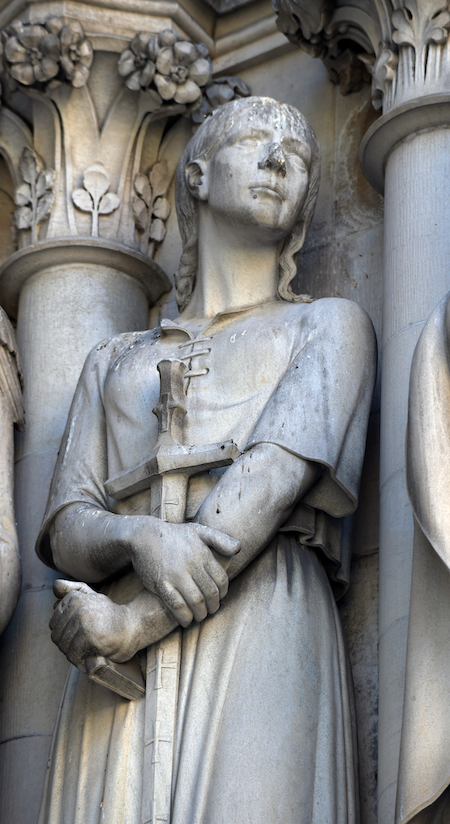
John Angel’s full-length jamb figure of Joan includes three objects – kirtle, sword, and book – each signifying one of the three eras of her brief life – childhood, military campaigns, and trial and execution. 

Joan of Arc: Superstar
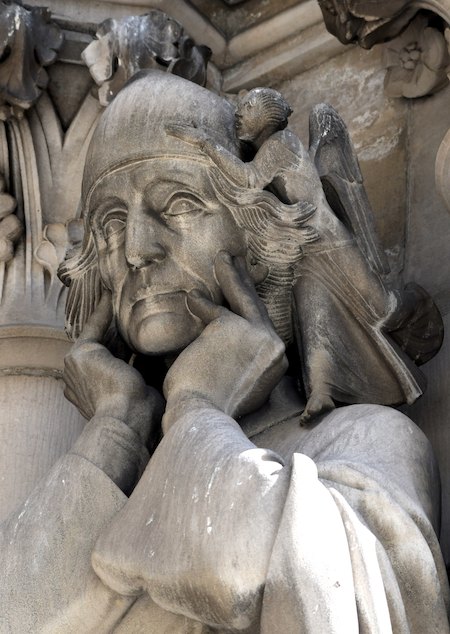
Close up of Joan of Arc statue. Photo: Robert F. Rodriguez.

The Kirtle

The first object is her short-sleeved, front-laced peasant dress known as a kirtle. She would have worn such a dress when she tended sheep in the fields of her native village, Domrémy, in the region of Lorraine. It was in these fields that, at age thirteen, she first heard the voices calling her to liberate France from foreign armies and install the uncrowned Dauphin to his rightful place on the throne. 

On the pedestal below, the first scene on the left-hand side shows Joan listening intently to an airborne being whose face appears above her. 

Joan is listening to the voice
Joan listening to a voice, left pedestal.. Photo: Robert F. Rodriguez.

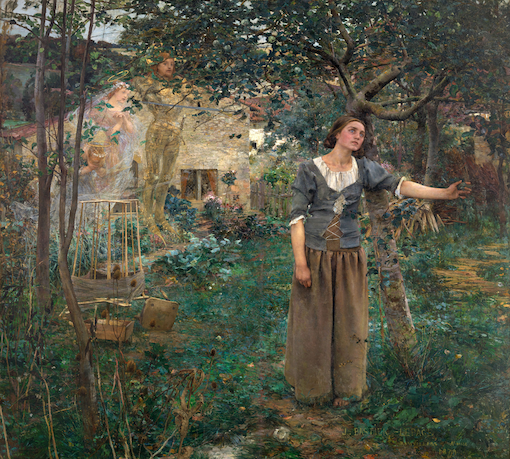
Julien Bastien-LePage’s painting depicts the same scene in colorful, dramatic detail. The saints are translucent images behind Joan, who stands frozen, transfixed by their voices. An interesting detail is the loom with its chair toppled on its side, signifying that Joan will no longer do the work traditionally done by women. The painting was created in the wake of the Franco-Prussian War of 1870-71. As part of the settlement, France ceded part of Joan’s home province of Lorraine to the German Empire. 

Joan listening to voice
Joan of Arc listening to the voices of the saints. Julien Bastien-LePage, artist. Oil on canvas, 1879. Photo: Metropolitan Museum of Art.

The Sword

The second object, signifying her military campaigns, is the sword that she enfolds with her arms. There are five crosses on its blade. Joan never used the sword as a weapon and never killed anyone. She led her troops into battle with her standard rather than her sword. After battles, she would comfort all who were wounded, both ally and enemy, and pray for the souls of all the slain. On the pedestal below, we see two scenes from Joan’s military career. 

Joan in battle

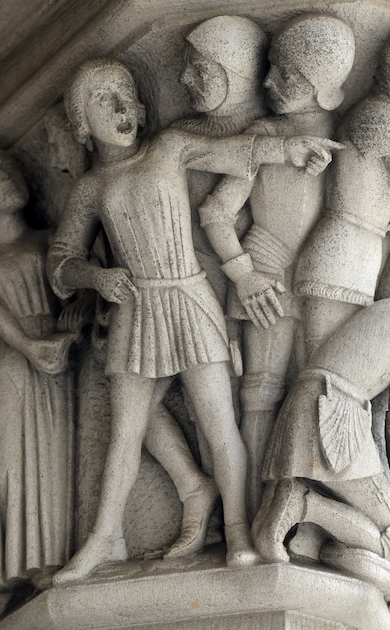
On the pedestal’s left and center faces, Joan, now seventeen, shouts commands to her troops on the battlefield. The scene is mostly likely the breaking of the English siege of Orléans, her most celebrated military success. Joan wears a man’s belted tunic and hose. Her insistence on wearing male attire would enrage the prelates at her trial.

Joan commands her troops
Left center of pedestal, Joan commands her troops. Photo: Robert F. Rodriguez.

Coronation

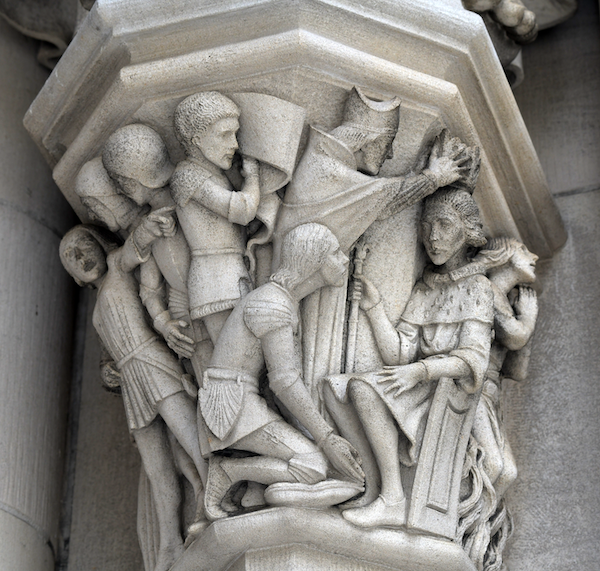
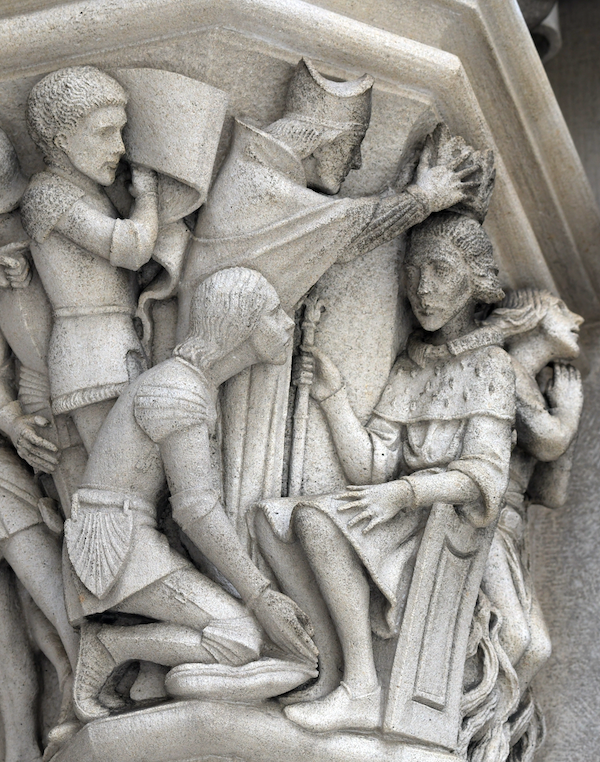
The next scene, center-right, is the coronation of Charles VII as rightful ruler of France. Joan, in armor, kneels as the bishop of Reims crowns the king. Charles, enthroned, sports an ermine cape and grasps a scepter in his right hand. 

The coronation of Charles VII
Center-Right of the pedestal depicting the coronation od Charles VII. Photo: Robert F. Rodriguez, 2026.

A significant detail – the position of the throne, which places Charles with his back to the image of Joan at the stake. When Joan was later captured, imprisoned, and put on trial, Charles made no attempt, either diplomatic or military, to win her release. He literally turned his back on the woman who put him on the throne.

Behind Joan, a soldier bears her battle standard. The standard featured a white field with many fleur-de-lys, an image of Christ in Glory accompanied by two angels, and the names Jesus and Maria. It was created at Tours while Joan’s army was preparing for the assault on Orléans. James Power, a Scottish painter, made it at Joan’s direction. Joan, at her trial, testified that the design was dictated to her by Saints Catherine and Margaret. She also testified that she always carried it into battle herself so that she would not have to kill anyone. 

In the painting below, the artist closely followed Joan’s description of the standard.

Joan of Arc with battle standard
Joan of Arc with her battle standard. Hermann Stilke, artist. Oil on canvas, 1843. Photo: Hermitage Museum via Wikimedia Commons.

After the coronation, Joan and her troops returned to the task of driving out the English but suffered reverses. An arrow lodged in her thigh during a failed attack on Paris. Burgundian forces, allies of the English, captured her as she was attempting to break a siege at Compiègne. The Burgundians sold Joan to the English for the enormous sum of 10,000 livres, which modern estimates equate to millions of dollars.

The Book

The third object Joan holds is the book in her left hand. Joan was illiterate, so it likely signifies the gospel book on which she swore an oath during her lengthy trial. She swore to testify truthfully, while reserving the right to keep secret the divine revelations she received from the voices.

Joan at trial
Joan of Arc swearing the oath at her trial. Anthony Serres, artist. Oil on canvas, 1867. Photo: Musée des Beaux-Arts de Bordeaux via Jeanne-darc.info.

Joan was put on trial in Rouen for sorcery and heresy. During the trial, she was imprisoned in a tower of Rouen Castle. An earlier Divine Stone post describes how a stone from that tower came to rest in the Cathedral’s Chapel of St. Martin.

https://divinestone.org/blog/the-joan-of-arc-stone/

Prosecutors grilled her endlessly about the voices she heard, suspecting they were demonic in origin. To them, her reliance on private revelations reeked of what would become known as Protestantism. They also harassed her about her insistence on wearing male attire, which they found quite aberrant, though Joan plausibly claimed it was a defense against sexual assault in prison. 

Joan held her own on the witness stand, but week after week of badgering wore her down. With someone guiding her hand, she signed a recantation. But she quickly withdrew the recantation, cognizant that by doing so, she was sure to be sentenced to a heretic’s death – burning at the stake.

Execution

Joan's execution
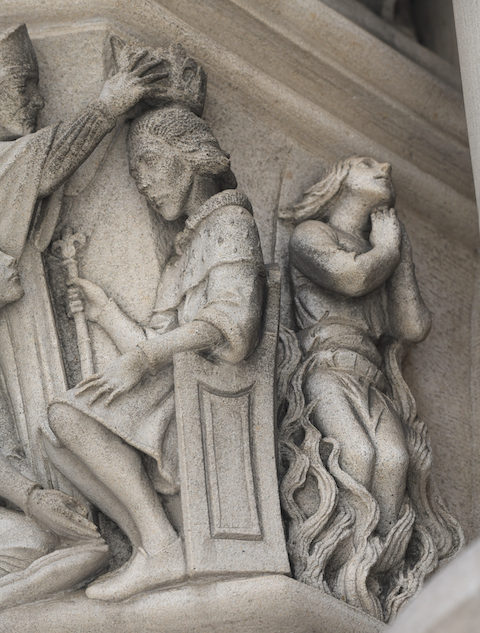
Right-side pedestal: the execution of Joan. Photo: Robert F. Rodriguez, 2026.

The pedestal’s final scene, on the right face, is Joan’s execution in the plaza fronting Rouen Cathedral. As the flames rise, Joan seems to merge with them. She looks heavenward, hands clasped in prayer. Eyewitness accounts report that she repeatedly cried out “Jesus!” Afterwards, the English executioner threw her ashes into the Seine, lest they become the object of veneration by the French.

Joan of Arc’s ashes thrown into the Seine. Rouen Cathedral in the background. Emile Deshays, artist. Engraving, c. 1900. Photo: Bibliothèque des Arts Décoratifs, Paris.

In 1452 – twenty-one years after Joan’s execution – Pope Callixtus III granted a request from Joan’s mother and brothers that her conviction be reexamined. Four years later, the allegations in the original trial were given a new trial and the first trial’s verdict was overturned. Joan was exonerated. But not until 1920 did the Roman Catholic Church declare her a saint, and then with a surprising hitch.

Canonization of Joan D'arc
Canonization of Joan of Arc. St. Peter’s Basilica, May 16, 1920. Photo: Jeanne-darc.info.

Was Joan of Arc really a martyr?

If this strikes you as an idle question with an obvious answer, then you may be as surprised as I was to discover that Joan of Arc is not designated a martyr in the Roman Catholic canon of saints. In Pope Benedict XV’s papal bull announcing Joan’s canonization, Divina Disponente (“By Divine Provision”), the word “martyr” is conspicuous by its absence. 

Rather, the document identifies her as Beata Ioanna de Arc, Virgo (“Blessed Joan of Arc, Virgin”). Note – “virgin,” not “virgin martyr.” Saints Margaret and Catherine, whose voices spoke to Joan, are designated virgin martyrs. So are many other female saints. Why not Joan?

Catholic author Bert Ghezzi explains the church’s position in his book Mystics and Miracles:

The church officially remembers Joan of Arc not as a martyr but as a virgin – the Maid of Orleans. Of course, Joan was a martyr, but not in the technical sense. Yes, she died because she did what she thought it was what God wanted her to do. But she was killed for her politics, not for her faith. Pagans did not execute her for refusing to worship their gods. Infidels did not slay her for defying them. Political enemies burned her at the stake for defeating them at war.

Divina Disponente’s stated justification for Joan’s canonization is: “… her innocence, faith, holiness, and obedience to the commandments of God, for which she endured all things to the point of a terrible and unjust death.” While he avoids the word “martyr,” at one point in the lengthy document the Holy Father appears to forget himself, writing “the small men (nani, lit. “dwarves”) responsible for Joan’s martyrdom (de martyrium Ioannae) died a most ignominious death.”

Author Mary Gordon, in her insightful article “Desperately Seeking Joan,” asserts that Joan is beyond category, so uniquely multifaceted as to defy the limitations of a term like “virgin martyr:”

… a look at her [Joan] in the clear light of her words and actions creates an image not of singleness but of fascinating complexity. She was a virgin and she died for what she believed, but she does not fit the type of the virgin martyr. Ardent, impatient, boastful, resistant, implacable, she is like all great saints, a personality of genius.

The Anglican churches echo the Roman Catholic skepticism about Joan’s status as a martyr. For her feast day of May 30, the Episcopal Church’s liturgical calendar lists Joan not as a martyr but a “mystic and soldier” while the Church of England designates her a “visionary.” The Anglican Church of Canada dodges the question, listing her only by name, and the Anglican Church of Australia simply ignores her.

The Superstar Saint

If the Roman and Anglican communions do not recognize Joan as a martyr, then why is her image in the cathedral’s Martyrs Portal?

It was only a few years after Joan’s canonization that Bishop William Thomas Manning, architect Ralph Adams Cram, and the other members of the Iconography Committee decided that the Cathedral should have a portal dedicated to martyrs. They also decided that Joan of Arc should be in it, ecclesiastical hairsplitting notwithstanding. 

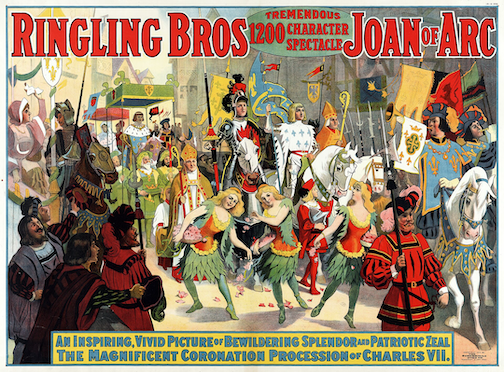
The committee was listening to the public, not the prelates. For by then, Joan had become a superstar among the saints, recognized, admired, and revered by millions. The depth to which her story stirred the popular imagination is reflected by numberless biographies, novels, plays, films, paintings, sculptures, and other media, both highbrow and lowbrow, even the performance art known as the circus.

Ringling Brothers
Ringling Brothers Circus Poster. Artist unknown. Chromolithograph, c. 1912. Photo: Library of Congress.

The aura of Joan’s sanctity touches not only the faithful but also the irreligious. Two of the best literary treatments of her story are by notably irreligious writers: Mark Twain’s biographical novel Joan of Arc and Bernard Shaw’s play Saint Joan. In fact, in 1924, Shaw’s play was having a long run on Broadway even as the cathedral’s leadership was preparing to resume construction and launch a major fundraising campaign.

St. Joan book design
Saint Joan, book cover design. Charles Ricketts, artist, 1923. Photo: Wikimedia Commons.

Nothing did more than World War I to inject Joan into the national consciousness of Americans. Like all the other Allied countries, the U.S. exploited Joan’s image for propaganda purposes. The poster below was ubiquitous – Joan as both Savior of France and the All-American Girl.

Joan of Arc saved France poster
Joan of Arc saved France. Lithograph poster. William Haskell Coffin, artist, 1918. Photo: Library of Congress.

Reflecting the scope of the public’s fascination with Joan, Cecil B. De Mille’s epic biopic Joan the Woman was the second-highest-grossing film released in 1916. The film begins and ends with scenes of British soldiers in the trenches, drawing an explicit parallel between Joan’s martyrdom and the sacrifices of soldiers on the battlefield. 

Joan the Woman movie poster
Joan the Woman, movie poster. Photo: IMBd.

Bishop Manning’s high regard for soldier saints undoubtedly influenced the decision to include Joan in the Martyrs Portal along with St. Alban, another soldier saint. Manning was an early critic of President Wilson’s policy of neutrality and an outspoken advocate for the United States joining the French and British in the fight. His service as a wartime Army chaplain made his admiration for the military all the more ardent. His biographer notes that “his voice was clear and persuasive in contradicting the assumption that religion and pacifism go hand in hand.” 

In our own time, for her rejection of traditional female roles and her cross-dressing, Joan has been adopted as a patron saint by those who fight for transgender rights. Leslie Feinberg, discussing Joan’s trial in her book Transgender Warriors, argues that “the core of the charges against Joan focused on her cross-dressing, the crime for which she ultimately was executed.” Feinberg regards her as a martyr: “Joan of Arc suffered the excruciating pain of being burned alive rather than renounce her identity.” The image below, an icon from Katy Miles-Wallace’s Queer Saints series, is a fresh take on a familiar saint.

St. Joan of Arc. Katy Miles-Wallace, artist. Photo: Courtesy of Qspirit.net

John Angel’s sculpture of Joan has intrigued and inspired visitors for the ninety years it has stood in the Martyrs Portal. Six centuries after her martyrdom, the aura of her superstardom is undimmed. During the many years I’ve been introducing visitors to St. John the Divine, I’ve taken hundreds of them to the Martyrs Portal. Few can identify the other sculpted figures, but rare is the visitor who does not immediately recognize St. Joan of Arc. Such is the saintly celebrity of the woman whom Mark Twain characterized as “easily and by far the most extraordinary person the human race has ever produced.”

Sources

  • Atwater, Donald. The Penguin Dictionary of Saints 2nd ed. (Penguin, 1983).
  • Ballan, Anna. “Joan of Arc: Warrior Muse” in Commonweal, December 28, 2023.
  • Bychowski, M.W. “The Patron Saint of Dysphoria: Joan of Arc as Transgender.” in http://www.thingstransform.com/2019/05/the-patron-saint-of-dysphoria-joan-of.html
  • Farmer, David Hugh. The Oxford Dictionary of Saints, 2nd ed. (OUP, 1987).
  • Feinbeg, Leslie. Transgender Warriors (1996).
  • Ghezzi, Bert. Mystics and Miracles (Loyola Press, 2004).
  • Gordon, Mary. “Desperately Seeking Joan” in Commonweal, June 21, 2004.
  • Holy See. Divina Disponente, Papal Bull, May 16, 1920.
  • Hughes, W.D.F. Prudently with Power: William Thomas Manning, Tenth Bishop of New York (1969).
  • “Joan of Arc – Her Battle Standard.” https://saint-joan-of-arc.com/banner.htm
  • “Joan of Arc – Her Sword.”  https://saint-joan-of-arc.com/sword.htm
  • Kilgore, Jennifer. “Joan of Arc as Propaganda Motif from the Dreyfus Affair to the Second World War” in Revue LISA v. 6,no. 8 (2008).
  • Kittredge, Cherry. “New Icons of Queer Saints created by artist Katy Miles-Wallace.” https://qspirit.net/queer-saints-katy-miles-wallace/
Categories
Divine Stone

St. Vincent of Saragossa: Protomartyr of Spain

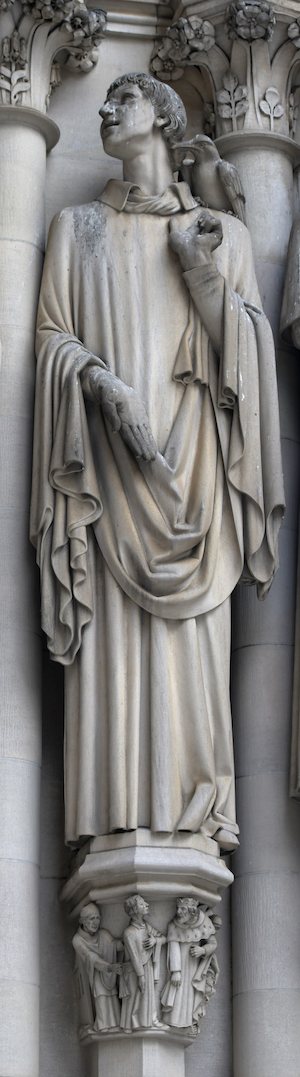
St. Vincent full statue
Full Statue of St. Vincent on the martyr’s portal south side. Photo: Robert F. Rodriguez.

St. Vincent was martyred during the Diocletian persecution of Christians (303-311). He was a deacon in the Roman settlement of Caesaraugusta, which today is the Spanish city of Zaragoza (aka Saragossa). Instead of a deacon’s customary dalmatic, he wears a cape-like chasuble over an alb. Another signifier of a deacon is draped over his left arm – the short scarf known as a maniple.

We find Vincent engaged in a conversation with his neighbor, St. Lawrence, which Vincent is enlivening with his expressive hands. Perched on his left shoulder, a raven, with its own role to play in the narrative of Vincent’s martyrdom.

Little is known about Vincent’s life aside from the colorful accounts of his martyrdom. The narrative in the Golden Legend appears to be based principally on the hymn to Vincent in the Peristephanon (“Crown of Martyrs”) of Prudentius, a late fourth century Christian poet who composed in Latin and may have been, like Vincent, a native of Caesaraugusta. The  Peristephanon has been translated into delightful English verse by Len Krisak.

According to these accounts, Vincent served under Valerius, bishop of Caesaraugusta. Valerius had a speech impediment and often relied on Vincent to speak on his behalf. During the Diocletian persecution, Valerius and Vincent were arrested for refusing to sacrifice to the pagan gods and brought before Dacian, the Roman governor of Valencia. 

The Pedestal

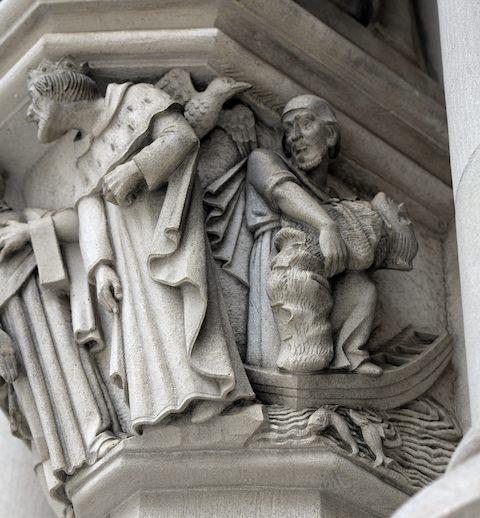
St. Vincent pedestal
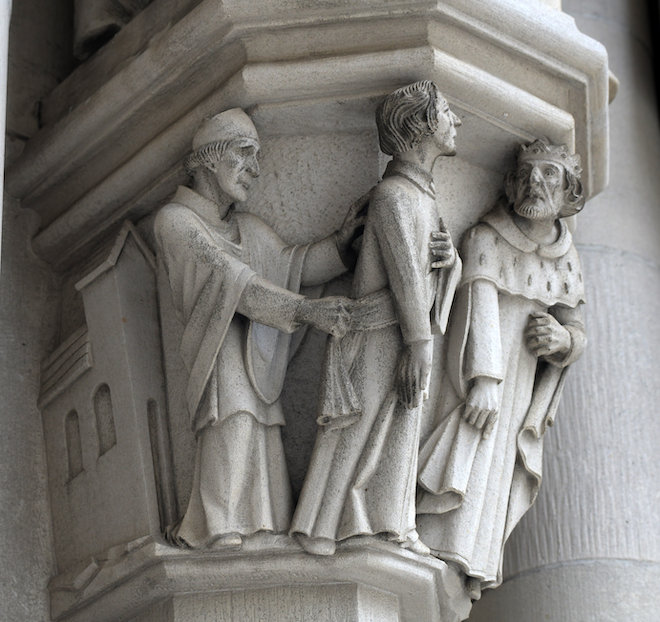
St.Vincent’s pedestal, left and center. Photo: Robert F. Rodriguez.

The left and center sides of the pedestal depict Vincent and Valerius coming before Dacian. (Dacian could be the twin brother of the emperor on St. Lawrence’s pedestal. Perhaps John Angel employed the same model for both figures.)

The elderly Valerius clings to Vincent. Vincent stands erect before Dacian with his hand on his heart as he states emphatically that neither he nor Valerius will deny their Christian faith. 

Vincent’s response angers Dacian. With fist clenched and face contorted with rage, he threatens Vincent with the bone-crushing horrors of the rack. Vincent responds:

O unhappy man, how weenest [expect] thou to anger me? The more grievously that thou tormentest me, so much more pity shall God have on me. Arise up, thou unhappy man and cursed, and by thy wicked spirit thou shalt be vanquished, for thou shalt find me more stronger by the virtue of God to suffer thy torments, than thou hast power to torment me.

While Valerius is sent into exile, Vincent’s audacious challenge to Dacian earns him a triathlon of tortures. His bones are broken on the rack. (In some accounts, a wine press replaces the rack, which explains how Vincent became the patron saint of winemakers.) His flesh is lacerated by iron hooks, then seared on the gridiron. The pain he has suffered only strengthens Vincent’s resolve, as the Legend recounts: And for all this, he was unmovable, but he prayed our Lord Jesu Christ with joined hands up to heaven.

The exasperated Dacian then has Vincent taken to a dark prison cell where he is placed atop a bed of pottery shards with razor-sharp edges – the death of a thousand cuts. Dacian assumes that Vincent cannot possibly survive. But when Dacian’s henchmen peek into the cell, they find it filled with light, the shards transformed into fragrant flowers, and the air filled with the music of angels. 

Dacian then orders that Vincent be transported to a soft bed where he hopes Vincent will recover sufficiently to be subjected to a new round of tortures. But this scheme also goes awry, for Vincent at last gives up his spirit to God.

St. Vincent's pedestal right side. Photo: Robert F. Rodriguez
St. Vincent’s pedestal, right side. Photo: Robert F. Rodriguez.

The pedestal, which leaves the visualization of Vincent’s gruesome ordeals to the viewer’s imagination, now picks up the narrative after Vincent’s death. Directly behind Dacian, we see a bird – a raven. The Legend tells the story:

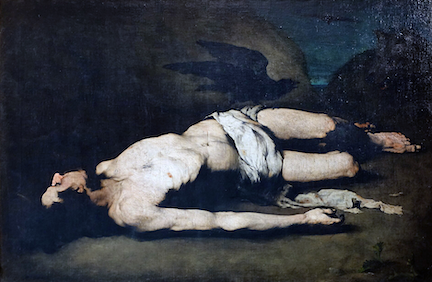
Then the body of St. Vincent was cast in a field for to be devoured of the beasts and fowls, by the commandment of Dacian, but it was kept by angels from touching of any beasts, and after came a raven which drove away all other birds and fowls, greater than he was, and chased away also a wolf with his bill and beak…

St. Vincent
Corpse of St. Vincent with ravens. Oil on canvas. Augustin Ribot, artist. 19th century. Courtesy of Palais des Beaux-Arts de Lille via Wikimedia Commons.

Wishing to be rid of Vincent for good, Dacian commands that Vincent’s body be recovered, placed in a sack, attached to a millstone, and buried at sea. On the right side of the pedestal, we see a sailor preparing to hoist the sack into the sea. In an amusing detail, fish gather to feast on the corpse. But by the time the boat returns to port, Vincent’s body has miraculously floated back to shore, intact.

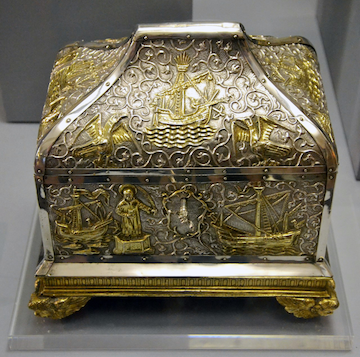
Vincent then receives a proper burial, but this is just the beginning of Vincent’s further peregrinations. At some point, Vincent’s relics were interred in a basilica in Córdoba. During the Moorish invasion of the Iberian peninsula in the 8th-century, the relics were moved to Portugal for safekeeping. One account has them interred for a time on Cape St. Vincent, the extreme southwestern point in Europe. Today, with exception of his left arm, Vincent’s relics rest in Lisbon Cathedral in a silver reliquary depicting the casting of Vincent’s body into the sea. 

Relics of St. Vincent, Lisbon Cathedral
Reliquary containing relics of St. Vincent in Lisbon Cathedral. Photo: Paulo Almeida Fernandes.

The saint’s purported left arm can be viewed in a reliquary in the ambulatory of Valencia Cathedral.

Reliquary of St. Vincent's arm
Reliquary containing the left arm of St. Vincent. Photo courtesy of Valencia Cathedral.

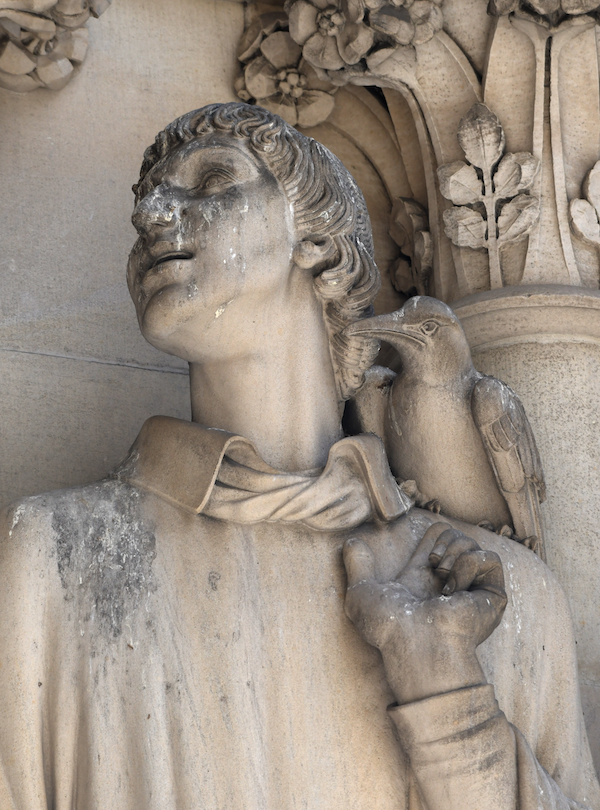
Vincent’s Raven

Vincent with Raven
Close-up of the raven on St. Vincent’s shoulder. Photo: Robert F. Rodriguez.

 The life-size raven perched on his shoulder makes Vincent stand out from the other figures in the portal. The raven is one of Vincent’s standard attributes, but one wonders if its prominence indicates a symbolic purpose beyond that of mere identification. I suggest that we might regard Vincent’s raven as a sign of God’s grace.

Ravens, by nature, are scavengers. Like vultures, they feed on decaying flesh. They are also one of the most intelligent species of birds, legendary for their cleverness. According to ornithologist Stephen Moss, “ravens have a larger brain relative to their body size than most birds.” 

Moss reports that ravens are known to find food by cooperating with human hunters and mammalian predators such as wolves. Though ravens are too small to kill large prey like deer, they have one big advantage over humans and wolves – they fly. Moss explains:

Only the raven can reconnoiter a large area of ground, locate potential prey, and then return to guide the hunters towards the target. If the hunters succeed in making a kill, they will feast on the animal’s flesh. But when they are done, they leave the remains behind, with enough meat on the bones for the ravens to scavenge a hearty meal.

If we consider how courageously Vincent endured the most excruciating torments with unwavering faith in God, it is unthinkable that a loving God would be so ungracious as to allow Vincent’s lifeless body to suffer the final indignity of being ravaged by predators. Instead, God sends a raven to drive the predators away.

That the raven should be chosen for this task is as ironic as it is extraordinary, for the raven is itself a flesh-eating predator. To abstain from feasting on Vincent’s corpse is contrary to every one of a raven’s natural instincts. Just as remarkable is how fiercely the ravens defend the corpse from other predators. The ravens even turn against the wolves, their hunting partners, as Prudentius recounts in Len Krisak’s translation:

This bird, from nearby bushes, drove

Away a savage wolf by beating

With its raucous wings and cries,

With feathers slashing at the eyes.

Prudentius compares Vincent’s ravens to those in an Old Testament passage depicted in the central portal above the figures of Elijah and Elisha. 

small carving Elijah
Detail of carving in progress on May 29, 1999, showing Elijah in the wilderness where he survived on food delivered by ravens. Simon Verity and Jean-Claude Marchionni, sculptors. Photo by Martha Cooper.

Here we see ravens again serving as agents of God’s grace. When the kingdom of Judah turns to the worship of Baal under the evil king Ahab, God withholds the rain. At God’s direction, the prophet Elijah escapes the wrath of Ahab and the drought by traveling to a brook in the wilderness. There “the ravens brought him bread and meat in the morning, and bread and meat in the evening, and he drank from the brook” (I Kings 17:6).

Ravens are uncommon in New York City. Perhaps it was God’s grace that brought a pair of living, breathing, squawking ravens to join the sculpted stone ravens on the west front last year. To the delight of local birders, the ravens built a nest in the gable of the south portal, high above the traffic roaring by on Amsterdam Avenue. When five chicks appeared this spring, the birders keeping watch on the nest rejoiced in much same spirit as did the psalmist many centuries before:

Sing to the Lord with thanksgiving; 

Make melody to our God upon the lyre!

He covers the heavens with clouds, 

He prepares rain for the earth, 

He makes grass grow upon the hills.

He gives to the beasts their food, 

And to the young ravens which cry. (Ps. 147:7-9)

Cathedral Ravens
Mother raven with four of her five chicks in the gable of the south portal, April, 2026. Photo: Lois Uttley.

Sources