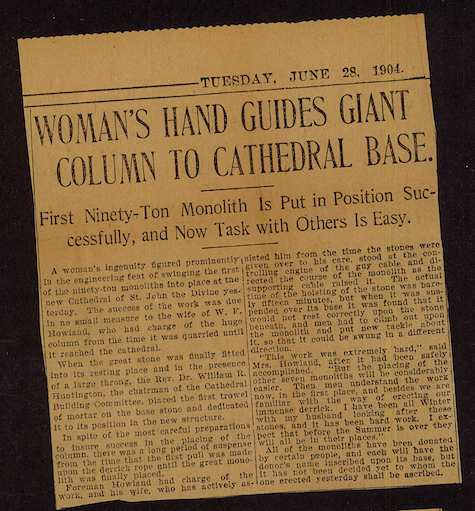
This newspaper clipping sat staring at me in that magical time machine of the Cathedral Archives. I had read multiple scholarly works about the raising of the monumental columns at the Cathedral, Scientific American, Engineering News, but had not run across this story. She is identifed as the wife of Foreman Howland.
From the time the columns left the quarry they were the responsibility of Superintendent Willis F. Howland. Mr. Howland was a prominent late 19th century granite contractor and engineering superintentent connected to the Vinalhaven granite quarries. Mr. Howland had an extremely capable partner in the Cathedral activities. Carrie A. Howland, Mr. Howland’s wife, guided the work of erecting the columns while he was at the controls of the raising machinery. She worked with Mr. Howland in all phases of the design and planning for the erection as they had with many previous monumental installations. She earned her place in the operation. The New York press found her work unique, unfortunately, based solely on being a woman. The jump story subheadline in the New York Tribune said “Odd Work For A Woman.”

Carrie Howland had years of experience gained in the erection of monuments of all sizes. She was familiar with the use of cables, ropes, pulleys, levers, scaffolds, hammers and drills. “This work was extremely hard,” said Mrs. Howland in the article, “but the placing of the other seven monoliths will be considerably easier. The men understand the work now, in the first place, and besides we are familiar with the way of erecting our immense derrick. I have been all winter with my husband looking after these stones, and it has been hard work. I expect that before the summer is over they will all be in their places.” It, however, took until November 30 for the final column to be set.

The New York Tribune reporter likened Mrs. Howland to Sabina von Steinbach, the legendary 13th century stone carver and sculptor. Local folklore credits Sabina with carving the allegorical statues of Ecclesia (the church) and Synagoga (the synagogue) on the south portal of the Cathedral Notre Dame de Strasbourg. She appears in multiple artworks that have extended the myth. Although she definitely existed, modern scholars are in doubt that she carved these statues. In the 13th-century, a woman’s position in the Guilds was dependent on special circumstances. She appeared to be trained by her father and was allowed to take over his workshop when he died.

There have been statues of Sabina and her father, the architect of the Cathedral in Strasbourg, since 1864.

Fast forward to the 1980s; there were many women cutters and carvers in the ranks of the Dean Morton era Stoneyard Institute, working on the southwest tower. Below, the carver Cynthia “Cynie” Linton.

■
- Many thanks to the Cathedral officials that allowed us access to the archives.
- Thanks to Archivist Wayne Kempton, our guide to the information
- https://en.wikipedia.org/wiki/Sabina_von_Steinbach