Categories
Divine Stone

Kazutaka Uchida 1948-2024

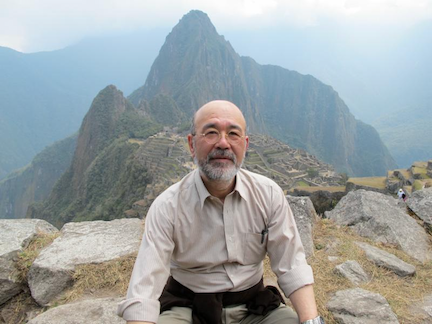
Word has reached us regarding the passing of stone carver and sculptor Kazutaka Uchida. We wish to offer condolences to his family, students and his many friends in the stone carving community. He was very proud of his many summers spent in the United States in the Pacific Northwest; Marble, Colorado, and Northern New Mexico teaching and working on his own carvings.

He was born and lived in Japan where he first studied sculpture. He received an advanced degree in sculpture from the Ecole Des Beaux-Arts in Paris in 1975. He returned to Japan and was commissioned to researched artisan traditions for the Japanese government. His experiences in Nepal greatly affected his art and his life.

Uchida found resonance in clear lines, subtle beauty, harmonious relationships, and the quiet power of elemental forms to evoke the transcendence and a feeling of Zen-like monastic tranquility and peace. The museum director Stephen C. McCough describes Uchida’s sculpture…”It is an art of large and simple gestures which lead the eye through and around the piece and then into the surrounding space. His forms are elegant and refined. They consist primarily of the sphere, the plane, the disk, the straight line and the rectangle.”

Sculptors carve and polish stones, not to make beautiful stones; rather, the forms they make are the result of their search for the limits of their artistic capabilities.

– Kazutaka Uchida
Uchida working on a sculpture at the Sax Stone Carving Workshop in Rinconada, New Mexico
Categories
Divine Stone

The Granite King

The Granite King
The Granite King. Image – Prominent and Progessive Americans, 1902

One of the largest and most important stone contractors in the country, John Peirce became known as the “Granite King”. The firm supplied the material and constructed the foundation piers and superstructure of this phase of the Cathedral. 

THe Granite King
John Peirce Company construction office on Cathedral grounds. June, 1908 NYPL, Digital Collections – Image ID 716214F, C/R 0687-D1

Born in Frankfort, Maine, Peirce had studied law at Harvard but chose to return to Maine in 1873 to take over his father’s granite business at Mount Waldo. His father had several important granite quarries as well as a general contracting and building business.  He took to the industry quickly and began to grow the enterprise. Through investment, directorships and ownership he acquired additional granite properties to the extent that he largely controlled the output of the stone in the state.  He gained interests in the Hallowell Granite Works and the Boswell Granite Company. Among these was the Boswell Granite Fox Island Company. Included were Vinalhaven’s vast granite resources. By the 1900’s there were over 46 small quarries on Vinalhaven. The Vinalhaven Warff Quarry was the source of the monumental columns at the Cathedral.

From Maine to New York

Peirce moved to New York City in the late 1880’s to oversee the operation of his New York and Maine Granite Paving Block Company.  One of the company’s contracts paved Fifth Avenue from 8th Street to 90th Street with granite blocks.

The Granite King
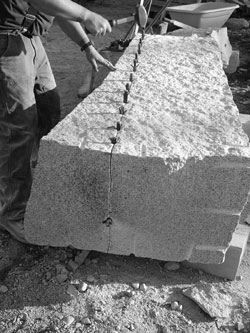
Granite being shaped at the quarry with feathers and wedges.

He also realized that New York was the building center of the country and granite had become the symbol of strength and solidity. By the 1890’s he began to furnish building materials and erect many buildings in the city. Grand Central Terminal, the 42nd street New York Public Library and New York City’s first subway system among them. Peirce’s firm soon grew to be one of the largest granite contractors in the country.

The Granite King
Granite Ashlars and Voussoirs from Quarry at Cathedral Site. July 1900 – Image NYPL Digital Collection

By 1915 concrete, steel and asphalt replaced much of the demand for stone building products. Sleek modernity, rising costs of construction, modern paving methods and the decline of the stone carvers art were killing the granite industry. The advent of railroads especially the vastly superior networks in the midwest and the development of the limestone industry added to the decline. The “Granite King’s ” John Peirce Company ceased to exist.

  • New York City Landmarks Preservation Commission
  • Prominent and Progressive Americans; an encyclopedia of contemporaneous biography, Harrison, Michael Charles, 1902, Vol. 2
  • New York Public Library Digital Collections


Categories
Divine Stone

“Jeep” Kincannon

"Jeep" Kincannon
Jeep Kincannon Carving a Label Stop – Photo Robert F Rodriguez

(This is an encore post following Robert F. Rodriguez’ article on the Kincannon brothers. – The original post appeared December 22, 2021 and was written by Joseph Kincannon.-RM)

Jeep, or rather D’Ellis Kincannon, started his apprenticeship in the stoneyard in 1980 after working in the Cathedral mail room for a year. He came to NYC to go to art school, but found it wasn’t for him. When the stone yard program started up it seemed a perfect fit, and it was.

He excelled as a banker mason. I think it’s fair to say that he and Jose (Tapia) were the top stone cutters. The Cathedral showcased their work for fundraising purposes. They were featured in multiple magazines and news publications.

Dean Morton reminisces about the Stoneyard
Dean James Parks Morton reminiscing about the stunning pinnacle carved by D’Ellis Kincannon during a video inerview on Nov. 19, 2015 at the Interchurch Center in New York City. – Image Robert F. Rodriguez

The Banker Mason

Jeep was also one of the first few to apprentice under Chris Hannaway. He had the highest regard for Chris and was disappointed to see him return to England. He often made reference to Chris’ mastery in banker masonry and anything stone related. Jeep’s prize possession was an old mallet that Chris had given him from his early days in Liverpool.

"Jeep" Kincannon
D’Ellis “Jeep” Kincannon carves a sill skeleton bed mould base on April 13, 1981 – Photo Robert F. Rodriguez
Chris Hannaway's Mallet
Jeep Kincannon’s mallet, from Chris Hannaway Image – Joseph Kincannon

Master Builder James Bambridge was impressed enough with D’Ellis’ work to once state that “his masonry is as perfect as if it had been poured into a mold.” It was obvious that this discipline was one that Jeep immediately embraced. He also had a gift for drafting and setting out. He was a natural at perceiving 3-dimensional intersections.

"Jeep" Kincannon
Jeep’s Pinnacle Carving – Image Robert F. Rodriguez

To advance Jeep’s skills even further, the Cathedral sent him to the Bath School for Architectural Trades in England. This was very rewarding for Jeep as he completely immersed himself in the trade. Aside from the school, he was taken aback at finding himself in a city that the Romans had built in part. He was also astounded that one of the local pubs had been in operation since the “Black Death.” This place became a regular haunt for Jeep and many of the other students.

After a year, Jeep returned to NYC and continued working as a banker mason. By this time, Alan Bird had replaced Chris Hannaway and the yard was humming along. Later Jeep advanced into the setting-out shop with fellow apprentice, Cynie Linton. He had real misgivings about leaving banker masonry. I remember him grumbling despite the promotion.

The Setting-Out Shop

Jeep and Cynie worked directly with James Bambridge transferring the original architect’s drawings into full-scale tower drawings that would later be numbered and patterned into various zinc templates for the banker masons’ shop. The masons used to laugh when he would step in to help an apprentice understand the complex templates. “Uh oh, Jeep’s got that look on his face!” This is not a look you wanted to see, as it usually meant an irretrievable mistake had been made in the stone work. If you had trouble understanding the templates he and Cynie were the ones to see.

"Jeep" Kincannon

Jeep Kincannon setting-out templates for an Ornate Gablet. Image – Smithsonian Magazine

As things slowed down in the setting-out shop, a new opportunity arose; a competition for the new carving apprenticeship under the tutelage of Nick Fairplay. Jeep scored in the top five. He served his three years and was later appointed as head carver. During this period, he contributed many celebrated carvings to the tower. Jeep continued on in that position for a year until he was positioned as the head of the drafting and setting-out department.

As Chief Draftsman, Jeep also worked on the tower with Master Mason Steve Boyle, for whom he had the greatest respect. Boyle was not one to embrace the limelight and Jeep often commented on how he was the unsung hero who quietly puzzled together the massive stones on the tower, a truly monumental task.

Working on the Tower

"Jeep" Kincannon with Angel Escobar
“Jeep” Kincannon with Angel Escobar up on the Southwest Tower. – Photo Joseph Kincannon

Steve relayed a story about how instrumental Jeep was in the setting of the first course of stonework:

“It should be mentioned that Jeep deserves credit for the tower actually fitting on the building. Delays in scaffold erection meant that the first stones that we laid were rather hurriedly positioned. The deadline for the installation of the Jerusalem Stone rapidly approached. The setting of this historic cornerstone included a well-publicized ceremony featuring high wire aerialist, Philippe Petit delivering a silver trowel to the Bishop of New York for the official blessing. Since the scaffolding was only partially in place, it hadn’t been possible to lay out all of the building lines as planned before Bambridge had to return to the UK.

This was alarming to me at the time as it meant this task might fall to me. Sure enough, as we began to set more stone it was clear that the first stones had been set too far over to the North resulting in the new stone overhanging by about a half inch. I called Bambridge in the U.K. and he told me I would have to do the setting out. He understood my uneasiness, but told me I could always rely on Jeep for help with this and he was right. Jeep had a thorough understanding of the whole project by this time and knew exactly what to do. Great thanks to him; everything ended up where it was supposed to be.”

-Master Mason Stephen Boyle

Cathedral Stoneworks

In 1989, he stepped away from drafting to join the carving team working on the West Front. Work on the Central Portal statuary had recently resumed under the direction of Simon Verity. For Jeep, the carving ended too soon. The Jewish Museum awarded a major contract to the stoneyard. It was an early 20th Century Gothic Revival building on 5th Avenue. The drafting department was about to become a very busy place.

This was the beginning of a new era. A commercial venture was underway with the goal of replenishing the depleted Cathedral coffers by taking on independent projects. It was a good effort, but the partnership with Cathedral Stoneworks ultimately marked the end of the tower project and any dream of completing the Cathedral. Jeep continued working as Chief Draftsman until he left in 1993.

He Wore Many Hats

He was one of the few who wore most of the hats available in the Cathedral stone yard. Those hats included sawyer, estimator, banker mason, setting-out, stone carver and fixer mason (on the tower). He would laugh and say that the only job he didn’t do was to run the planer. That position belonged to Nelson Otero, and to only Nelson Otero.

D’Ellis often expressed his admiration for other modest people who produced great stone work for the tower. He often referred to Yves Pierre and Angel Escobar. He once said that “The very first time Angel picked up a chisel, he knew what to do with it. And, it was a little unnerving.” These guys were natural stone cutters, but not inclined to talk in front of the T.V. cameras.

Beyond the Cathedral, he would spend the next eight years teaching, designing, cutting and carving stone on large public and private projects with Kincannon Studios in Texas until his death in 2001. I can say that throughout this period, as busy as we were, he was ready to drop everything and return to NYC if the team reunited to finish the tower. There’s no doubt about that.

Jeep Kincannon
Dragon by D’Ellis Kincannon – Photo by Robert F. Rodriguez
  • The author of this post, Joseph Kincannon, is the younger brother of D’Ellis “Jeep” Kincannon. Joseph is a teacher and architectural sculptor. Professor Kincannon is currently the Chair of Stone Carving at the American College of Building Arts.
Categories
Divine Stone

The Kincannon Brothers

The Kincannon Brothers
D’Ellis “Jeep” Kincannon shapes a pinnacle stone with a long chisel while his brother Joseph Kincannon works on a small tracery on Oct. 31, 1984.

from competition to commiseration…

When D’Ellis “Jeep” Kincannon and his younger brother Joseph worked together as banker masons at The Cathedral of St. John the Divine, there was a quiet but definite fraternal competition. Joseph, five years younger, explains, “Jeep and I were more competitive. I suppose that’s because the end product was clearly defined through shop drawings and job tickets, no guess work. Although extremely complex, masonry work was straight up geometry, allowing the stone cutter to have a more clear-eyed focus on speed and production, leading to a more competitive drive.”

When both brothers were invited to work in the carving shed, however, Joseph says it was like “jumping into the abyss.” And the nature of the brothers’ competition changed.

He recalls,“even with drawings and/or models, there were surprises around every corner — a lot more uncertainty. And to add more pressure, the carvings had to be woven into finely finished stones that a banker mason had already labored over. Neither Jeep nor I felt confident enough to gloat. We were more likely compelled to commiserate. Nick (Fairplay) was very democratic, and articulate in his damning critiques.”

In temperament, the brothers were opposite sides of the coin. Jeep was more quiet and reserved, while Joseph was more outgoing.

Master Carver Nicholas Fairplay said they were like “chalk and cheese.” Nicholas was referring to their approach to carving and differing styles, but their individual personalities were probably factored into his assessment.

According to Nicholas, Jeep was “detail oriented but he found it very difficult to be bold and get out of the box.” By contrast, “Joseph was bold immediately and very fluid, very creative on his pieces.”  

When the brothers began designing and carving label stops for the lower levels of the south tower, they chose topics of interest to them. For instance, Jeep may have been inspired by mythology and forest creatures.

The Kincannon Brothers
D’Ellis “Jeep” Kincannon gently chisels away at the underside of his horned creature “Goat Man” carving on June 3, 1985.

His delicately carved piece of a grotesque with swept back horns, long drooping ears, flowing beard and mustache looks like a young Pan or satyr. In ancient Greek religion Pan is the god of the wild, shepherds and flocks, and companion of the nymphs. Pan is usually represented as having the hindquarters, legs, and horns of a goat, in the same manner as a faun or satyr. Jeep’s work resides on the West façade of St. Paul’s tower, facing Amsterdam Avenue.

For his next label stop carving Jeep worked on a whimsical little forest creature. This happy looking elf featured tight ringlets of hair, long pointed ears and flexing muscular arms. Jeep achieved depth with his exacting carving technique.

The Kincannon Brothers
D’Ellis “Jeep” Kincannon carves curly hair on his “Mighty Might” buttress gablet label stop carving on June 2, 1986.

Jeep’s interpretation featured an exquisitely carved face emerging from thick and sinuously veined foliage on both sides of a creature’s head, with more foliage sprouting from his mouth.

"Jeeps" Green Man
D’Ellis “Jeep” Kincannon’s Green Man label stop and the row of gablets are seen on the northeast corner of the tower on Sept. 13, 2022.

Joseph’s carving style differed from his older brother’s as seen in the variety of his carvings, ranging from humorous creations to odd looking creatures. Two conveyed hidden messages.

If Jeep could make a Green Man, then Joseph chose a carving that could be called a Green Cat. A round-faced feline with tongue sticking out seems to emerge from a border of foliage and acorns. Joseph recalls “it was one of my earliest carvings. Damned thing put me through hell.”

Joseph's Green Cat
Joseph Kincannon starts carving a feline on a buttress gablet label stop in a 1985 photo. Photo by Mary Bloom

While Joseph’s Green Cat can be seen on the tower’s west façade, his remaining three label stops are all set on the South elevation. 

The first carving with a hidden message can be seen in Joseph’s imp with his fingers in his ears.  He said “the stoneyard was struggling at the time. If memory serves there were a lot of layoffs, a management shakeup, accompanied by many painful meetings.”  Joseph kept his head down and kept on working – he didn’t want to hear it. But there was also another reason for the gesture, he explains, “The carving is pointed in the direction of my mother’s apartment building (on Broadway and W. 111 Street) and she can be a little long-winded. The gift-of-the-gab runs in the family, so this was an inside joke. Hence, the inspiration for this ugly little head is two-fold.”

The Kincannon Brothers
Closeup of Joseph Kincannon’s carving of a figure with fingers plugging his ears on June 3, 1985.

A funny carving with deep set round eyes, wearing a brimless hat and using both hands to pull his mouth wide apart, elicited a comment from James Parks Morton, then Dean of the Cathedral. In a 2015 video interview the Dean remarked on the stone carving, “One of the things they recaptured was carving with a sense of humor,” he said, as he did his imitation of the funny looking carving. “It’s a scream,” he added.

Joseph Grotesque
This buttress gablet label stop seen on May 24,1986 shows a wide-eyed imp pulling his mouth wide open, carved by Joseph Kincannon.

Joseph had another secret hidden in a carving of a ragged-toothed grotesque with flaring nostrils and pointed ears. Joseph clearly had in mind that this secret could only be seen by someone on the ground looking up at this label stop on the east elevation. Recently, viewed through a camera with a super telephoto lens, a wonderfully carved detail of a face peacefully peering out from deep inside the creature’s wide open rounded mouth was visible. This carving is a masterpiece of skill and execution.

The Kincannon Brothers
A face serenely peers out from inside a demon’s toothy mouth on Joseph Kincannon’s label stop on the tower’s south facade, seen on June 17, 2024.

Together, Jeep and Joseph carved seven of the 14 label stops for the buttress gablets, among the earliest individually designed works to come out of the carving shed.

Both brothers worked for the Cathedral Institute and later the Cathedral Stoneworks for over 10 years. When construction stopped in the early 1990s Joseph and his wife Holly started Kincannon Studios in Austin, TX. Jeep joined them later and stayed with the stoneworking studio until he passed away in 2001.

Commenting on the Kincannon brothers, Master Mason Stephen Boyle also observed that, while their personalities may have been far different from each other,

both shared the same serious commitment to producing the highest standard of work no matter what area they were working in…both intensely focused and perfectionists.

– Master Mason Stephen Boyle

When is a grotesque a gargoyle?

Many people mistakenly believe that every carving on a Gothic church is a gargoyle.

The word is derived from the Old French gargouille, meaning “throat.” According to Wikipedia, in Gothic architecture, a gargoyle is a carved or formed grotesque with a spout designed to convey water from a roof and away from the side of a building, thereby preventing it from running down masonry walls and eroding the mortar between. Gargoyles are usually elongated fantastical animals because their length determines how far water is directed from the wall. When Gothic flying buttresses were used, aqueducts were sometimes cut into the buttress to divert water over the aisle walls. 

Grotesques vs. Gargoyles
This is a closeup view of gargoyles at Notre Dame Cathedral in Paris.Their open mouths discharges water away from the building.

A grotesque is a fantastic or mythical figure carved from stone and fixed to the walls or roof of a building and does not project far from the wall.

"Jeep" Kincannon label stop
D’Ellis “Jeep” Kincannon’s Goat Man is seen on June 3, 1985. It is an example of a grotesque carving.

Grotesques often depict whimsical, mythical creatures in dramatic or humorous ways. Although grotesques typically depict a wide range of subjects, they are often hybrids of different mythical, human, and animalistic features.

  • This is the third in a series of articles about the carvings on the Southwest Tower by Robert F. Rodriguez, an artist/photographer-in-residence at the Cathedral as these artworks were being created. All the images in this article were taken by the author. He spent more than 10 years documenting all facets of the construction work. His working life includes photo editor at Gannett Newspapers for 38 years and The Daily Mail for ten.
Categories
Divine Stone

A Sister’s Request

A Sister's Request
Stephen Boyle, former Master Mason and tower construction supervisor, carefully lifts a marble tablet along the circular stone staircase at The Cathedral of St. John the Divine on June 18, 2024. He assisted in bringing the stone, dedicated to James R. Bambridge, the Stoneyard Institute’s Master Builder, to the base of St. Paul’s tower where it will be permanently installed.

One step closer to realizing a sister’s wish.

It took four of us to haul a 30-lb. marble tablet up the narrow, circular, stone staircase to St. Paul’s tower at the Cathedral of St. John the Divine.

Stephen Boyle, former master mason, and I handled the first leg, carefully lifting the marble memorial plaque dedicated to James R. Bambridge, the Stoneyard Institute’s Master Builder, up the seemingly endless staircase. 

Bambridge Tablet
This is a closeup of the memorial stone carved by Cathedral stone cutter Timothy Smith honoring James R. Bambridge, the Stoneyard Institute’s first Master Builder, seen at Tim’s home in Philmont, NY on Oct. 13, 2022.

On hand to lend some muscle were Jim Patterson, Facilities Director at the Cathedral, and David Goughnour, Assistant Facilities Director. Besides the narrow and sometimes dimly lit staircase, we had to maneuver along a narrow catwalk bordering the undulating vaulted ceiling and then up one final, very narrow, corkscrew staircase to the base of the tower.

Up in the Nave
David Goughnour, Assistant Facilities Director, carefully hauls a marble tablet along a catwalk above the vaulting at The Cathedral of St. John the Divine on June 18, 2024. David assisted in bringing the stone, dedicated to James R. Bambridge, the Stoneyard Institute’s Master Builder, to the base of St. Paul’s tower where it will be permanently installed.
Jim Patterson, top, Director of Facilities, and David Goughnour, assistant director, carefully lift a marble tablet along the circular staircase at The Cathedral of St. John the Divine on June 18, 2024.

The idea of delivering the tablet to the tower, which took about a half hour, started almost 10 years ago with a handwritten Air Mail letter from Bambridge’s sister, Doreen Clark, who lives in Yorkshire, England. She was asking for a memorial in honor of her brother, who passed away in 2012. That request came to Timothy Smith, one of the original five stone cutters hired by Bambridge and Dean James Parks Morton in 1979.

JAMES BAMBRIDGE

Bambridge had an extensive resume as a Cathedral builder, one of the few people in the world qualified to take on the job of constructing the towers at St. John the Divine

Master Builder James Bambridge poses for a portrait in the stoneyard shed on July 8, 1981.

He worked on many buildings damaged by bombs during World War II, including the Houses of Parliament. Bambridge also worked in Canada as Master Mason for restoration work at the Anglican Cathedral in St. Johns, Newfoundland. In 1967 he moved to Liverpool’s Anglican Cathedral. Later, Bambridge was appointed Master Mason at Wells Cathedral and, in 1979, was asked to help complete St. John the Divine.

Bambridge had to build the stoneyard operation entirely from scratch – there were no architectural blueprints, no stones, no stonecutting equipment and no stone cutters.

Within a few years Bambridge created a dynamic workplace with a crew as large as 30 people employed in various capacities, including cutting stones, creating the schematics, carving the elaborate figures and finally building the tower. His legacy, according to a magazine interview, was “that I can teach another generation of stone cutters.” 

A Sister's Request
Working on the first few courses on St. Paul’s tower, Master Mason Stephen Boyle and Master Builder James Bambridge spread a bed of mortar prior to setting an ashlar on Nov. 9, 1982.

After seven years at the Cathedral, in late 1985 or early 1986, Bambridge returned to England and consulted on the restoration of the historic Grand Buildings in Trafalgar Square, London. With that project finished, Bambridge retired to his small holding in Dorset, England and passed away in 2012.

The Tablet’s Request

Sometime in 2015 or 2016, Timothy Smith received Doreen Clark’s special request.

Timothy said it took only several months to complete the memorial tablet. He consulted with Doreen on his final design.

Then the tablet languished on his porch for several years until he and I had a chance conversation. He told me that the Bambridge tablet and a second tablet in honor of his stoneyard colleagues were ready to be installed at the Cathedral if he had a way to get them there – a two-plus hour drive from Manhattan.

Timothy Smith Tablets
Cathedral Institute stone cutter Timothy Smith looks at the two memorial tablets he carved, seen at his home in Philmont, NY on Oct. 13, 2022. The marble tablet on left recognizes many of the workers who went through the Stoneyard Institute program and the right tablet honors James R. Bambridge, the stoneyard’s first Master Builder.

My wife Stephanie and I had upcoming plans to be in the Berkshires, not far from where Timothy lived. I told him I would pick up the tablets and hold them until we could make arrangements to install them at an appropriate place in the Cathedral. The only hitch was that Timothy and his wife Laurie would be away when we were in the area. He explained that the tablets were on his porch and I could come anytime. 

I requested that he alert the Sheriff’s office so I would not be arrested for theft and trespassing.

In 2023, I carefully packed up the tablets without incident and without having to be bailed out of the local jail.

The Final Location

It took a while to make arrangements for their installation, with Dean Patrick Malloy lending assistance. After our morning’s exertions hauling the Bambridge memorial tablet up to the tower in June 2024, there was still work to be done.

The interior of the tower that started to rise in 1982 is a dark chamber lined primarily with brick and with several louvre doors for ventilation and to allow in some light. It rises over 30 feet to where heavy steel beams, which were to support a 13-bell carillon, form the base of the ceiling. 

Inside the tower
This is a view of the interior of the partially constructed St. Paul’s tower, seen on June 18, 2024. Stephen Boyle and Robert F. Rodriguez delivered a memorial tablet honoring James R. Bambridge, the Master Builder, to the chamber. Bambridge’s sister, Doreen Clark, requested that a memorial for her brother be set in the tower.

In the dim light Stephen Boyle and Jim Patterson checked a few areas on the walls for a suitable location to permanently place the plaque. They will devise a mounting system to keep the marble tablet secure and I will look into having a photo of Bambridge displayed in a weatherproof frame to accompany the tablet.

A Sister's Request
Master Mason Stephen Boyle and Jim Patterson, Director of Facilities at the The Cathedral of St. John the Divine, examine a wall on St. Paul’s tower for permanent installation of the tablet. June 18, 2024.

Once the tablet is secured, Stephen and I hope to have a formal dedication and blessing of the tablet by Cathedral clergy sometime in the fall.

A sister’s request will then be fully honored.

A Sister's Request
Artist-in-Residence Robert F. Rodriguez and Master Mason Stephen Boyle pose with the memorial tablet for Master Builder James R. Bambridge after it was safely delivered to the tower on June 18, 2024.
  • All images in this article were taken by the author, photojournalist and Cathedral Artist-in-Residence, Robert F. Rodriguez.