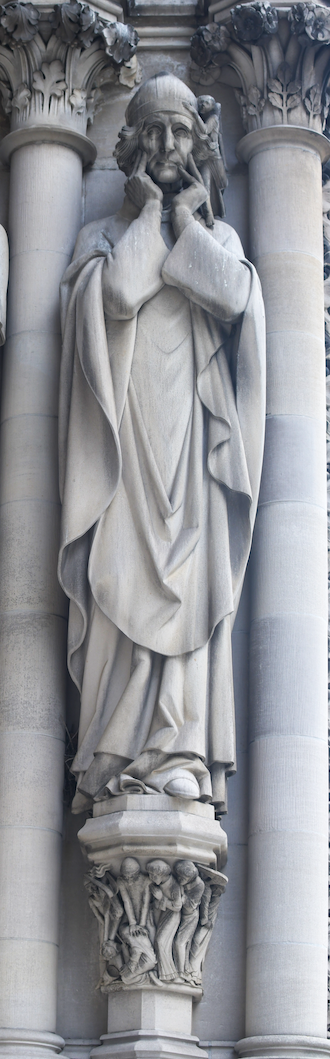
St. Denis occupies the last niche on the south side of the Martyrs Portal, directly across from another martyred bishop, St. Thomas Becket.
Denis was born in Italy in the first half of the third century. “Denis” is the French form of his original name, Dionysius – a common name in the Greco-Roman world, and one that would later become the source of much confusion.
Denis was one of seven bishops commissioned to travel from Rome to spread the Christian faith in the province of Gaul. Rusticus, a priest, and Euletherius, a deacon, accompanied him. They established a church on an island in the River Seine in the Roman settlement of Lutetia, now Paris. The three of them were martyred in the persecution initiated by the emperor Decian in 250-251. These bare facts are from Gregory of Tours’ sixth-century History of the Franks, the earliest extant account of Denis’s life.
In sculptor John Angel’s full-length figure, Denis wears a chasuble over an alb. Tall and gaunt, with the bishop’s miter atop his head, he fills the niche from top to bottom. A small angel sits on his left shoulder, a visual echo of the raven perched on St. Vincent, two niches away. The expression on his face seems pained. He presses his hands to his cheeks, as if he has a headache (in fact, he later became the patron saint of headache sufferers).
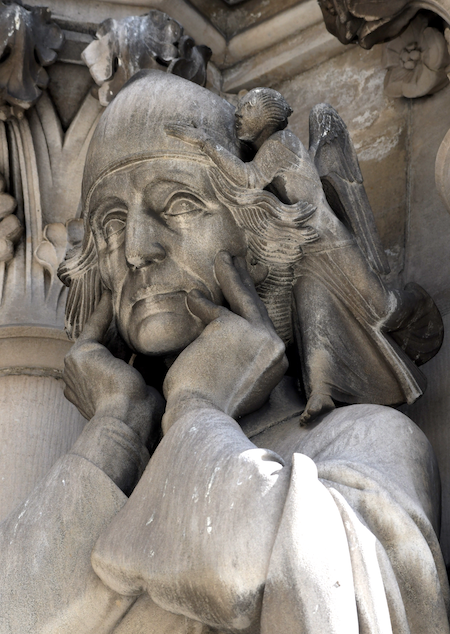
It takes a moment for an observer to realize that Denis’s head is not attached to his body and that he is holding it in his hands.
The pedestal shows his martyrdom. The scene is Montmartre, the “Hill of Martyrs.” Denis kneels between two Roman soldiers. The soldiers are anachronistically clad in the mail and armor of medieval knights. To ensure a clean cut, one soldier stabilizes Denis while the other swings the axe. As Denis’s head falls, an angel swoops down to catch it in mid-air as his miter tumbles to the ground.
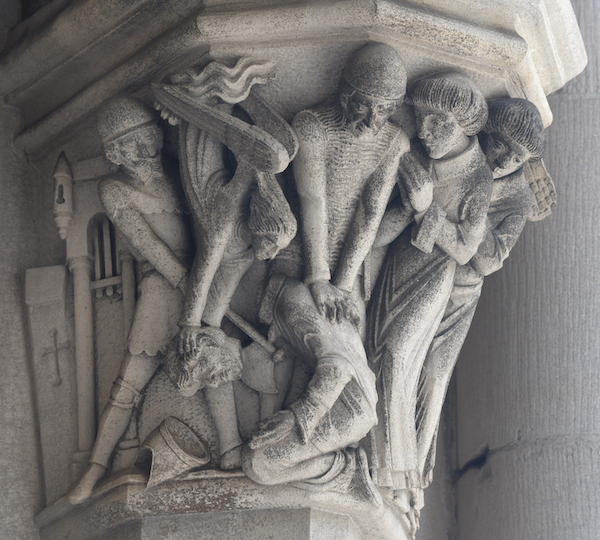
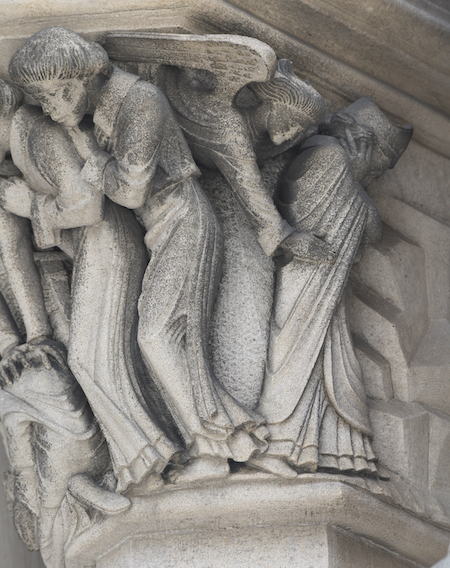
To the right of the soldiers, Rusticus and Euletherius await their own executions. Behind them, an angel leads away Denis, who holds his head in the manner we see above.
Legend has it that Denis proceeded to walk six miles to the site of what is now the Basilica of St. Denis with his disembodied head preaching a sermon of repentance. Denis thus became the first in a long line of saintly cephalophores (literally, “head-carriers”).
Denis and other cephalophores are usually depicted holding their heads in one of two ways. The most common is for the saint to hold the head between the hands at waist- or chest-level, as in the sculpture of St. Denis on the west front of Notre-Dame in Paris.

The other way is for the saint to nestle the head in the crook of the elbow, as in this illustration from a 16th century devotional book. Bishop Denis strolls along with his head in his hands, accompanied by two angels, while his underlings sprawl on the ground alongside their own severed heads. Apparently, rank has its privileges even among martyrs.
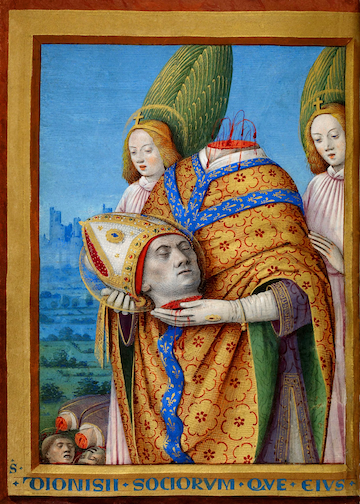
John Angel was prone to make his own variations on centuries-old iconographic practices. His image of Denis has the saint holding his head where it belongs – above his neck and shoulders. I have come across only one similar sculpture. Dating from 1941, the statue stands alongside a fountain in a park in the Montmartre district of Paris. There is a legend that en route to his burial site, the saint paused to wash his head in the fountain.

I would note in passing that it is uncommon to see images of St. Denis that have his head still attached to his body, but there is one in the archivolts of the west entrance to the cathedral’s Synod House.

Denis and his companions were buried six miles north of Paris. In 630, Dagobert, king of the Franks, founded an abbey at the site of Denis’s burial and built a basilica over the grave, replacing earlier shrines. When Dagobert was interred there in 639, it established the abbey church as the burial place for the kings and queens of France for the next eleven centuries. With royal patronage, the abbey became one of the most important in France, with a large library and an active scriptorium.
A curious thing happened to Denis during the centuries after his death – he became a composite character. He came to be confused with the Athenian Dionysius who was converted to the Christian faith by the apostle Paul (Acts 17:34). Because the conversion occurred during Paul’s sermon on the Areopagus (“Hill of Ares”), this first-century figure is known as Dionysius the Areopagite.
In the fifth century, an author of philosophical and mystical works, believed by scholars to be a Syrian, led readers to believe that his writings were the work of the first-century Dionysius the Areopagite. Perhaps the writer was hoping to bestow an aura of apostolic authority upon his work. This author, whose real name is unknown, is now referred to as Pseudo-Dionysius.
By the ninth century, manuscripts of his works made their way to the abbey’s library. The abbot at that time, Hilduin, wrote a biography of Denis that conflated the third-century bishop of Paris not only with the Areopagite but also with Pseudo-Dionysius. It became widely-accepted that these three were the same person. Not until the Renaissance would humanist scholars begin to untangle the three identities.
Thus, when the Benedictine abbot Suger read the works of Pseudo-Dionysius in the twelfth century, he believed that they had been written by the saint whose relics lay in the crypt of his abbey church. Suger’s encounter with Pseudo-Dionysius’s The Celestial Hierarchies and other works would change the course of architectural history.

When Suger became the abbot in 1122, the seventh-century basilica was showing its age. It was now too small to accommodate the crowds of pilgrims who came to venerate the relics of St. Denis. Suger’s vision of a transformed abbey church was guided in large part by Pseudo-Dionysius’s philosophy of light, as summarized in Otto von Simson’s classic intellectual history of the origins of Gothic architecture:
This thinker [Pseudo-Dionysius] blends Neoplatonic philosophy with the magnificent theology of light in the Gospel of John, where the divine Logos is conceived as the true Light that shineth in the darkness, by which all things were made, and that enlighteneth every man that cometh into this world. Upon this passage, the Pseudo-Areopagite bases the edifice of his own thought.
Creation is to him an act of illumination…
Suger envisioned a church filled with illumination – sunlight filtered through stained glass, candlelight reflecting from liturgical objects, polychromatic flashes of light glinting off gemstones. He described the effect such objects had on him in his writings on his reconstruction of the abbey church:
… then it seems to me that I see myself dwelling, as it were, in some strange region of the universe which neither exists entirely in the slime of the earth nor entirely in the purity of heaven, and that, by the grace of God, I can be transported from the inferior to the higher world in an anagogical manner.
To achieve his vision of a light-filled worship space, Suger’s master builders and masons – their names now lost to us – employed design features that would become standard for Gothic cathedrals: pointed arches, cross-ribbed vaults, complex piers composed of colonettes, expansive fenestration, a large round window on the west wall, columnar jamb figures and a kings’ gallery on the exterior.

Von Simson describes the effect of the basilica’s interior on visitors:
In the physical light that illuminated the sanctuary, the mystical reality seemed to become palpable to the senses. The distinction between physical nature and theological significance was bridged by the notion of corporeal light as an “analogy” to the divine light. Can we marvel that this world view called for a style of sacred architecture in which the meaning of light was acknowledged as magnificently as it was in Gothic?
During his lifetime, Suger oversaw the rebuilding of the church’s west front, narthex, choir, and ambulatory. The spacious double ambulatory is a brilliant, breath-taking realization of Suger’s vision. An ingenious interplay of pointed transverse and rounded diagonal ribs enables the large chapel windows to flood the ambulatory with light.

The Basilica Cathedral of St. Denis (it was upgraded to diocesan status in 1966) is generally recognized as the first church built in the architectural style now known as Gothic. Nine centuries later, there is a satisfying symmetry in seeing the namesake of the style’s first flowering grace the west front of what may be the last of the great Gothic cathedrals.
■
Sources:
- Bloch, R. Howard. Paris and her Cathedrals (2022).
- Farmer, David Hugh. The Oxford Dictionary of Saints, 2nd ed. (1987).
- Gregory of Tours. The History of the Franks, O.M. Dalton, translator (1927).
- Panofsky, Erwin. Abbot Suger on the Abbey Church of St. Denis, 2nd ed. (1979).
- Simson, Otto von. The Gothic Cathedral (1956).
- Stoddard, Whitney. Art & Architecture in Medieval France (1972).
- Stracke, Richard. “Saint Denis: The Iconography.” https://www.christianiconography.info/denis.html
- “Pseudo-Dionysius the Areopagite,” Stanford Encyclopedia of Philosophy. https://plato.stanford.edu/entries/pseudo-dionysius-areopagite/