More of a dream than could be realized
(Part One of Three parts dealing with Cathedral Stoneworks by Cathedral Artist-in-Residence, photojournalist Robert F. Rodriguez – RM)
The Cathedral Stoneworks’ project list was impressive:
- The Jewish Museum of New York
- Carnegie-Mellon University’s College of Fine Arts in Pittsburgh
- The Trinity Buildings, Broadway
- The Coca Cola Building, Fifth Avenue
- Grand Central Terminal
- Museum of the American Indian NYC / US Custom House
- Rockefeller Center
- Columbia University
- Huffington Library, Indiana
- and many others
New equipment arriving at the Stoneyard was state-of-the-art:
- Four-axis Stigma profiling saw
- Six-axis Van Voorden router
- Van Voorden 10-foot Apollo saw
- Seventy-blade gang saw
- Gregori bridge polisher
- Intergraph’s MicroStation design software
- Point Control’s SmartCam software
The recognition and awards poured in for David Teitelbaum and his team:
- Preservation League of New York
- The New York Landmarks Conservancy
- Municipal Arts Society
- Classical America
- The President’s Advisory Council on Historic Preservation
Cathedral Stoneworks started in 1989 as a joint venture with the Cathedral of St. John the Divine. That effort began with much fanfare and promise and sadly ended only five years later. So, what went wrong? A deep exploration and interviews with numerous Cathedral staff, administrators and others will provide some insight.
The Stoneyard Institute, the vision of James Parks Morton, Dean of the Cathedral, resumed construction of the Gothic edifice in 1979 after a decades-long hiatus dating back to the start of World War II. There was a modest amount of several million dollars remaining in the Cathedral’s Building Fund from the previous 1925-1941 construction phase to seed this new chapter, but ongoing fundraising to continue the third major building cycle would always be a challenge.
Over the next decade the Dean embarked on a few construction- and real estate-related affiliations to bring in funds to keep the project going, sometimes with mixed results. Shock waves from the 1987 Black Monday stock market crash rippling across the global economy likely affected Cathedral fundraising efforts as well and could have threatened the entire Stoneyard Institute building program.
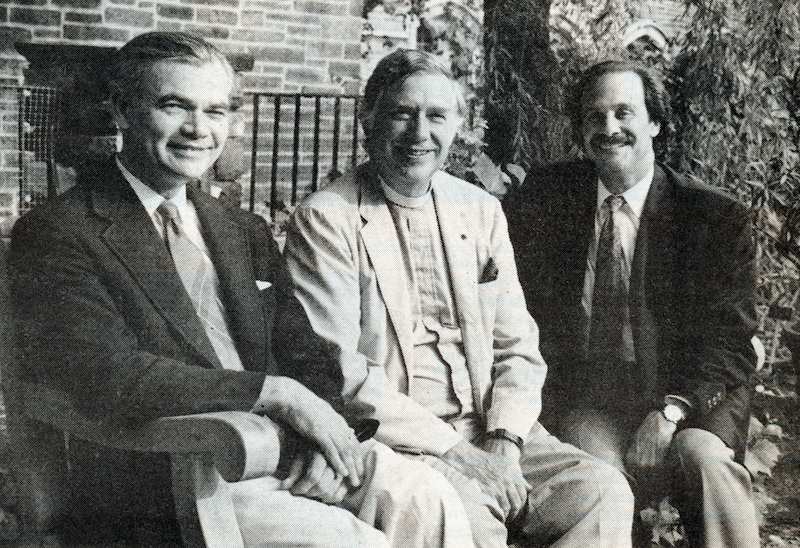
A new solution came about in July 1989 — establishing a profit / non-profit partnership that would use the current Stoneyard Institute crew for outside restoration and other building projects with a percentage of the profits coming back to the Cathedral for the tower construction. The new entity was called Cathedral Stoneworks.
“The dream is that we’ll have so much money we will be able to take on many, many more workers. Then, work on the Cathedral can proceed more quickly,” Dean Morton said in a 1992 Cathedral newsletter article, where he added, “In the 80s we had to lay off people because the Cathedral was the only thing we were building.”
Construction at the Cathedral has always been marked by pauses and major interruptions. Work stoppages or slowdowns came from changes in architects, global wars, recessions, cost overruns, a shift in philosophies from the church hierarchy and, often, a lack of funds.
In 1887, Bishop Henry Codman Potter called “the erection of a cathedral not only important but necessary,” so he issued “a public appeal to the citizens of New York” for funds to build the cathedral.
Ground was broken in 1892 and from the start, construction was literally in a hole. J.P. Morgan, a devout and wealthy Episcopalian, came to the rescue with a $500,000 donation (worth almost $19,500,000 in today’s dollars) after extensive cost overruns in digging the foundation threatened the entire project
In 1925, Franklin D. Roosevelt, a decade before he became U.S. president, kicked off a campaign at Madison Square Garden to raise $10 million in private donations (a staggering $163 million in today’s dollars) for the next stage of construction, which was spearheaded by Bishop William T. Manning. This cash infusion allowed building the nave to continue even through the Depression, but work halted in 1941 with the start of World War II. It may have been around this time that the Cathedral was nicknamed St. John the Unfinished.
Two decades and two bishops after the end of World War II, Bishop Paul Moore Jr. decided to revive construction and placed stewardship of the project into the hands of his new Dean, James Parks Morton. It is also notable that descendants of J.P. Morgan (his grandson Robert Pennoyer) and Franklin D. Roosevelt (his grandson Curtis Roosevelt) were on hand for the ceremony to bless the delivery of the first stone to the new Stoneyard in 1979.
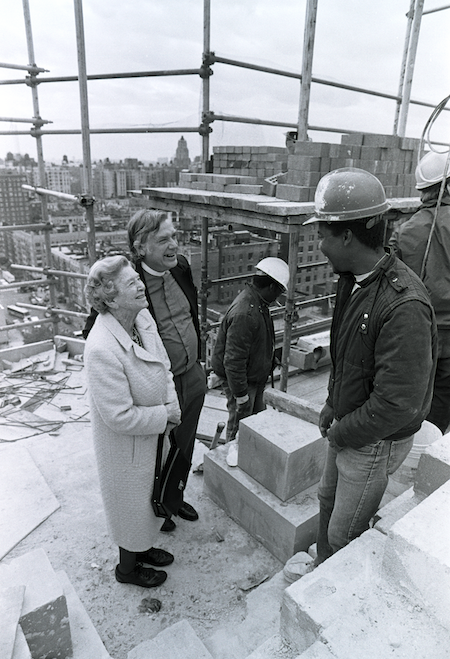
Dean Morton was frequently seen in the Stoneyard and on the tower giving tours and progress updates to potential donors. “Buy A Stone” brochures — an ashlar for $100 and a spring course base for $10,000 — were widely circulated and fundraising dinners were held. Even with ongoing efforts to secure capital and with many favorable news articles, the overly ambitious plan to have both towers erected by 1992 never materialized because of limited financial resources.
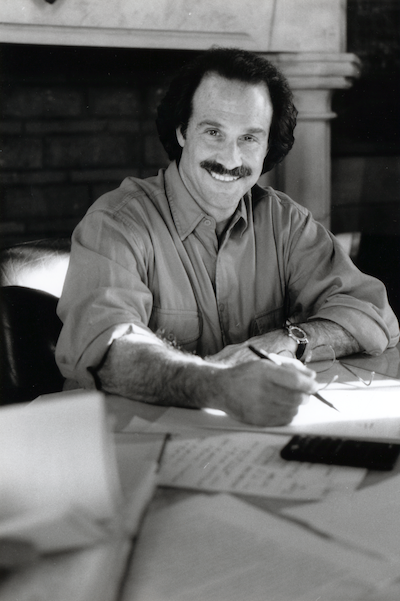
Dean Morton turned to David Teitelbaum, known in New York real estate and preservation circles for his innovative approach to adaptive reuse of historic properties. The federal landmark Archive building in Greenwich Village, the Barbizon Hotel, the Rodin Studios and 111 Fourth Avenue were some of his developments. Thus, Cathedral Stoneworks was formed.
The Dean said, “For the past eight years, David Teitelbaum and I have been professional colleagues through our association with the Municipal Art Society and our joint interest in the Cathedral. David was one of the first real estate developers in New York to implement the concept of adaptive reuse of historic buildings … and he remains one of the few to champion actively the cause of historic preservation and conservation.”
“Of course, we will continue to build the Cathedral. But now, miracle of miracles, Cathedral Stoneworks will help supplement our fundraising efforts for this and other church programs. You can imagine how happy this makes me,” Dean Morton continued.
Steve Maun, who worked with Teitelbaum from 1978 – 1984 at Teitelbaum Holdings, said that Teitelbaum was “the best salesman I’ve ever known,” adding, “the only bigger dreamer than David was Dean Morton.”
From his experience with the Archive Building and Barbizon projects, Maun also noted that Teitelbaum had “a pattern of getting in over his head.”
Of the partnership, Teitelbaum said, “He (Dean Morton) felt my experience in combining profit and not-for-profit ventures, in reconciling historical preservation and development, gave me the credentials I’d need to succeed.”
At this time, the Stoneyard had a crew of 20-25 workers who contributed to building the Cathedral’s southwest tower. Teitelbaum needed to bring in many more workers with different skill sets to manage the Stoneworks program. Initially, the new organization would almost double its staffing. From his Cathedral Stoneworks Biographies marketing brochure, Teitelbaum envisioned having 122 employees by 1993.
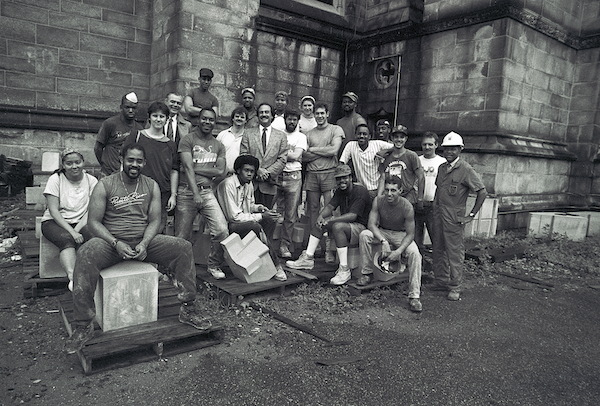
Many long-time cutters and carvers from the Stoneyard Institute moved to higher positions at Cathedral Stoneworks. Master Mason and Instructor Alan Bird moved up to Clerk of the Works; Michael D. Davidson was named Director of Restoration and D’Ellis “Jeep” Kincannon became Chief Draftsman. Stoneyard stalwart Eddie Pizarro was selected as Stoneyard Manager, Angel Escobar rose to lead cutter, Geraldo Perez and Theresa “Treese” Robb became journeyman masons.
New skills and administration positions also needed to be filled. Wei Ching-Song was hired as Director of Computer Services, Tim de Christopher joined as a draftsman, Piet Offringa as an architect, and Jacqueline Snyder became Vice President, with David Teitelbaum serving as partner.
There was also a call for stone carvers, who came from many countries and backgrounds.
Chris Pascoe, who worked at Gloucester Cathedral in England for seven years was offered the position of head mason trainer. “What Teitelbaum tried to do, to bring all that talent together, was absolutely amazing,” he said.
Russian-born Oleg Kokurochnikov (who later changed his name to Lobykin) commented, “The most valuable experience working for Cathedral Stoneworks was meeting stone carvers from around the world at one place. Sharing different approaches learning and improving skills in architectural stone carving and stonework in general was unbelievable knowledge and practice that still benefits my work today.”
Miroslav Maler from the Czech Republic came to Stoneworks as a self-described contractor, sculptor, restoration specialist, stone carver and “gun for hire,” who worked on numerous restoration projects in New York City.
“All the stars aligned for a kid that had no direction,” said Kristian Matthews, who was hired as an apprentice and worked on the Jewish Museum. “I’m grateful to David to this day to be given the opportunity,” Matthews continued.

Part of a Cathedral Stoneworks promotional brochure.
Another early addition to the expanding Stoneworks staff was Holly Young, who had just graduated from Columbia University’s School of Architecture and joined the staff as an architect. Recalling the early years, Young said “We had a very international team! And the Cathedral and Community hovered over us like a giant tree blossoming. Good work was accomplished, and professional growth was possible.” A few years later Holly would marry Joseph Kincannon, then Cathedral Stoneworks Head carver.
The seeds of Cathedral Stoneworks started with a restoration program devised several years earlier by then Master of the Works John Walsh and directed by Michael D. Davidson who apprenticed in Scotland and came to the Cathedral after restoring embassies in Athens and Warsaw.
In a 1987 Cathedral newsletter article, Davidson said, “Guided by John Walsh, Master of the Works here, I’ve set about the business of forming an apprentice training program in restoration. Qualified technicians teach scaffolding and cleaning. Decorative patching and pointing, stone replacement, blueprint reading, estimating and managing form the curriculum.
According to Davidson, “We began work on an ambitious pointing program above the seven chapels of the Cathedral. Good news travels fast. No sooner had we begun our own restoration than calls came in from other churches wanting our expertise. Trinity Church in Lower Manhattan was the first. Soon to follow were St. Paul’s in Yonkers, Christ Church in Staten Island, Grace Church in Nyack and St. Ann’s in the Bronx. Corporations and private building owners have been calling as well. What began as training apprentices to build the Cathedral has expanded to restoration. It seems the raising of the stones is an act of common purpose that answers common need.”
In a recent interview, Davidson recalled doing a six-month stint performing evaluations on local churches. Deferred and critical work on these old building came into a master plan with John Walsh as Engineer of Record, which gave it legitimacy. Davidson also pointed out that the jobs provided income to the Stoneyard while giving an avenue to put the Stoneyard crew on outside work under the 501-3C provision. The Cathedral Stoneyard Institute was considered a nonprofit entity exempt from federal income tax under the Internal Revenue Code.
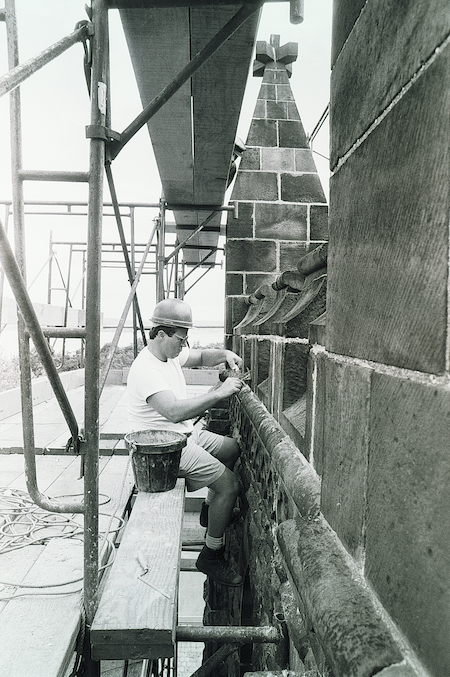
One of the early projects that Davidson directed was a rehabilitation of the tower at Grace Episcopal Church in Nyack, New York. Stoneyard crew members Ruben Nunez, Johnny Lugo, Cynthia “Cynie” Linton, Timothy Smith, Raymond Duggan, Eric Jahn and Stephen Boyle were all involved. The existing stone was not quarried anymore, so Davidson and crew removed bad stone, strengthened it through pinning and stitching, cleaned it, applied a water proofer and reset it, using mortar analyzed to find the exact color. To recreate a capstone to crown the church, Linton, one of the first Stoneyard carvers, retooled the architectural detail that had disappeared.
The largest job started under Davidson’s direction was the multi-year restoration at Fifth Avenue Presbyterian Church in New York, which saw as many as 25 workers involved. The stone of the 1850 brownstone had exfoliated (deteriorated) to such an extent that none of its once sharp gothic details were visible. The multi-year project later came under the umbrella of Teitelbaum’s Cathedral Stoneworks.
The newly hired Holly Young became Davidson’s assistant on the project, working on code/permit work, shop drawings, scheduling, project planning and other construction administration.
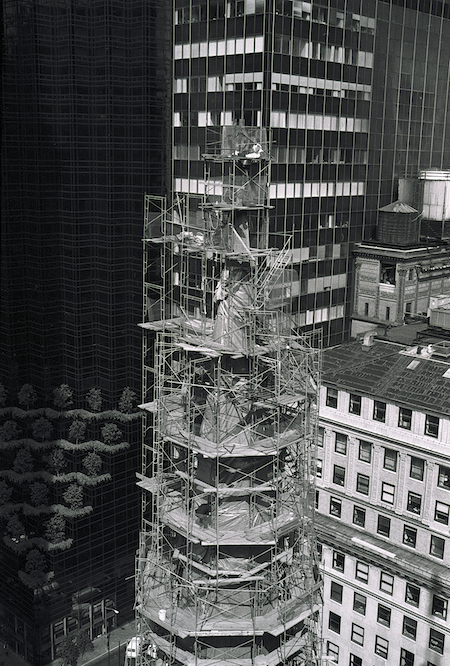
The exterior restoration work involved stone replacement, re-carving, and consolidation of the severely deteriorated brownstone façade, and the replacement of the North Tower fleche (a slender church spire), according to Goshow Architects, who coordinated all the elements of the project.
The work garnered much recognition, including awards from the Municipal Arts Society (Best Not-for-Profit Restoration award), Preservation League of New York (Restoration Award) and the President’s Advisory Council on Historic Preservation.
While Cathedral Stoneworks was getting its footing, Trinity Church on Wall Street was an early patron, using them for repair and restoration of some buildings owned by the church. The Stoneworks crew performed restoration and recladding of the Trinity and United States Realty Buildings at 111 and 115 Broadway, just north of Trinity.
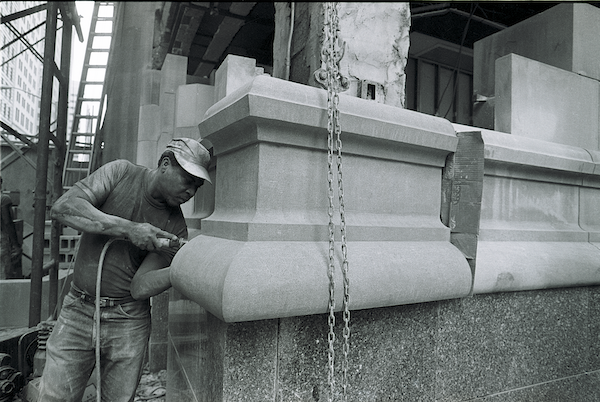
“At 111-115 Broadway, over $1 million of domestic granite and limestone has been delivered,” according to John T. Walsh, P.E., president of the Stoneyard Institute and Cathedral Master of the Works.
A November. 1990 New York Times article reported that the $800,000 project to fabricate the façade for the new Jewish Museum building was “one of the early triumphs that brought praise and publicity to (Cathedral) Stoneworks.”
Teitelbaum needed to expand the footprint of the Stoneyard to accommodate the expanded staff. Architect John Barton oversaw extension of the carving shed along the north wall of the Cathedral’s nave, spreading it almost to the north transept. Also, several trailers were linked, turning the original L-shaped cutting and machinery shed into a U-shaped structure.
From July 1990 to January 1991 Cathedral Stoneworks, NYC, listed as the stone supplier, worked on stone carving mockups and samples for Jewish Museum project architect Kevin Roche, whose design doubled the size of the museum, providing it with a seven-story addition.
Apprentice stone cutter Chris Pellettieri immersed himself in the project and said, “a lot of handwork was needed, the work was very complicated,” and that it was “a high point” in his time at Stoneworks.
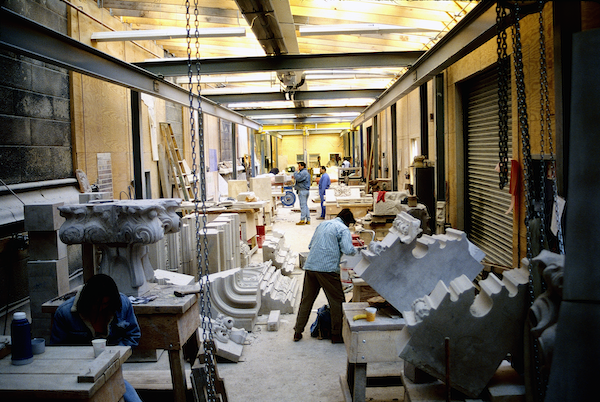
This endeavor was all hands-on deck with Juan Salazar, Ruben Dario Llano, Theresa “Treese” Robb, Jose da Silva Fonseca, Amy Brier, Sebastién Casamayor, J’in Shen Wang, Patrick Berthaud, Yves Pierre and others working on stones.
A Jewish Museum newsletter later provided an update: “Limestone Going Up! Between September 1991 and January 1992, the new façade of the Jewish Museum has gone up, stone by stone, with the beautifully carved limestone created by Cathedral Stoneworks.” The façade installation at the museum was performed by another company, Pansini Stone.
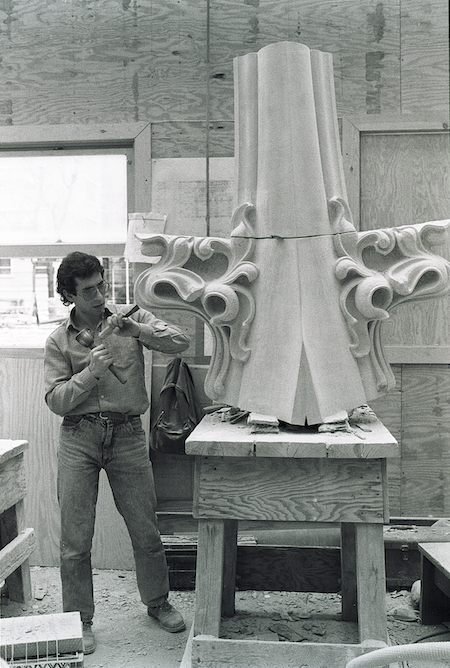
One of the last blocks created was a five-foot-plus pinnacle with oversized crockets that looked like wings spreading from the limestone. Carved by José Silva de Fonseca, the intricate stone was the crown of the museum’s $24.4 million expansion and donated to the Jewish Museum by Dean James Parks Morton, who said the gift was an attempt to counteract symbolically a recent upsurge in anti-Semitism in American and Europe.
Stoneworks secured another high-profile job in late 1990 when it signed a $1 million contract to carve five monumental niches telling the history of architecture at Carnegie Mellon University’s College of Fine Arts building in Pittsburgh, PA.

Nicholas Fairplay, the first Cathedral Head Carver, who left several years earlier to start his own stone carving business, led an international team of sculptors-in-residence on campus. Fairplay was project manager, master carver and design developer, carving in situ five niches on the building facade, each representing a type of architecture: Medieval, Greek, Roman, Renaissance, and World/Oriental cultures. Each niche contains various scenes and figures from mythology, religion and history.
Simon Verity, Emmanuel Fourchet, Ruben Dario Llano and Juan Salazar formed the Stoneworks team on site. Other carvers from Great Britain and France were also part of the carving effort. Clerk of the Works Alan Bird would frequently visit the site to check on progress and attend meetings.
Llano described himself as the “go to guy” at Carnegie Mellon, adding that “I earned my ‘master’s degree in stone carving,’” by all that he learned over the three years spent at the site.
One major job that eluded Cathedral Stoneworks was the Federal Triangle Project in Washington, D.C. that planned to add a new building and supporting structures to a complex of Federal buildings tucked between Pennsylvania and Constitution avenues adjacent to the White House.
The scope of the work entailed carving 10 five-foot-tall eagles, five tympanums 17-feet across and a 12-foot statue of President Woodrow Wilson.
Teitelbaum also proposed establishing a training program for D.C.-area youths like the Cathedral Institute as well as a plant to house computerized equipment designed specifically for the job.
As often happens in large scale government projects, cost overruns led to delays in starting the project. In September 1990, the architectural firm, which included I.M. Pei, made cost-saving changes that included using plaster rather than stone for the decorative elements.
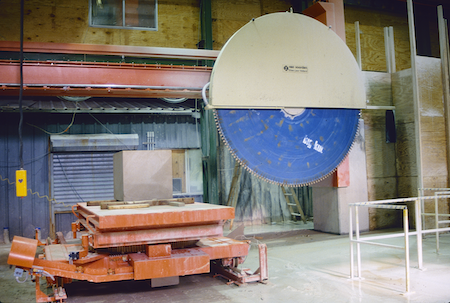
From the beginning, Teitelbaum realized that the existing array of saws at the Stoneyard was inadequate. The two circular saws and a planer in the Stoneyard were repurposed from decades-old, abandoned equipment found in an Indiana quarry.
“We’re buying two fabulous new computer saws,” said Teitelbaum. “These will give us that competitive edge. With the machines, we’ll be able to take on large commercial projects and still be able to provide hand-finished stones of the highest caliber. The saws can shape a block of stone 20-30 times faster than by hand.”
The first two saws were installed around 1990, with Stoneworks also planning to purchase additional saws for a factory in the Bronx, which was targeted to open shortly afterwards. This new stone fabricating facility would provide highly articulated stones to the commercial market, offering both quality and speed in delivery to conventional stone-erection contractors. Apparently, the Bronx operation never materialized.
Touting the new saws, a 1990 New York Times article observed: “While stone craftsmen like Angel Escobar and James Fowler slowly chip away at giant limestone blocks to create textured window jambs and gargoyles of tiny birds and squirrels, three computer scientists operate huge robotic saws and drills that do most of the cutting and shaping.”
■