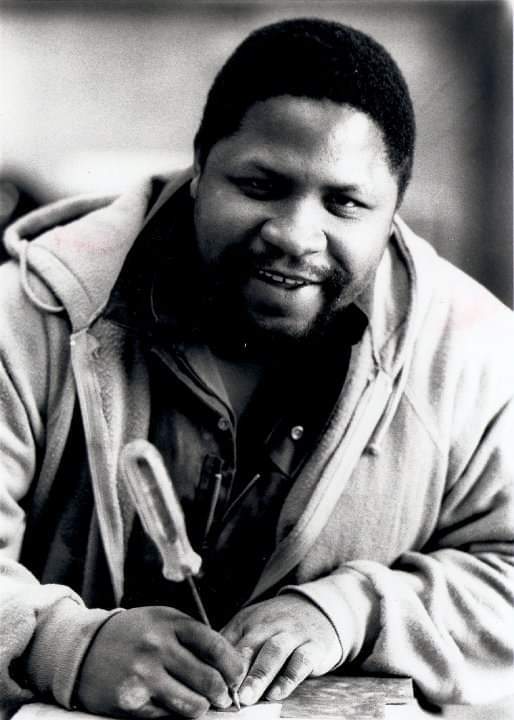
Sisters pay tribute
On a damp and rainy Sunday Angel Escobar’s sisters and other family members visited the Cathedral of St. John the Divine to pay tribute to the quiet and unassuming stonecutter who recently passed away.
Dina Chiclana, Olga Escobar, Cecilia Escobar and several cousins came together to literally touch stones that Angel worked on when the Cathedral started to build its towers and many dreams in the 1980s and early 1990s.
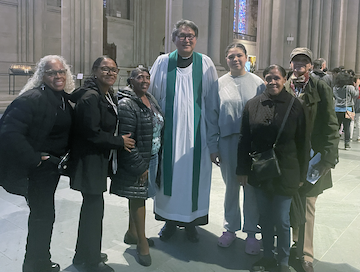
After the service the sisters and cousins met with Canon Steven Lee, Vicar of the Cathedral, who wrote:
“It is especially meaningful to remember someone whose hands helped shape the Cathedral and who was so valued by his fellow stonecutters and carvers.”
– Canon Steven Lee, entering the name of Angel Escobar in the Cathedral’s Prayers for the Dead.
A touching moment came when the group visited the Columbarium to visit Ruben Gibson’s niche. Ruben, one of the Stoneyard’s lead carvers, passed away in 1988. Angel credited Ruben’s support and encouragement for helping him overcome his hesitation to move into cutting and carving stones – where Angel excelled and displayed his artistic side. One of Angel’s sisters, Olga, said that Angel was always shy and preferred to stay in the background, adding that she was the one who defended him in the school yard against bullies.
The family group waded through puddles, wrapped against the heavy rain, to reach the pile of carved limestone blocks that were never set on the tower when work stopped.
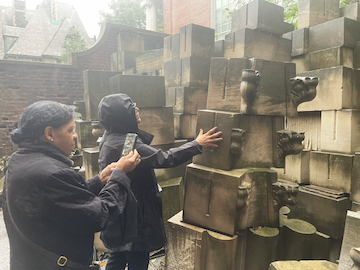
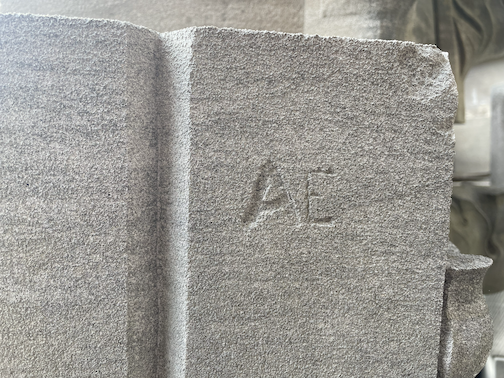
Among the ashlars, column bases, pinnacles and elaborately carved stones, one block – part of a gablet with carved crockets – stood out. On one side, the initials ‘AE’ were clearly visible. This stone was Angel’s legacy that his family could touch to connect with their departed sibling.
“I remember being impressed by Angel’s native understanding of sculpture, we were looking together at historic sculptures in a book , and he was talking about them. I remember thinking that I had to go to school to know the things that he was saying off the top of his head. He was a very sweet man and I have many memories of him and his gentle ways.” – Amy Brier
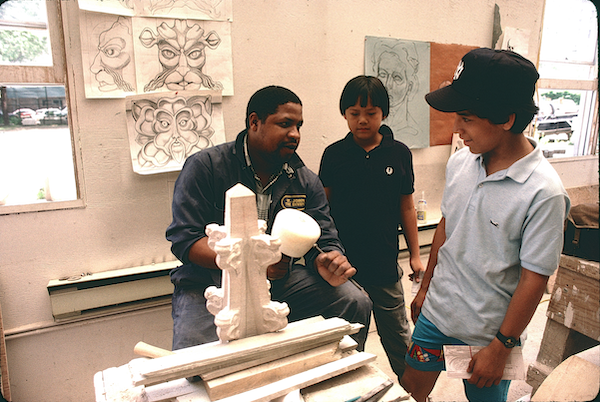
“Apart from being one of the nicest guys you could hope to work with, Angel could always be relied upon to turn out a first rate, crisp and neat piece of finished work. Even the visiting French artisans of the Compagnons were impressed by his skill. Sincerest condolences to Eddie and Angel’s family” – Stephen Boyle
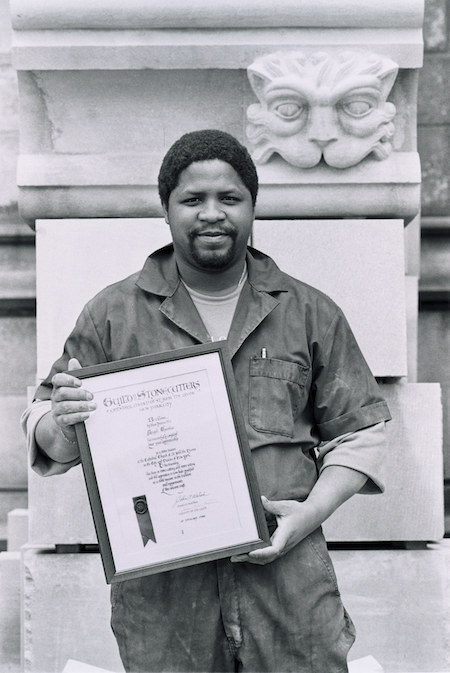
“Angel was very reserved. He had a quiet confidence that was especially important when it came to moving large stones. When I started on the saw, he was just joining the banker masons as an apprentice. I remember Jeep, Poni, Jose and Ruben all commenting on how easy stone cutting came to him. Angel was just a natural. The same went for carving. He just eased into it. Angel was extremely competent in anything he did at the stoneyard, but he liked to keep a low profile. Anyone who worked with him followed his lead, but he was a reluctant leader because he was humble. Joe Schiff said it right; he led by quiet example. Mostly though, I remember Angel for his sense of humor. He had a contagious laugh.” – Joseph Kincannon
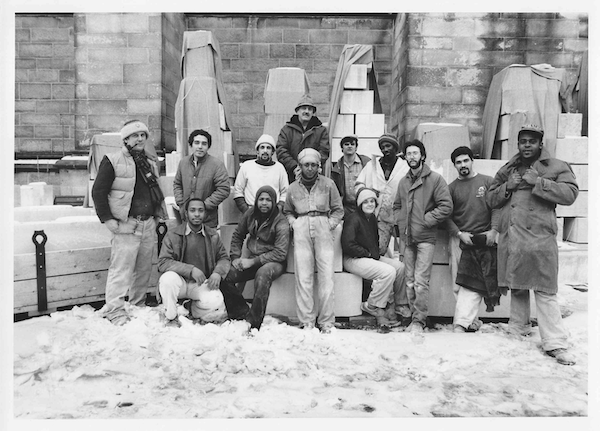
“It saddens me each time I hear of the passing of one of our masons. It’s different. The impact of it is like brothers or sisters, from another mother has passed on. My condolences to his family and ours. May He Rest in StoneMason’s Paradise. I thank you for the memories.” – Carol Hazel
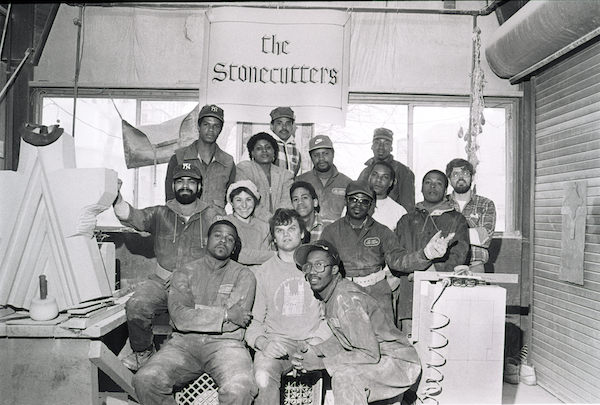
Front, from left, James Jamerson, Master Mason, Alan Bird, James McKnight.
Second row, Pedro Colon, Theresa “Treese” Robb, Geraldo Perez, Harold Doman, Sid (last name unknown).
Third row: Dwayne Crawford, Carol Hazel, Angel Escobar, Yves Pierre, Joseph Chiffriller.
Top Row: Rudi (last name unknow) and Arthur (last name unknown). Photo: Robert F. Rodriguez.
Angel’s Carving Days
By the spring of 1985 a carving shed was built along the Cathedral’s north wall. Nick (Master Carver Fairplay) moved in along with Ruben Gibson, Cynie Linton, Joseph Kincannon and D’Ellis “Jeep” Kincannon. Nick also had Angel Escobar do some carvings. Angel did not want to do carving full time but “I pulled him (in) a couple of times; he had a very natural ability,” Nick said.

One of Angel’s works shows a beast with glaring eyes and a broad mustache practically drooping onto the stone below. The other carving resembles a feline animal with curls sweeping away from its face and high arched eyebrows.

Angel Escobar’s two carvings (south face string course) both show fantastic beasts, something Newt Scamander from the Harry Potter films might be searching for.

Humble Beginnings
As a boy growing up in East Harlem, Angel Escobar would look across 112th Street at the looming structure rising on Morningside Heights to the West. “When I was small, I used to wonder what that big thing was,” he said. A few years later, he would pick up a mallet and chisel to help build the tower at The Cathedral of St. John the Divine. “I never thought I would be working at the church,” Angel adds.
“I was hanging out a lot on the streets by the time I was in my teens. My mother had died and I dropped out of school,” Angel remembers. “I had to do for myself.”
“Me, I didn’t like being in the street. So when I heard the Renegades had given up their chains and stopped fighting to do something for the community, I found out about it,” Angel continues.
A New York Times article reported, “a youth gang called the Renegades (sometimes spelled Renigades) is using city loan funds and their own labor to create new homes for their families out of a battered and abandoned East Harlem tenement.” This was the beginning of “sweat equity” or “urban homesteading” and Angel started learning the building trades. The outfit he was working for went out of business and the owner recommended that Angel apply to the Cathedral’s Stoneyard program.
As a trainee, the soft spoken and introverted Angel moved limestone blocks around the machinery shop and drove the crane and forklift that transported finished stones from the cutting shed to the stacks by the side of the Cathedral for the first two years.
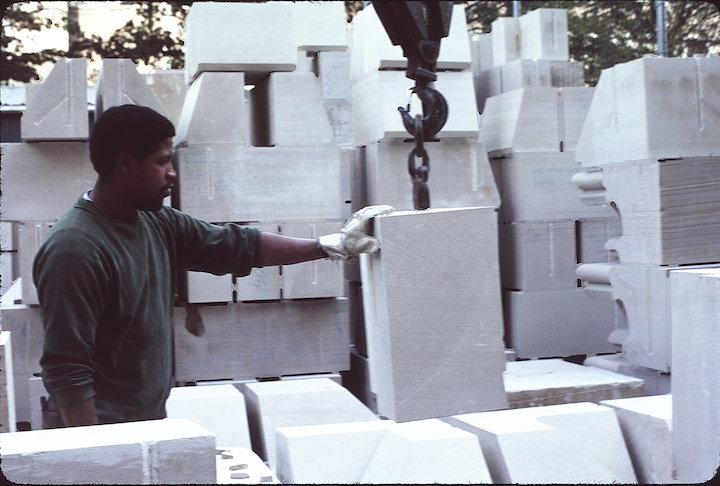
Angel would occasionally be treated to homemade lunch brought to the Stoneyard by his wife Maritza and oldest daughter Angela, who remembers walking through the Cathedral to get to the Stoneyard. As a 5-year-old, “I was afraid of the huge stone statues,” she said.
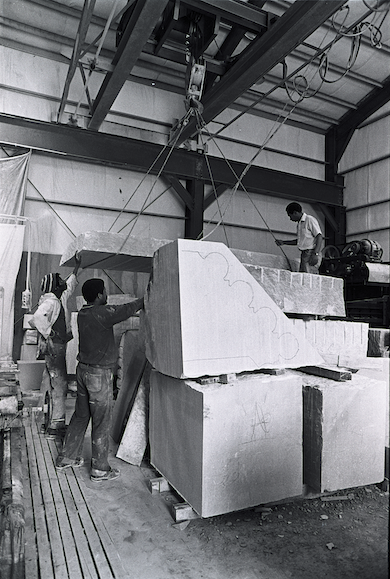
Initially, Angel was intimidated by Master Mason Alan Bird, the primary instructor for the apprentices, and was reluctant to move into stone cutting. “I was scared to be a stonecutter,” he said, “because Alan was so strict, you made a mistake he’d get on your case. I didn’t want to cut stone; I was scared to cut it. I didn’t want to make mistakes.”
Angel credits Ruben Gibson, a fellow apprentice who started shortly after Angel, for helping him overcome his fears. “Ruben put it in me, he put confidence in me. He made me a stonecutter. He believed in me. I loved Ruben,” Angel said.
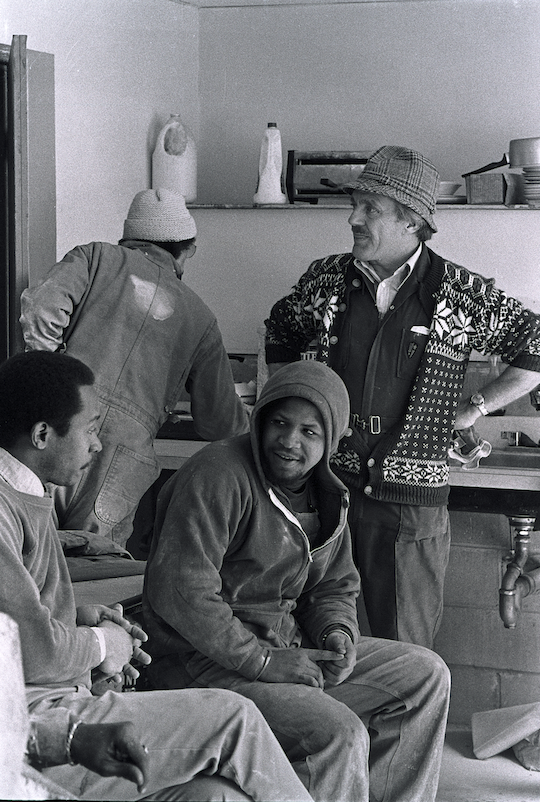
Angel credits Ruben Gibson, a fellow apprentice who started shortly after Angel, for helping him overcome his fears. “Ruben put it in me, he put confidence in me. He made me a stonecutter. He believed in me. I loved Ruben,” Angel said.
Timothy Smith recalls that Angel could cut his stones exactly up to the zinc template measurements – but Angel needed some lessons in fractions. At first, Angel had trouble understanding that the larger the number of the fraction, the smaller the measurement actually was. Timothy gave Angel a tutorial on a whiteboard: ½ inch is larger than ¼ inch and 1/64 inch is smaller than 1/32 inch. Angel caught on quickly.

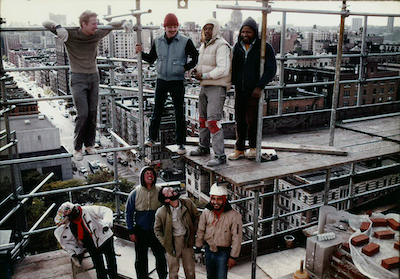
In the summer months when construction on the tower was the focus, Angel occasionally worked topside moving stones from below to the construction floor or helping to set stones. This may have been his least favorite job: “I’m afraid of heights,” he confessed.
Eddie Pizarro, another stonecutter from East Harlem, compliments Angel’s cutting skills: “To me, Angel had the best boasting pattern. Very neat. All his finished stones looked the same. He always had a steady hand for boasting the stone.”
Angel also got direction from José Tapia. “He taught me a lot,” he reminisces.
Angel refers to José as “my brother” because José lived with Angel’s family after José’s parents died in an auto accident in Puerto Rico. Angel’s mother and José’s mother were sisters, so Angel’s mother “took him (José) in, a cousin, but raised by my family,” Angel explains.
José also brought in another member of the extended family to the Stoneyard when Eddie Pizarro, another cousin, came on board. All three share the same paternal grandparents who were from Ponce, PR.

According to Eddie, the cousins “all had different opinions; we were raised to use what you are good at and make a living in the construction field. The Stoneyard united us and Angel kept us focused,” he said. “I remember (Angel) telling us we are here (at the Stoneyard) to make history and we will always be remembered and, to this day, it is true.”
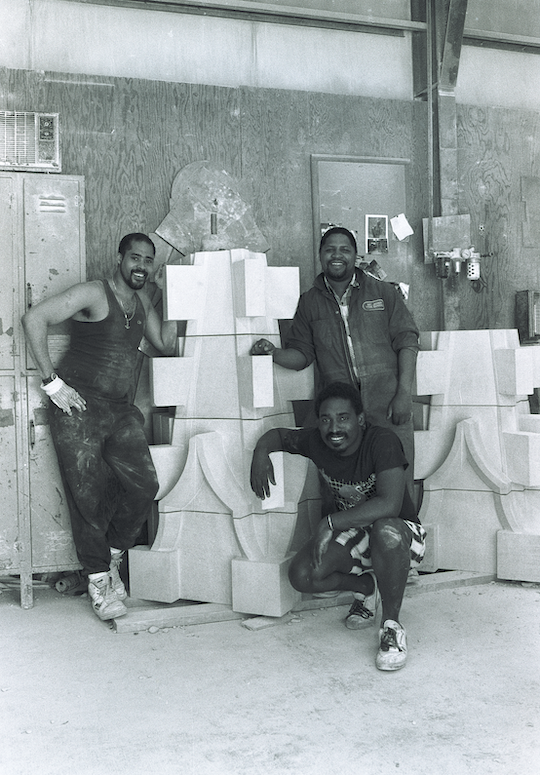
As Angel’s skills and confidence grew cutting intricate blocks in the cutting shed, another opportunity came up and, once again, Ruben Gibson provided the necessary push.
The Cathedral program needed to start training some apprentice stonecutters in the art of stone carving. Following a blind carving competition, Master Carver Nicholas Fairplay, recognizing Angel’s potential, named him a candidate for the carving program.
“I was scared to do carving, but then again Ruben came in and put confidence in me and started teaching me. It was kind of easy for me because I used to draw faces on the stones and Ruben picked up on that. Ruben had a way of getting to me,” Angel said. “The way Ruben explained stuff, he made it seem easy. Ruben wanted me in the (carving) shed bad!”
However, Angel was not ready to give up working in the cutting shed so he moved between cutting and carving as the needs dictated. Angel could just as easily cut a springer or tracery stone as he could carve foliage on a crocket or create a unique Gothic face on a cornice stone. Angel must have been very happy to work in the carving shed when his mentor Ruben became lead carver.
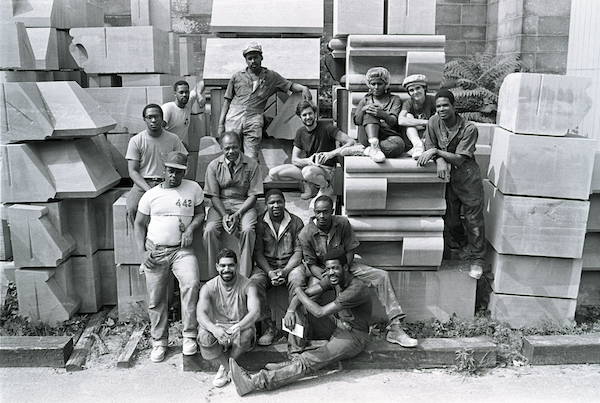
Seated on ground: Pedro Colon, unknown.
Second row: James Jamerson, Frank Walcott, Angel Escobar, unknown.
Third row: Ruben Gibson (glasses), Eddie Pizarro, José Tapia (standing), Nicholas Fairplay (kneeling), Carol Hazel, Cynthia “Cynie” Linton, Dwayne Crawford. Photo: Robert F. Rodriguez.
Around 1993 funding for the program dried up and the stoneyard was forced to shut down. Looking back over his 13-year career at the Cathedral, Angel would have loved teaching the next generation of stonecutters if the program had continued, a role he saw for himself. “It’s a skill that you never forget,” he said.

Asked if he thought the Cathedral would ever resume rebuilding, Angel ponders, “perhaps…that’s the way churches work.”
■