For this final article in a series on the Martyrs Portal, we will lift up our eyes to the heavens as we examine the archivolts, the three ornamental bands of voussoirs on the underside of the arches spanning the portal from side to side.
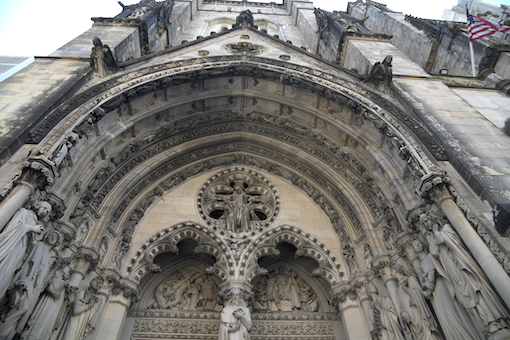
The archivolts are decorated with angels, as they are at many another cathedral. The architect intended that the three major portals of St. John the Divine should follow this longstanding Gothic tradition. To date, his intention is unrealized. The Martyrs Portal, completed 1935, is the only one with angels in its archivolts.
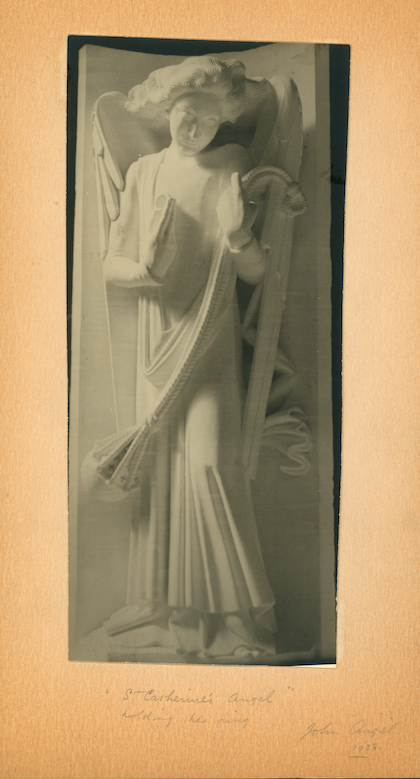
There are twelve sculpted angels on each band, thirty-six in all. It is worth craning one’s neck for a good look at them. Each angel is unique, and each has a job to do. My own informal census counted twenty-three angels holding scrolls, seven with trumpets, one with a lute, one with a censer, and four with hands folded in prayer or adoration.
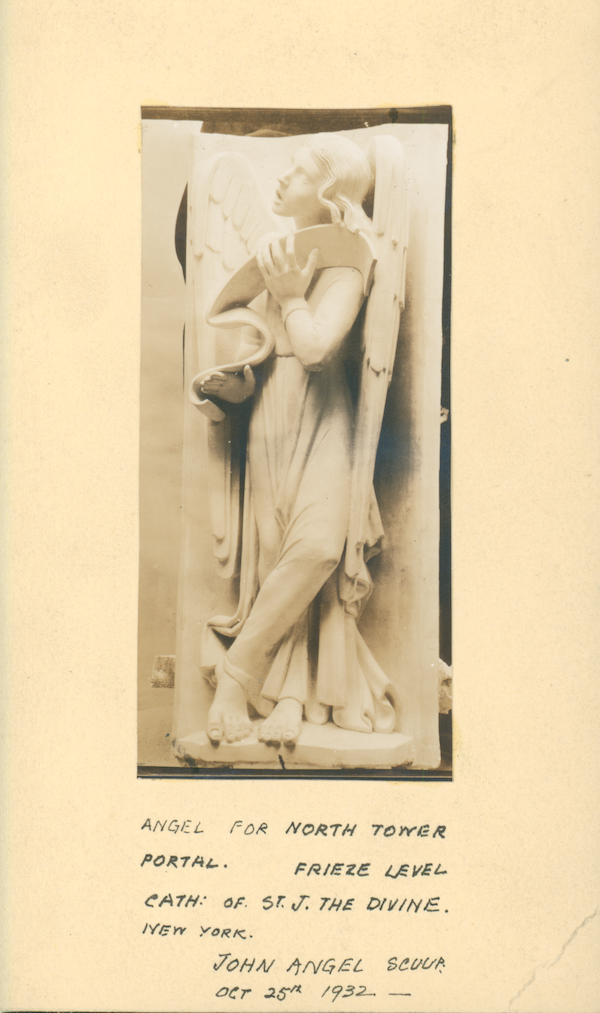
John Angel, sculptor.
Oct 25th 1932
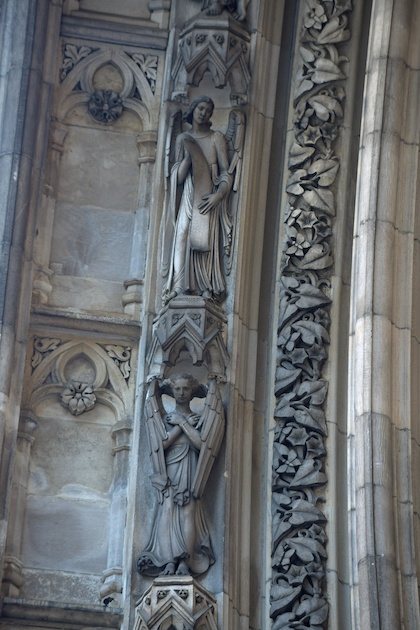
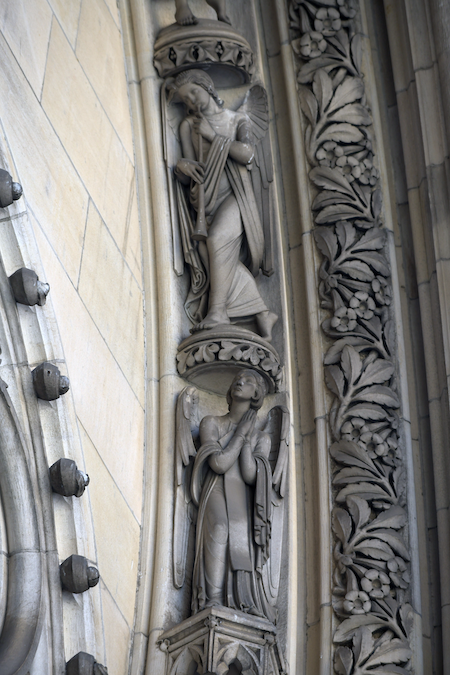
There are enigmatic carvings of eight seated women interspersed with the angels on the lowest rank of archivolts. They sit directly above the eight full-length figures on the portal’s north and south sides. Visitors frequently overlook them or, if they do observe them, usually walk away wondering who they are and how they relate to the saints below them.
As to who they are – they are sibyls, ancient seers who lived in the age before the coming of Christ and were later believed to have prophesied his birth, crucifixion, and resurrection.
As to how they relate to the martyrs in the portal, the answer is – not at all. The architect intended the sibyls for the central portal, where they would have been appropriate companions of other forerunners of Christ. Due to difficulties with the central portal project, the sibyls were installed instead in the north portal, even though they are unrelated to the portal’s theme of martyrdom. The sibyls do not really belong with the martyrs. One might think of them as squatters. Nevertheless, they do bring to the portal a vibe of the mysterious and exotic.
About Sibyls
Sibyls were prophetesses in the Greco-Roman world, with origins in the ancient Near East. Sibyls resemble oracles in that they were invariably female and uttered their prophecies while in an ecstatic state and in language that was often obscure and ambiguous.
But while an oracle was the agent of a specific Greek god and was consulted at a temple dedicated to that god, sibyls were, in a sense, freelancers. They were not necessarily aligned with specific gods. They dwelt in caves and grottoes rather than temples. Their names derive from the locations with which they are associated.
The sibyl of Cumae in southern Italy is the most notable sibyl of the classical world, best-known for her role in the Aeneid. Vergil vividly describes the scariness of an encounter with a sibyl: … suddenly all her features, all her color changes, her braided hair flies loose and her breast heaves, her heart bursts with frenzy, she seems to rise in height, the ring of her voice no longer human …(Aeneid VI.59-63, transl. Robert Fagles).

The prophecies of the Greek and Roman sibyls were written down in Greek hexameters and collected in the Libri Sibyllini (Sybilline Books). Romans revered the sibyls; the Senate would consult the Sybilline Books in times of crisis. In the fourth century, with Christianity having become the state religion, the Roman emperor Honorius ordered the pagan Sybilline Books destroyed.
Meanwhile, a new tradition of sibylline literature had begun among Hellenistic Jews as early as the second century BCE. Writing in Greek hexameters under the names of the classical sibyls, Jewish writers inserted prophecies for Israel and attacks on polytheism into the pagan oracles. By the second century CE, Christians authors had taken over, as scholar Anke Holdenried explains:
Christian authors thus placed Christian prophecies concerning both the Nativity and the Second Coming into the mouth of the Sibyls to use apparently pagan prophecies to undermine pagan polytheism from within its own ranks …
Another scholar, Jorge Guillermo, writes of how the pagan sibyls “acquired new identities as veritable Christian visionaries … They would come to enjoy the same level of legitimacy as had been previously granted only to the long-hallowed prophecies of the respected canonical prophets in the Hebrew Bible.”
The Judeo-Christian writings were collected into the fourteen books of the Oracula Sybillina (Sibylline Oracles). Many of the early Church Fathers treated the Oracula as authoritative when they cited it in their own writings. Guillermo points out that in the Divine Institutes, the third-century theologian Lactantius “makes more references to the sibyl than he does to all the Old Testament prophets combined.”
By the fifth century, interest in the Oracula was waning along with knowledge of Greek as the western empire dissolved and the Latin-speaking western church grew further away from its Greek-speaking brethren in the east.
The rediscovery of classical literature and culture in the early years of the Renaissance reignited interest in sibyls. By the quattrocento, sibyls had become a familiar subject in art and would remain one throughout the Renaissance. Below, Perugino’s fresco demonstrates that the sibyls were once again on an equal footing with the Hebrew prophets. Their names appear in small letters at the bottom of the picture.

The most famous sibyls of all are those on the ceiling of the Sistine Chapel, where Michelangelo has them alternate with Hebrew prophets around the ceiling’s perimeter.
Classical scholarship would eventually debunk the notion that Greco-Roman sibyls prophesied the Christian faith. The Gothic Revival of the nineteenth century brought about a resurgence of interest in sibyls, hence architect Ralph Adams Cram’s intention to include them in the iconographic program for the cathedral’s west front.
The Sibyls of the Martyrs Portal
There are eight sibyls in the niches above the jamb figures. All but two of them hold books containing their prophecies. Each sibyl is accompanied by one or two attributes signifying the nature of her prophecy.
Starting on the north side and reading left to right, the sibyls are:
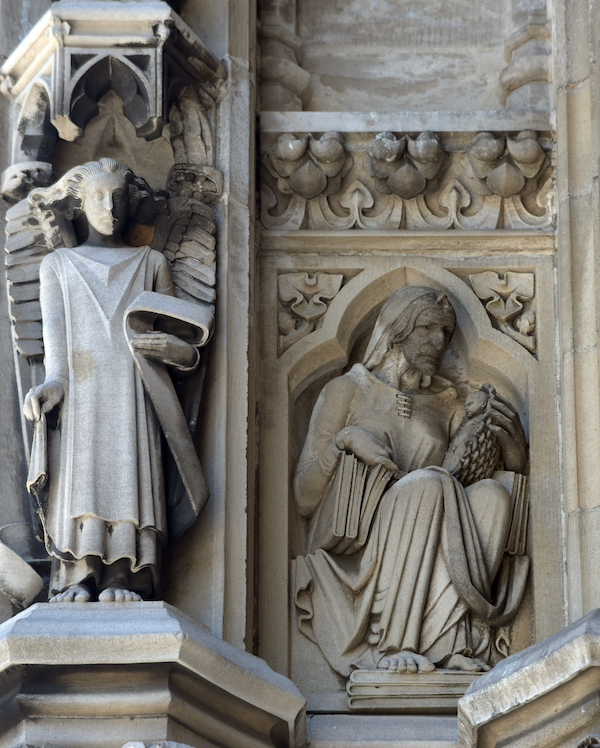
Cumana (aka Alamathea), the sibyl of Cumae, holds a sponge dipped in vinegar, a prophecy of the Crucifixion, echoing Psalm 69:21: “In my thirst they gave me vinegar to drink.”
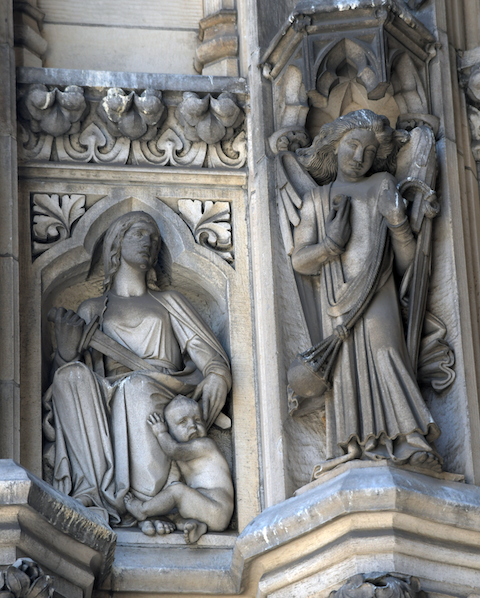
Europa holds a sword and an infant, a prophecy of Herod’s massacre of the Holy Innocents (Matt. 2:16-18).
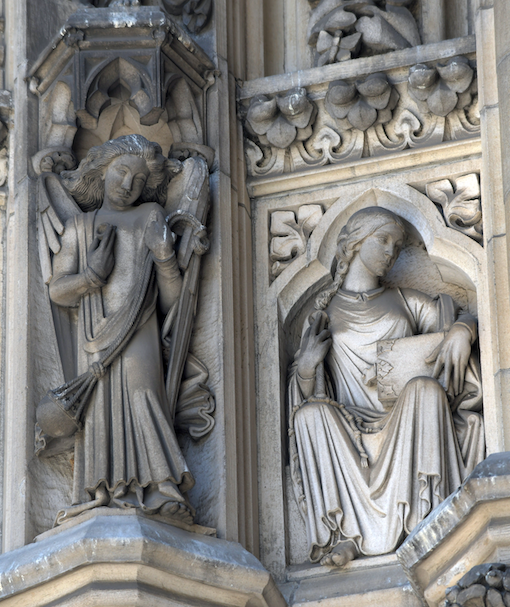
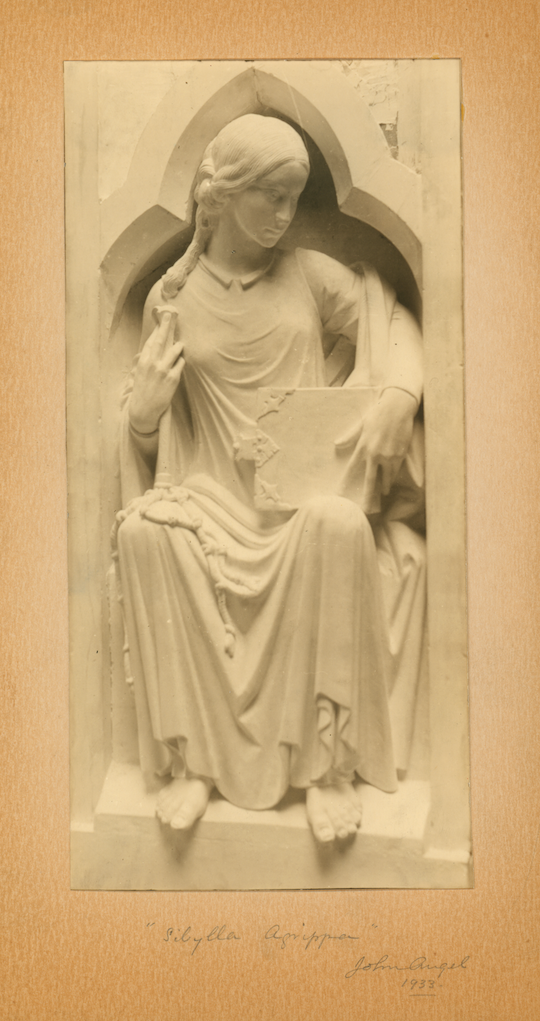
Agrippa (or Agrippine) has in her lap a scourge, a prophecy of the scourging of Christ by Roman soldiers (Mark 15:15), the high priest’s men (Matt. 27-67, Luke 22:63), and by Pontius Pilate himself (John 19:1).
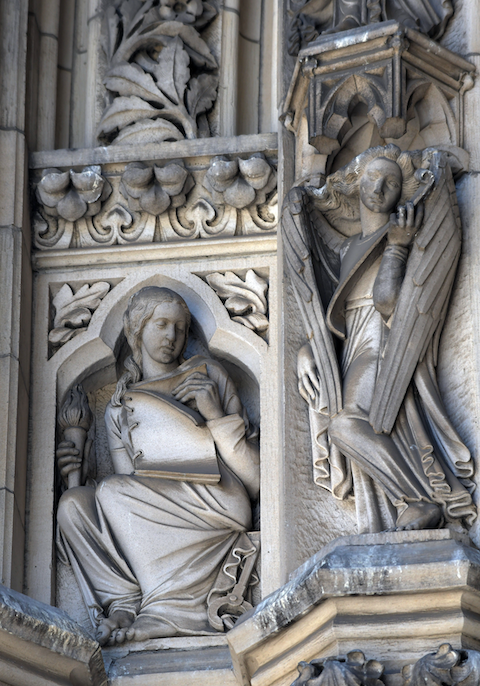
Libyica holds a torch in her right hand, a prophecy of Christ “the Light of the World” (John 8:12). Alongside her left foot sits a pair of pincers. Pincers are sometimes included in the Arma Christi, the objects associated with the Passion. Pincers would have been used to remove the nails from Christ’s hands and feet. Pincers do not appear to be a common attribute of the Libyan Sibyl and their inclusion here may be John Angel’s inspiration.

Continuing on the south side, again reading left to right:
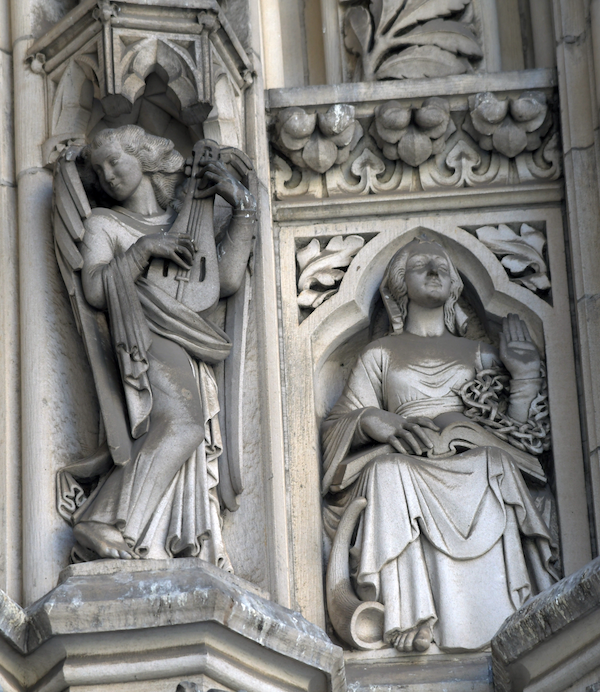
Delphica is not to be confused with the famous oracle of Apollo in Delphi. A crown of thorns, another instrument of the Passion, encircles her raised left arm. Alongside her sits a horn. Other depictions of her have either a crown of thorns or a horn, but John Angel has included both. Scholar Robin Raybould, writing of a different depiction of Delphica, suggests that her horn is a cornucopia that has been transformed into a trumpet.

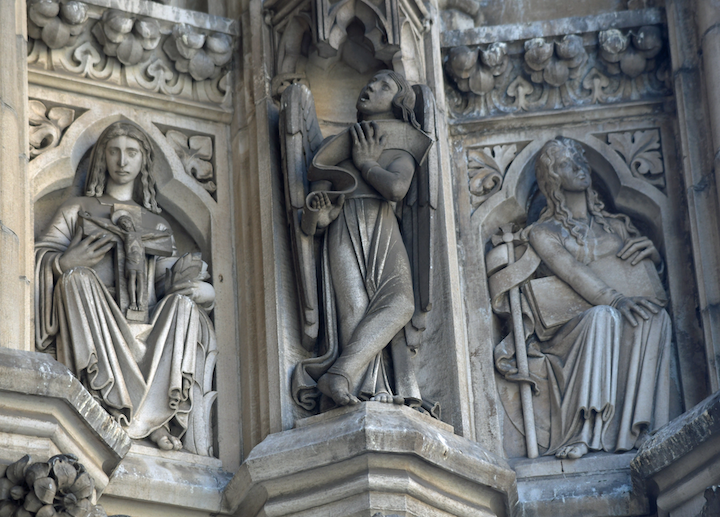
Hellespontica holds a crucifix in her lap. Her left hand holds what appears to be the spikelet of a stalk of wheat, a symbol of the Eucharist, the Body of Christ.
Phrygia bears a cross and banner, a prophecy of the Resurrection.
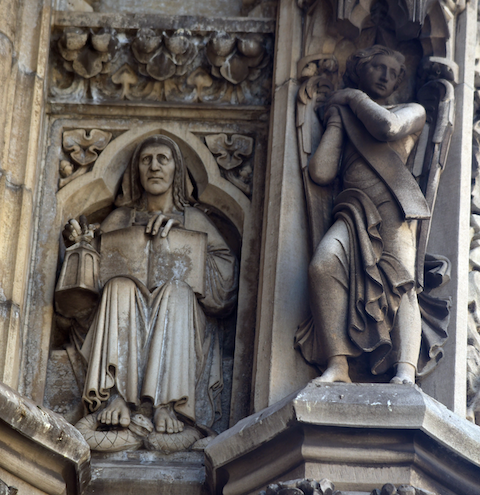
Persica holds a lamp in her right hand as she rests her feet atop a dragon, symbolizing the overthrow of Satan and the “light that shineth in the darkness” (John 1:5).
The Law Bay Reredos
Sibyls can be found in only one other Cathedral location – the elaborately carved wooden reredos in the Law Bay designed by Ernest Pellegrini of the Irving & Casson Company. Pellegrini was on Cram’s A-team of artisans along with John Angel, Charles Connick, Ernest Lakeman and others whose work appears in the Cathedral
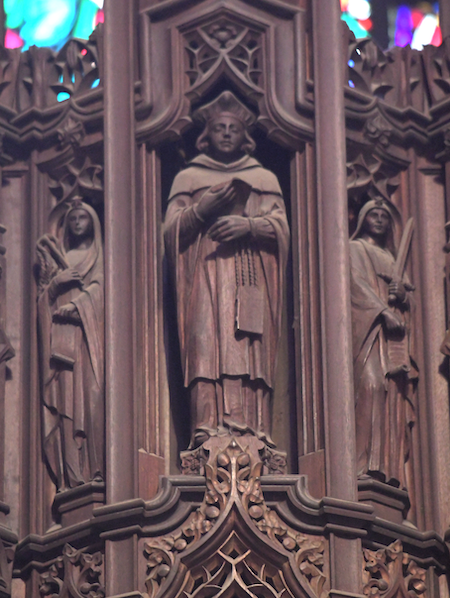
The central section of the reredos has three spires. On the left spire, St. Yves is flanked by Sibyl Agrippa, holding a scourge, and Sibyl Erythraea, with a sword.
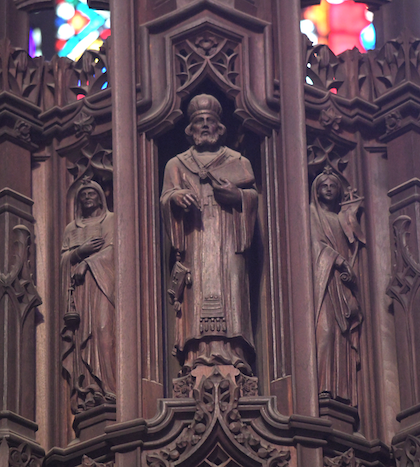
On the right spire, St. Philogonius is flanked by Sibyl Persica, holding a lamp and standing atop a dragon, and Sibyl Phrygia, with cross and banner.
The attributes of sibyls are not as standardized as those for saints. You will find images of sibyls with attributes different than these. For the sibyls they created at the Cathedral, both John Angel and Ernest Pellegrini generally followed the same iconographic vocabulary as did Dutch graphic artist Lucas van Leyden for his well-known woodcuts of the canonical twelve sibyls, c. 1530. The van Leyden sibyls can be viewed at the following site:
https://commons.wikimedia.org/wiki/Category:Woodcut_series_of_Sibyls_by_Lucas_van_Leyden
This is the tenth and final article in a series on the north portal of the Cathedral of St. John the Divine, known as the Martyrs Portal. To the best of my knowledge, the series is the first detailed commentary on the portal’s sculpture and iconography since it was completed ninety years ago. I am deeply grateful to Divine Stone founder Roger Murphy for publishing my work, to Robert Rodriguez for enlivening my articles with his superb photography, and to Wayne Kempton for his faithful stewardship of the Cathedral’s archives and his kind assistance with my research. TF
■
Sources
- Crestwood, Julian. “The Sibyls: From Greek Prophetess to Sistine Ceiling.” https://www.romanmythology.com/comparative-mythology/roman-sibyls-across-cultures/
- Guillermo, Jorge. Sibyls: Prophecy and Power in the Ancient World (2013).
- Holdenried, Anke. The Sibyl and Her Scribes (2006).